

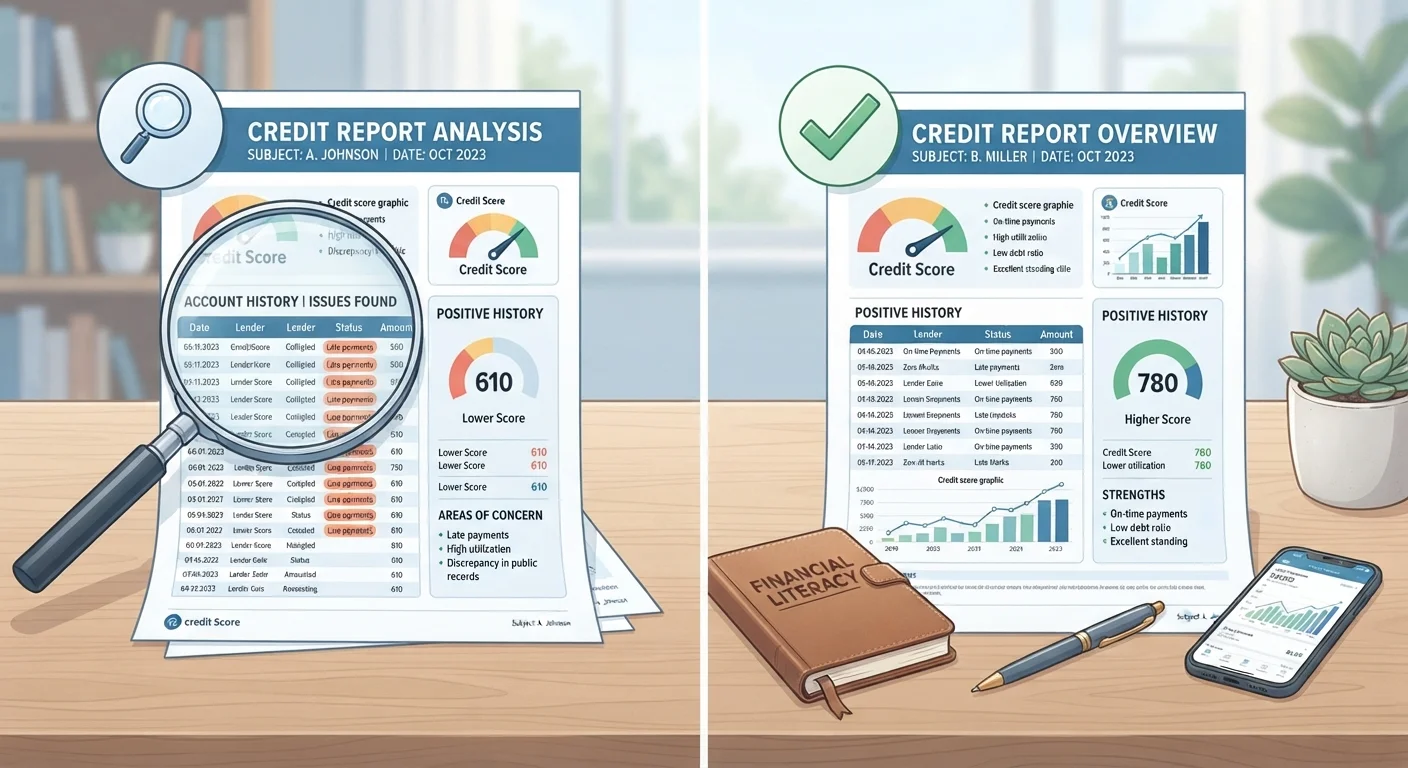
Option A
Hard Inquiry
The credit check that lenders log when you actively apply for credit.
Best for: Understanding which applications can temporarily lower your credit score and why.
Option B
Soft Inquiry
The background credit check that leaves your score completely untouched.
Best for: Rate shopping, pre-approval checks, and employer or background screenings.
What Makes a Hard Inquiry 'Hard'
A hard inquiry — sometimes called a hard pull — is generated when a lender or creditor reviews your credit report as part of a formal application for credit. Common triggers include applying for a credit card, personal loan, auto loan, or mortgage. The key distinction is your explicit authorization: you've initiated a request for credit, and the lender needs a full picture of your creditworthiness to make a decision.
Under the Fair Credit Reporting Act (FCRA), lenders must have a permissible purpose to access your report. Hard inquiries satisfy that requirement. The consequence is a temporary, modest dip in your credit score — typically between two and five points, though the exact impact varies based on your overall credit profile. The CFPB notes that a single hard inquiry rarely has a dramatic effect, but accumulating several in a short period can signal financial stress to lenders.
Hard inquiries stay on your credit report for two years, but their scoring impact fades significantly after about 12 months. To understand exactly how inquiries factor into the broader scoring picture, see our breakdown of what credit scores actually measure.
| Criterion | Hard Inquiry | Soft Inquiry |
|---|---|---|
| Triggered by | Formal credit application | Background check, self-check, pre-qual |
| Score impact | Yes — typically 2–5 points | None |
| Visible to lenders | Yes | No (visible only to you) |
| Stays on report | 2 years | Varies; not scored |
| Requires your authorization | Yes — you initiate | Not always (e.g., promotional) |
| Rate-shopping protection | Yes (mortgage, auto, student loans) | N/A — no impact to group |
Soft Inquiries: The Invisible Credit Check
A soft inquiry — or soft pull — happens when your credit is reviewed without you applying for new credit. These checks don't affect your score at all, regardless of how many occur. Common soft inquiry scenarios include:
- Checking your own credit report or score through a credit monitoring service or AnnualCreditReport.com
- Pre-qualification or pre-approval offers from lenders exploring whether to extend you an offer
- Employer background checks (with your consent)
- Existing creditors reviewing your account for limit increases or risk management
Soft inquiries do appear on your credit report in a section visible only to you — not to lenders making credit decisions. This means they're informational only. If you've been holding off on checking your own credit because you feared damaging your score, you can safely stop worrying. Regular self-monitoring is one of the habits highlighted in our guide to financial moves that quietly hurt your score.
~5 pts
Typical score drop per hard inquiry
According to FICO, a single hard inquiry generally lowers a score by fewer than five points for most consumers.
12 months
When hard inquiry impact fades most
Hard inquiries remain on credit reports for two years, but scoring models generally weight them most heavily in the first 12 months.
45 days
Rate-shopping window (newer FICO models)
FICO's newer scoring models allow up to 45 days of mortgage or auto loan shopping before treating multiple inquiries as more than one.
Rate Shopping: When Multiple Hard Inquiries Work in Your Favor
One of the most misunderstood credit rules involves shopping for a mortgage or auto loan. Many consumers assume each lender inquiry causes a separate score penalty — and avoid comparing rates as a result. That caution is often unnecessary.
FICO and VantageScore, the two dominant scoring models, have built-in rate-shopping protections. Multiple hard inquiries for the same loan type within a defined window are typically grouped and counted as a single inquiry. FICO's newer models use a 45-day window; older FICO versions use 14 days. VantageScore uses a rolling 14-day window.
The practical takeaway: cluster your loan applications within that window, gather quotes from multiple lenders, and let the scoring models do the math. The temporary hit from one grouped inquiry is far less costly than paying a higher interest rate for the life of a loan because you didn't comparison shop. Before submitting any applications, run through our credit readiness checklist to make sure your profile is in the best shape possible.
Note that this grouping protection applies to mortgage, auto, and student loan inquiries — not credit card applications, which are each counted separately.
Credit Card Applications Don't Get the Same Protection
The rate-shopping grouping rule applies specifically to installment loan categories like mortgages, auto loans, and student loans — not credit cards. Each credit card application generates its own separate hard inquiry with its own individual score impact. If you're considering multiple cards, space out those applications by several months where possible to limit the cumulative effect on your score.
Protecting Your Score Without Avoiding Credit
Fear of hard inquiries sometimes leads people to avoid legitimate credit activity — which can actually hurt long-term score health by limiting credit mix and history length. The goal isn't to eliminate hard inquiries; it's to be intentional about when they happen.
A few practical principles to apply:
- Space out credit card applications. There's no rate-shopping grouping for cards, so applying for several in a short period stacks the inquiries and raises red flags for lenders.
- Use pre-qualification tools first. Many card issuers and lenders now offer soft-pull pre-qualification. Use these to screen your options before triggering a hard pull.
- Monitor your report regularly. Unauthorized hard inquiries can signal identity theft. You're entitled to free reports from all three major bureaus through AnnualCreditReport.com.
- Dispute errors promptly. If a hard inquiry appears that you didn't authorize, you have the right to dispute it with the relevant credit bureau under the FCRA.
Your credit score also shapes real-world outcomes far beyond approval decisions — from the interest rate on your next auto loan (see how credit scores affect auto loan terms) to your mortgage options (see how scores shape mortgage options). Managing inquiries wisely is one small but meaningful piece of that larger picture.
This article is for general informational and educational purposes only and does not constitute personalized financial or legal advice. Consult a qualified financial professional for guidance specific to your situation.
The content on this site is for informational purposes only and is not a substitute for professional advice. Always consult a qualified professional for guidance specific to your situation.