

Why Fitness Jargon Feels Like a Foreign Language
Walk into any gym or open a beginner workout app, and you'll likely encounter a wall of unfamiliar terms: supersets, RPE, eccentric phase, periodization. For someone just starting out, this vocabulary can feel more intimidating than the exercise itself.
This reference guide cuts through the noise. Below, you'll find plain-language explanations of the terms beginners encounter most often — organized so you can look up what you need, when you need it. If you're just returning to movement after a long break, you may also find our guide to restarting exercise a useful companion.
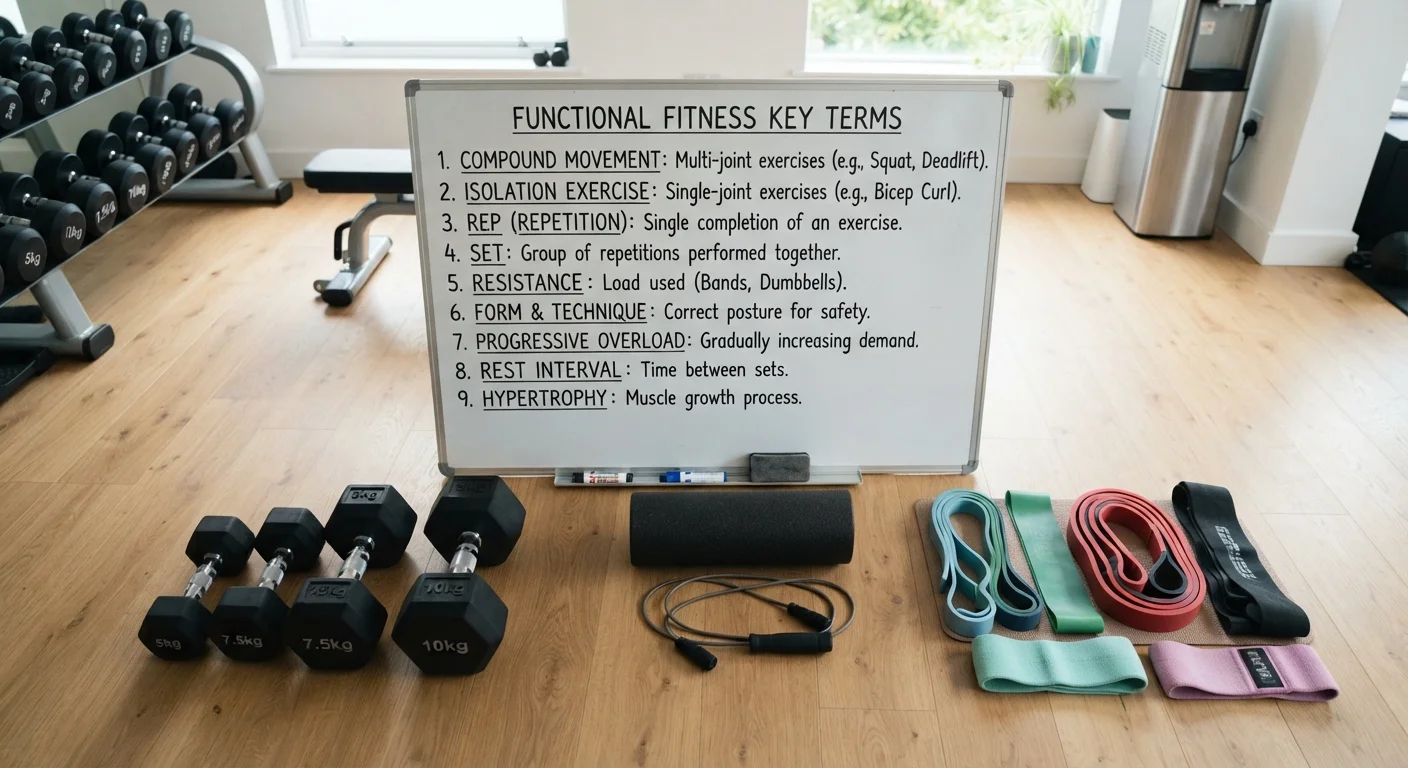
Rep (Repetition)
One complete execution of a single exercise movement — for example, one squat or one push-up. Reps are counted to measure exercise volume.
Set
A group of consecutive repetitions performed without stopping to rest. A workout plan typically prescribes a fixed number of sets per exercise.
Progressive Overload
The practice of gradually increasing the challenge of exercise over time — through more weight, more reps, less rest, or greater movement complexity — to drive continued adaptation.
HIIT
High-Intensity Interval Training. A format alternating short, high-effort bursts with brief rest or low-intensity recovery periods to elevate cardiovascular demand.
Compound Exercise
A movement that recruits multiple muscle groups at once, such as a squat or deadlift. Compound exercises are generally time-efficient and form the backbone of most strength programs.
Eccentric Phase
The portion of a movement where the working muscle lengthens under load — for example, lowering yourself during a squat. Slowing this phase increases muscle stimulus.
RPE (Rate of Perceived Exertion)
A self-assessed scale — usually 1 to 10 — measuring how hard an effort feels during exercise. It helps regulate intensity without requiring equipment.
Active Recovery
Low-intensity movement performed on rest days, such as gentle walking or stretching, to aid circulation and reduce muscle soreness without adding significant training load.
Core Training Terms: What Plans and Coaches Actually Mean
Most workout instructions are built around a handful of structural concepts. Once you recognize these, programming language becomes far more readable.
| Typical beginner set range | 2–3 sets per exercise (General guideline, American College of Sports Medicine) |
| Rep range for muscle endurance | 12–20+ reps (ACSM resistance training guidelines) |
| Rep range for strength building | 1–6 reps at higher load (ACSM resistance training guidelines) |
| Recommended weekly activity (adults) | 150 min moderate or 75 min vigorous aerobic activity (U.S. Department of Health and Human Services Physical Activity Guidelines) |
| RPE scale range | 1 (no effort) to 10 (maximal effort) (Standard perceived exertion scale) |
Reps and sets are the foundation. A rep (repetition) is one complete execution of a movement — one squat, one push-up. A set is a group of consecutive reps performed without rest. When a plan says "3 sets of 10," it means ten repetitions performed together, three separate times, with rest between each set.
Rest interval is the recovery period between sets. Shorter rest (30–60 seconds) keeps heart rate elevated and suits conditioning goals; longer rest (2–3 minutes) is common when building maximal strength.
Progressive overload is the principle of gradually increasing the demand placed on your body over time — more weight, more reps, less rest, or more complex movement. It's the core mechanism behind long-term improvement, and it's why doing the same routine indefinitely produces diminishing returns.
RPE stands for Rate of Perceived Exertion — a self-reported scale (typically 1–10) measuring how hard an effort feels. An RPE of 6 means moderate effort; RPE of 9 means near-maximal. It's a practical tool when precise measurements aren't available.
Workout Formats, Movement Types, and Recovery Concepts
Beyond individual exercises, fitness plans organize movement into broader formats — and understanding these helps you decode program structure and choose approaches that suit your goals. For a side-by-side breakdown of popular styles, see fitness approaches compared.
150 min
Recommended weekly moderate aerobic activity for adults
Per the U.S. Department of Health and Human Services Physical Activity Guidelines for Americans.
2x per week
Minimum recommended muscle-strengthening days
The same federal guidelines recommend strength-training activities at least twice per week for all major muscle groups.
HIIT (High-Intensity Interval Training) alternates short bursts of high-effort exercise with brief recovery periods. The intervals push cardiovascular demand higher than steady-state cardio for the same duration.
Compound vs. isolation movements: A compound exercise recruits multiple muscle groups simultaneously — a squat engages glutes, quadriceps, hamstrings, and core together. An isolation exercise targets a single muscle — a bicep curl, for example. Beginners often benefit from prioritizing compound movements for efficiency.
Eccentric and concentric phases describe the two halves of most movements. The concentric phase is the muscle-shortening effort (lifting the weight); the eccentric phase is the controlled lengthening (lowering it). Slowing the eccentric phase increases time under tension and is a common technique for building strength.
Active recovery refers to low-intensity movement — a gentle walk or light stretching — performed on rest days to promote circulation without adding significant training stress. It differs from complete rest, where movement is minimized entirely.
Understanding these terms gives you the vocabulary to follow any program with clarity. If motivation becomes the sticking point, explore the mental traps that derail fitness intentions — because knowledge alone rarely keeps people moving.
This article is for general informational purposes only and does not constitute medical or professional fitness advice. Consult a qualified healthcare provider before beginning a new exercise program, especially if you have any underlying health conditions.
The content on this site is for informational purposes only and is not a substitute for professional advice. Always consult a qualified professional for guidance specific to your situation.