

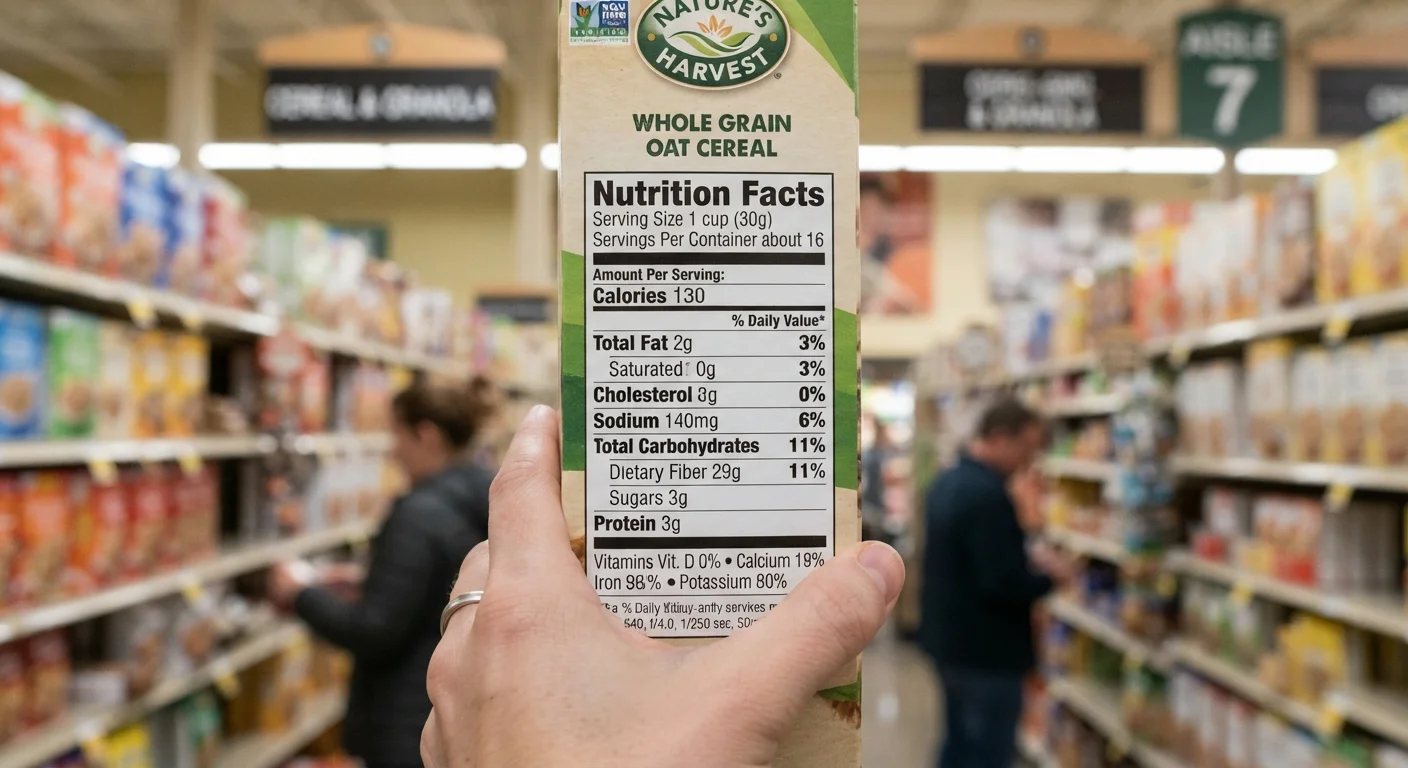
Why the Nutrition Facts Label Exists
The Nutrition Facts label became federally required on most packaged foods in the United States in the 1990s, with a significant redesign implemented by the FDA in 2020. The update reflected decades of nutrition research — most notably by making added sugars their own line and enlarging the calorie display to reflect how people actually eat.
The label is a standardized snapshot: same format, same reference values, across every product. That consistency is what makes it a useful comparison tool rather than just a compliance requirement. If you're new to thinking about nutrition more broadly, our nutrition basics guide provides helpful foundational context.
What you will need
How to Read Every Section, Step by Step
The label follows a logical top-to-bottom structure. Reading it in order — rather than jumping straight to calories or fat — prevents the most common misinterpretations. Follow the steps below with any packaged food in hand.
Labels Inform — They Don't Prescribe
Nutrition facts labels provide general dietary information based on a 2,000-calorie reference diet, which won't match every person's needs. This article is for general educational purposes and is not medical or dietary advice. If you have a health condition, food allergy, or specific nutritional goal, consult a registered dietitian or healthcare provider before making significant changes to your diet.
Start with serving size and servings per container
The serving size sits at the very top of the label for good reason — every number below it is calculated based on that amount. Serving sizes are standardized by the FDA to reflect amounts people typically eat, not necessarily the amount you should eat.
Check the number of servings per container before reading anything else. A 20 oz bottle of juice listing 2.5 servings means every calorie and nutrient figure must be multiplied if you drink the whole bottle.
Read the calorie count in context
Calories measure how much energy a serving provides. The calorie count is displayed prominently, but it only becomes meaningful alongside the serving size you just confirmed. A 90-calorie serving looks modest — until you realize the package holds four servings.
Calories alone don't tell you about nutritional quality. A food can be calorie-dense and nutrient-rich, or calorie-light and nutrient-poor. Use calories as one data point, not the whole story.
Review the nutrients to limit
The label highlights nutrients many Americans already consume in excess: saturated fat, sodium, and added sugars. High intake of these is linked by research to increased risk of cardiovascular disease and other chronic conditions.
- Saturated fat is listed in grams and as % DV. Most health guidelines recommend keeping it low.
- Sodium is particularly easy to accumulate across multiple processed foods in a single day.
- Added sugars — distinct from naturally occurring sugars in fruit or dairy — now appear as their own line. Our guide on added sugar explains where it hides and how to think about reducing it.
Identify nutrients to get enough of
Below the nutrients to limit, look for those most Americans fall short on: dietary fiber, potassium, calcium, iron, and Vitamin D. These are listed because deficiency in each is a recognized public health concern.
Dietary fiber deserves particular attention. Beyond digestive health, it plays a role in blood sugar regulation and cardiovascular wellness. For a deeper dive, see our article on dietary fiber.
Interpret the % Daily Value column
The % Daily Value (% DV) column tells you how much of each nutrient a single serving contributes toward recommended daily intake, based on a 2,000-calorie reference diet. It's a comparative tool, not a personal prescription.
Use the FDA's general benchmarks: 5% DV or less means a nutrient is low in that food; 20% DV or more means it's high. This lets you compare two similar products at a glance without doing complex math.
Glance at the ingredient list
Though technically separate from the Nutrition Facts panel, the ingredient list directly below it adds critical context. Ingredients are listed in descending order by weight, so the first few ingredients make up the bulk of the product.
A short ingredient list with recognizable items generally indicates less processing. If sugar (under any of its many names) appears in the first two or three spots, the product is likely high in added sugars regardless of what the front of the package claims. Our broader guide on whole foods vs. processed foods can help you understand what ingredient lists reveal about processing levels.
Use % DV as a Quick Benchmark
A general rule from the FDA: 5% DV or less is considered low for a nutrient, while 20% DV or more is considered high. Use these thresholds to quickly gauge whether a serving delivers a meaningful amount — or a concerning amount — of any given nutrient. This shortcut works across fat, sodium, fiber, and most vitamins and minerals.
Watch for Multi-Serving Packages
Many items that look like single-serving packages — a bottle of juice, a small bag of chips — actually contain two or more servings. If you consume the whole package, multiply every number on the label by the number of servings listed. This is one of the most common ways calorie and sodium intake gets underestimated.
Putting the Label in Perspective
Nutrition labels are tools for informed decision-making, not scorecards for judging a food as good or bad. A single food item rarely determines the quality of an overall diet. What matters most is the pattern of choices across meals and days.
That said, consistent label reading builds genuine nutritional awareness. Over time, you'll develop a faster intuition for spotting high-sodium packaged foods, identifying fiber-rich options, or recognizing when a product's front-of-package claims don't match what's inside. For a practical next step, consider running a weekly grocery nutrition audit on your regular purchases.
It's also worth knowing that labels don't capture everything. The glycemic impact of a food, its degree of processing, or how it interacts with other foods in a meal aren't visible on the panel. Our article on glycemic index and glycemic load explores one such dimension in depth.
This article is for general informational and educational purposes only and does not constitute medical or dietary advice. Consult a qualified healthcare professional or registered dietitian for guidance tailored to your individual health needs.
The content on this site is for informational purposes only and is not a substitute for professional advice. Always consult a qualified professional for guidance specific to your situation.