

Two Forces Working Against You Every Time You Brake
When something unexpected appears in the road, stopping your car is never instant — it's a two-phase process, and understanding those phases changes how you drive.
Phase one is reaction distance. Before your brakes do anything, time passes. Your eyes register the hazard, your brain processes it, and your foot moves from the accelerator to the brake pedal. At an average reaction time of 1.5 seconds, a car traveling at 60 mph covers 132 feet — nearly half a football field — before a single brake is applied.
Phase two is braking distance. This is the distance your car travels after the brakes are fully engaged. Unlike reaction distance, braking distance is governed by physics: the faster you're going, the exponentially more distance you need. At 30 mph, a typical passenger car might need around 45 feet to stop on dry pavement. At 60 mph — double the speed — braking distance doesn't double; it roughly quadruples to around 180 feet. That's the square relationship at work.
132 ft
Distance traveled before braking at 60 mph
Based on an average human reaction time of 1.5 seconds at highway speed, before brakes are applied.
4×
Braking distance increase when speed doubles
Kinetic energy grows with the square of speed; doubling from 30 to 60 mph roughly quadruples the stopping distance needed.
50%+
Stopping distance increase on wet pavement
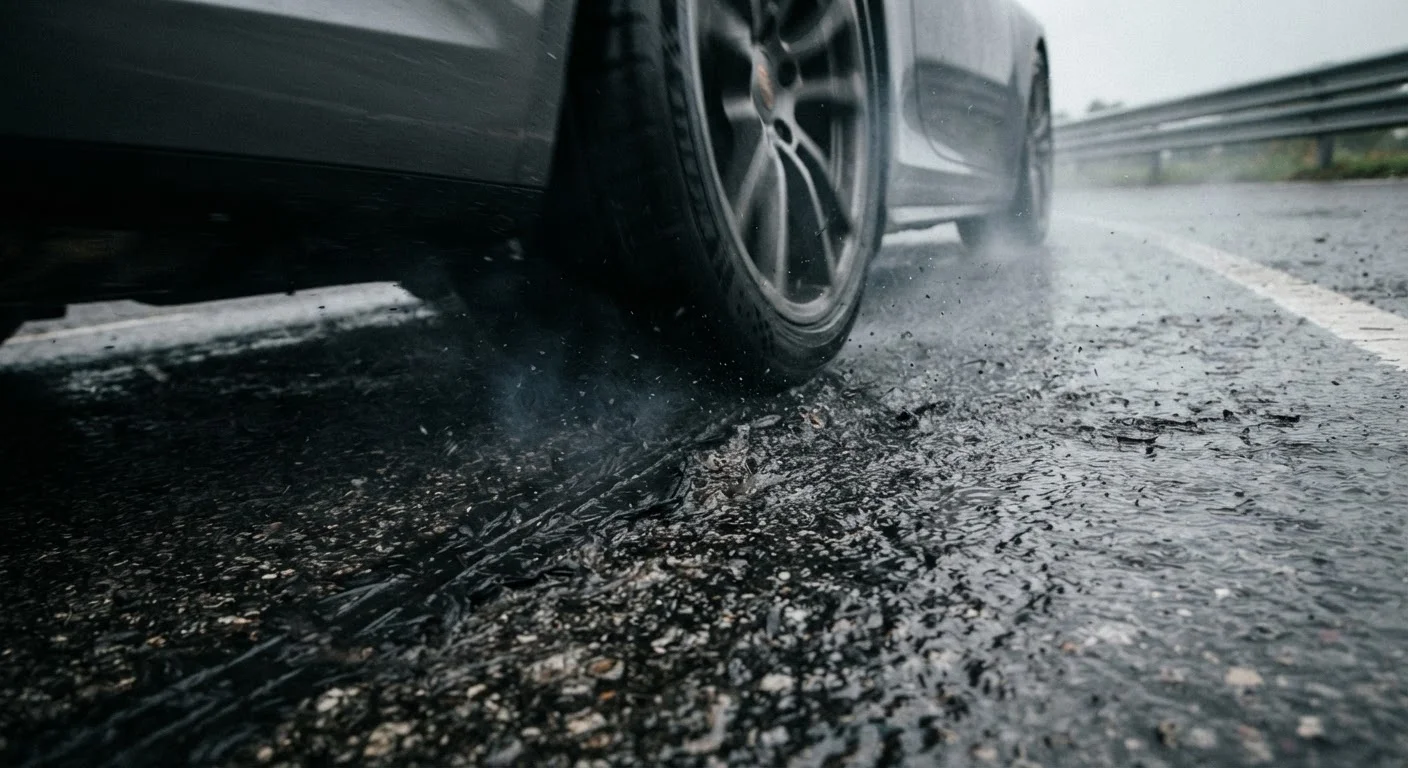
Wet roads significantly reduce tire-to-road friction, extending how far a car travels before coming to a complete stop.
Why Speed Is the Variable That Changes Everything
Most drivers think of speed in linear terms — 10 mph faster means 10 mph more to manage. But kinetic energy, which is what your brakes are fighting against, grows with the square of velocity. A car at 60 mph carries four times the kinetic energy of the same car at 30 mph. Your brakes have to dissipate all of that energy through heat and friction before the car stops.
This is why speed limit changes on wet, winding, or residential roads aren't arbitrary. A 25 mph zone means stopping distances are genuinely manageable for sudden hazards like children, cyclists, or cars backing out of driveways. At 45 mph on the same street, the margin for error shrinks dramatically.
Use Speed Reduction as a Braking Advantage
Dropping your highway speed by just 10 mph meaningfully reduces the kinetic energy your brakes must overcome. On long trips or in uncertain conditions, slightly lower speeds can dramatically increase your stopping margin without adding much travel time. It's one of the easiest, lowest-cost safety adjustments available.
Road Conditions, Tires, and Brakes: The Variables You Can Control
Physics sets the ceiling on how fast you can stop. The condition of your vehicle and the road you're on determines whether you're anywhere close to that ceiling.
Road surface: Dry asphalt offers the most grip. Wet pavement can increase stopping distance by 50% or more. Ice is far worse — stopping distances on black ice can be ten times longer than on dry road. For a deeper look at how rain specifically changes your risk profile, see how wet roads affect stopping and control.
Tire tread depth: Tread grooves channel water away from the contact patch between tire and road. Worn tires lose this ability, reducing grip and extending braking distances significantly. A tire worn to the legal minimum tread depth of 2/32 of an inch performs considerably worse in wet conditions than a new tire.
Brake condition: Worn brake pads, warped rotors, or low brake fluid pressure reduce braking force. Regular inspections — typically every 12,000 miles or annually — help ensure your brakes can deliver their rated stopping power when you need it most.
ABS Helps, But Doesn't Eliminate Physics
Anti-lock braking systems (ABS) prevent wheel lockup during hard braking, helping drivers maintain steering control. They can improve stopping performance on many surfaces, particularly wet or uneven pavement. However, ABS does not override the fundamental relationship between speed, weight, and stopping distance — it works within those limits, not around them.
The Practical Takeaway: Following Distance Is Your Safety Buffer
You can't change reaction time. You can't repeal physics. But you can control how much space you put between your car and the one in front of you.
The 3-second rule is a simple benchmark: watch the car ahead pass a fixed landmark (a sign, a shadow, a crack in the road), then count. If you reach that same point in under 3 seconds, you're too close. In rain, fog, or on any road where grip is reduced, extend that cushion to at least 6 seconds.
Highways at high speed, construction zones, and heavy traffic all call for more space, not less. The irony of tailgating is that it rarely saves meaningful time — but it removes almost all of your stopping margin. Treating following distance as a non-negotiable habit is one of the highest-value safety decisions a driver can make.
Understanding stopping distance doesn't require an engineering degree. It just requires recognizing that your car can't defy physics — but your driving habits can work with those physics instead of against them.
Frequently Asked Questions
Reaction distance is how far your car travels while your brain registers a hazard and your foot moves to the brake pedal. Braking distance is how far the car travels after the brakes engage until it stops. Total stopping distance is the sum of both.
Wet pavement can increase stopping distances by 50% or more compared to dry conditions. Reduced friction between tires and the road surface means brakes take longer to slow the car down. Speed and tire tread depth also play major roles in how severe the difference is.
Cruise control doesn't directly change braking distance once you apply the brakes. However, it can slow your reaction time slightly because your foot isn't hovering near the brake pedal. Many driving safety experts recommend turning off cruise control in poor weather or heavy traffic.
Worn tires have shallower tread grooves, which reduces their ability to channel water away and maintain grip on the road surface. This leads to longer braking distances, particularly on wet roads. Tires worn below the legal tread depth limit are significantly less effective at stopping.
The commonly recommended baseline is the 3-second rule — pick a fixed point ahead and make sure at least 3 seconds pass between when the car in front passes it and when you do. In wet, icy, or high-speed conditions, increase that gap to 6 seconds or more.
The content on this site is for informational purposes only and is not a substitute for professional advice. Always consult a qualified professional for guidance specific to your situation.