

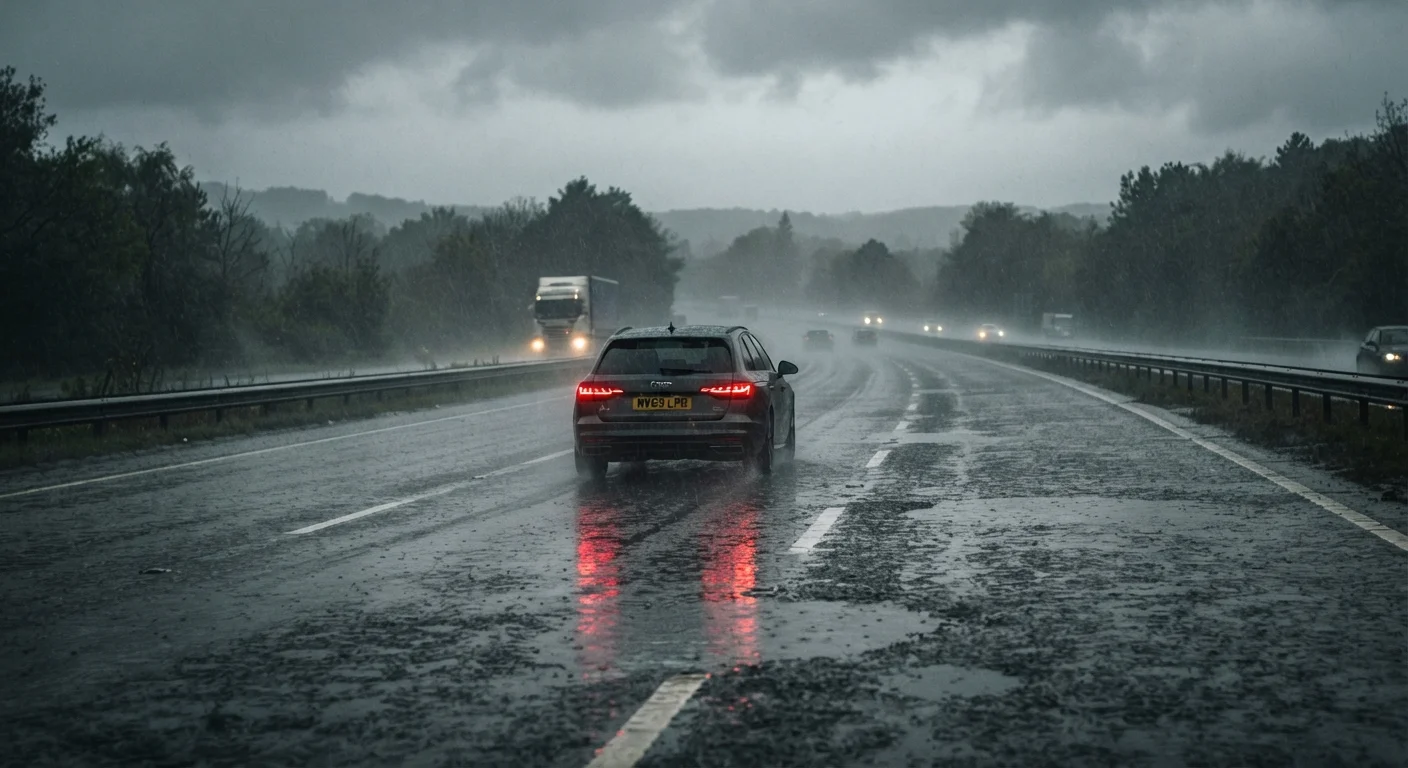
Why Rain Changes Everything Under Your Tires
Most drivers know rain makes roads slippery — but the actual physics of what happens under your tires is more dramatic than most people realize. A dry road gives your tires a firm surface to grip and bite into. Add water, and that firm surface becomes a variable one. Your tires must now continuously push water out of the way to maintain contact with the pavement.
When rain falls faster than your tires can displace the water — or when you're moving too quickly for tread channels to do their job — you lose traction. That's not a minor reduction in grip. On wet pavement, friction can drop by roughly a third compared to dry conditions. On roads covered with standing water, the drop is even steeper.
There's another factor many drivers overlook: the first 10–20 minutes of a rain shower are often the most hazardous. Motor oil, rubber particles, and road grime that have accumulated on the asphalt mix with the initial rainfall to form a slick film. After sustained rain flushes the surface, conditions often improve — but that early window catches many drivers off guard.
The First Rain Is Often the Slickest
The road surface accumulates oil, rubber dust, and debris during dry periods. When rain begins, that layer mixes with water and creates a slick film before sustained rainfall can wash it away. This means the first 10–20 minutes of a rain shower — especially after a long dry spell — often represent peak slipperiness. Treat the beginning of any rain event with extra caution.
Stopping Distances Go Up — More Than You'd Expect
Braking on a wet road is a fundamentally different experience than braking on dry pavement. Your brakes apply the same clamping force regardless of conditions, but what happens at the tire-road interface depends entirely on how much grip is available. On wet roads, that grip is reduced, so the distance required to come to a full stop increases substantially.
A vehicle traveling at 60 mph on dry pavement may need around 180 feet to stop. On wet pavement, that distance can stretch to 270 feet or more — roughly the length of an average city block. The relationship between speed and stopping distance isn't linear either. Doubling your speed more than doubles the distance you need to stop.
This is why following distance matters so much in the rain. Tailgating is already a leading cause of rear-end collisions on dry roads — in wet conditions, the same gap becomes even more inadequate. Doubling your usual following distance isn't overcaution; it's basic math. For a deeper look at how stopping physics work, see the science behind stopping distance.
Visibility: The Problem Above the Road
Traction isn't the only issue in the rain. Visibility drops too, and sometimes faster than drivers adjust for. Rain on the windshield, road spray from other vehicles, and glare from wet pavement all reduce how far ahead you can clearly see. At night, those problems multiply — wet pavement reflects headlights and oncoming glare in ways that make judging distance and speed harder. Night driving already amplifies everyday hazards, and combining low light with rain is one of the more demanding conditions everyday drivers face.
What helps: use your low-beam headlights any time visibility is reduced by rain, even during daylight hours. Many states legally require this. Keep your windshield clean — both inside and out — since a film on the interior dramatically worsens glare in wet conditions. Make sure your wipers are in good working order before rain season arrives; worn blades streak and smear rather than clear.
Check Your Wipers Before Rain Season
Wiper blades typically need replacement every six to twelve months, but many drivers only notice they're worn when they need them most. Test your wipers on a wet windshield before the season changes — streaking, skipping, or squeaking are signs the blades need to be swapped out. Replacing them is inexpensive and takes minutes.
Your Tires Are Your First Line of Defense
No driving adjustment fully compensates for tires that can't do their job. Tread channels exist specifically to evacuate water from the contact patch — the small area where rubber meets road. When tread wears down, those channels get shallower, and water has nowhere to go. The tire rides up on the water film instead of cutting through it.
Tread depth is typically measured in 32nds of an inch. New tires usually start around 10/32 to 11/32 inches. The legal minimum in most U.S. states is 2/32 — but wet-weather performance degrades well before you reach that threshold. Many safety experts suggest considering replacement when tread reaches 4/32 inches if you regularly drive in wet conditions.
Tire pressure matters just as much. An under-inflated tire deforms under load in ways that reduce the effectiveness of tread channels. Maintaining proper tire pressure is one of the simplest and most impactful things a driver can do for wet-weather safety. Check your vehicle's door placard — not the number on the tire sidewall — for the correct pressure.
~70%
Weather-related crashes occurring on wet pavement
According to data from the U.S. Federal Highway Administration, the vast majority of weather-related crashes happen on wet roads rather than icy or snowy ones.
50%+
Increase in stopping distance on wet vs. dry roads
Engineering and safety testing broadly shows wet pavement can increase stopping distances by half or more depending on speed, tire condition, and water depth.
35 mph
Speed at which hydroplaning can begin
Safety researchers note that hydroplaning risk begins at speeds as low as 35 mph on tires with worn tread or on roads with standing water.
Practical Adjustments That Make a Real Difference
Driving in rain doesn't require a completely different skill set — it requires applying the fundamentals more deliberately. Slow down: your speed determines how much time your tires have to push water aside, and even a 10 mph reduction meaningfully lowers hydroplaning risk. Increase your following distance. Avoid sudden steering inputs or hard braking, which can upset vehicle balance on a slippery surface.
If you do start to hydroplane, the instinct to brake hard is counterproductive. Ease off the gas, hold the wheel steady, and allow the tires to naturally regain contact. If your vehicle has a manual transmission, avoid downshifting abruptly. Modern ABS (anti-lock braking systems) help on wet surfaces, but they don't restore traction that simply isn't there.
Puddles of standing water are worth treating with extra care — their depth is hard to judge from inside a vehicle, and hitting deep water at speed can cause an abrupt loss of control. When the road ahead looks wet and unfamiliar, the most protective habit is a simple one: slow down before you need to.
Wet roads aren't the same as icy roads, but the underlying challenge is the same — less grip means more margin required. For a comparison of how rain differs from winter surface conditions, see how black ice, slush, and packed snow each change what you should do.
Frequently Asked Questions
Hydroplaning can begin at speeds as low as 35 mph, particularly on tires with low tread depth. At highway speeds, even tires in good condition can lose full contact with standing water. Slowing down significantly reduces the risk.
Ease off the accelerator gently — do not brake suddenly. Keep the steering wheel pointed in the direction you want to go and wait for your tires to regain contact with the road. Sudden inputs during hydroplaning can cause a spin.
Rain at night compounds visibility challenges since headlights reflect off wet pavement and oncoming glare increases. However, the first rain after a dry period — at any time of day — tends to be especially slippery due to accumulated road oils lifting to the surface.
A general guideline is to at least double your normal following distance in wet conditions. Since stopping distances increase substantially on wet roads, the standard three-second rule may not provide enough buffer at higher speeds.
All-season tires are designed to handle wet conditions better than summer-only tires, but their performance still depends on tread depth and proper inflation. Tires worn below 4/32 of an inch perform significantly worse in wet conditions regardless of their designation.
It's generally advisable to avoid cruise control in wet conditions. If your tires begin to hydroplane, cruise control may attempt to maintain speed rather than allow you to naturally ease off the throttle, which can worsen the situation.
The content on this site is for informational purposes only and is not a substitute for professional advice. Always consult a qualified professional for guidance specific to your situation.