

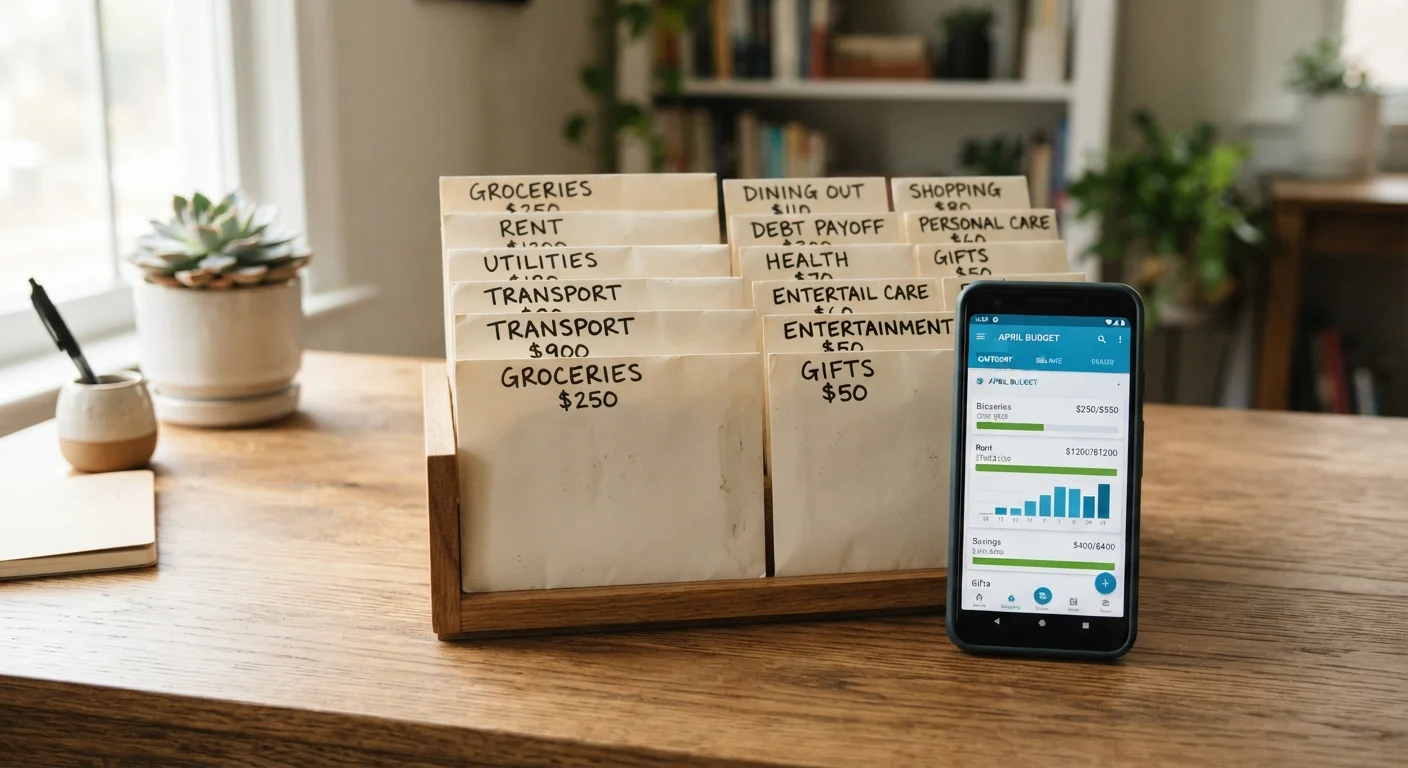
How the Original System Works
The envelope method dates back decades and was popularized as a practical tool for households living paycheck to paycheck. The mechanics are simple: at the start of each pay period, you withdraw your budgeted cash and sort it into labeled envelopes — one per spending category. Groceries get $400. Dining out gets $150. Gas gets $120. And so on.
When you go to the grocery store, you bring the grocery envelope. When it's empty, you're done spending on groceries until the next pay period. There's no mental math, no checking an app — the envelope tells you exactly where you stand.
This tactile friction is the system's greatest strength. Research in behavioral economics consistently finds that spending physical cash feels more painful than swiping a card, which naturally curbs impulse purchases. The envelope creates a visible, concrete limit that a credit card balance never provides.
For a broader introduction to structured budgeting, see our ground-up guide for new savers.
Adapting Envelope Budgeting for a Cashless Life
Most Americans rarely carry cash today. That doesn't make the envelope method obsolete — it just requires translation. The goal is to replicate the same spending boundaries digitally.
Three common approaches work well:
- Budgeting apps with category limits: Several apps allow you to set monthly spending caps per category and track transactions in real time. When you approach a limit, you get a notification — the digital equivalent of a nearly empty envelope.
- Bank sub-accounts or savings buckets: Some banks allow you to create labeled sub-accounts within a single checking account. You fund each bucket at the start of the month and spend only from the relevant one. The separation is visual and functional.
- Spreadsheet tracking: A simple spreadsheet with columns for each category, a starting balance, and a running total of purchases can work just as well — it just requires manual entry discipline.
The method you choose matters less than your commitment to respecting the limits. The envelope system only works when the boundary is treated as real, whether it's made of paper or pixels.
Start With Just Three or Four Envelopes
New budgeters often try to create a category for every possible expense, which becomes overwhelming quickly. Start with your highest-variable, highest-risk categories — typically groceries, dining, entertainment, and personal care — and add more envelopes only after the first two months feel manageable. Simplicity improves consistency.
If you're new to structured budgeting, pairing the envelope method with a sinking fund for predictable annual expenses — like car registration or holiday gifts — can prevent category budgets from getting derailed. See how sinking funds and emergency funds work together.
Setting Up Your Envelopes: A Practical Starting Point
Getting started requires two things: knowing your take-home income and understanding where your money currently goes. Pull two to three months of bank and credit card statements and sort transactions into rough categories. This gives you realistic baselines rather than wishful estimates.
Focus envelopes on variable expenses — the categories where your spending fluctuates and tends to overshoot. Fixed bills like rent, loan payments, and insurance don't need envelopes because the amounts don't change.
78%
Americans living paycheck to paycheck
A 2023 survey by LendingClub found that roughly 78% of U.S. consumers were living paycheck to paycheck, underscoring the need for structured spending frameworks.
18%
Average overspend on dining and food
Consumer expenditure data from the U.S. Bureau of Labor Statistics consistently shows food-away-from-home as one of the most frequently underestimated budget categories.
Once you've set initial amounts, run the system for a full month before adjusting. The first cycle almost always reveals that some envelopes were too tight and others too generous. That feedback is the point — the system teaches you your actual spending patterns faster than any estimate can.
For a step-by-step walkthrough of building income and expense categories from scratch, our seven-step budget guide covers the full process. You can also compare this approach to other frameworks in our overview of zero-based budgeting vs. the 50/30/20 rule.
This article is for general informational and educational purposes only and does not constitute personalized financial advice. Consult a qualified financial professional for guidance tailored to your specific situation.
Frequently Asked Questions
No. While the original method uses physical cash and paper envelopes, the same logic applies digitally. You can use a budgeting app, a spreadsheet, or separate bank accounts labeled by category. What matters is that each category has a hard spending limit you respect.
Focus on variable expenses that tend to fluctuate and overshoot — groceries, dining out, entertainment, clothing, and personal care are common choices. Fixed bills like rent and insurance don't need envelopes because the amounts don't change month to month.
You have two options: take money from another envelope to cover the gap, or stop spending in that category for the rest of the month. Either choice forces a conscious trade-off, which is exactly what the system is designed to create. Over time, overspending becomes less frequent as your estimates improve.
It can work, but it requires a different setup. Many people with variable income budget based on their lowest expected monthly earnings, then treat any extra as a buffer or savings boost. The key is setting envelope amounts before spending begins, not after.
The 50/30/20 rule divides income into three broad buckets — needs, wants, and savings. Envelope budgeting is more granular, assigning limits to individual categories. The two approaches aren't mutually exclusive; some people use percentage guidelines to set their envelope amounts.
Most people need two to three months before their category estimates feel accurate and their spending patterns shift. The first month is mostly data-gathering. Results in reduced overspending and higher savings rates typically become clear by the second or third cycle.
The content on this site is for informational purposes only and is not a substitute for professional advice. Always consult a qualified professional for guidance specific to your situation.