

Our Verdict
Emergency funds and sinking funds are complementary tools, not alternatives. An emergency fund protects against financial shocks you cannot predict; a sinking fund smooths out costs you can see coming. Together, they form the foundation of a budget that can actually hold up over a full year.
| Best for | Recommended |
|---|---|
| Those with unpredictable income or high financial risk | Emergency Fund (priority) |
| Those managing known upcoming expenses like car registration or holiday gifts | Sinking Fund (priority) |
| Those building a long-term, resilient household budget | Both funds running simultaneously |
What Each Fund Is Actually For
These two savings tools are often lumped together, but they serve fundamentally different purposes. Confusing them can leave you raiding the wrong account at the wrong time.
An emergency fund is a financial buffer for genuine, unplanned crises: a sudden job loss, an unexpected medical bill, a car breakdown with no warning, or a home appliance that fails without notice. The defining feature is uncertainty — you don't know when or whether these events will happen. The Consumer Financial Protection Bureau (CFPB) generally describes an emergency fund as a safety net that helps households avoid high-cost debt when income is disrupted or unexpected expenses arise.
A sinking fund, by contrast, is designed for expenses you know are coming — even if they don't hit every month. Annual car registration, holiday spending, a family vacation, back-to-school costs, or a planned home repair all qualify. You're not saving for a surprise; you're saving for something predictable but irregular. Understanding fixed vs. variable expenses is a useful starting point for identifying what belongs in a sinking fund versus your regular monthly budget.
How the Two Funds Compare
While both require setting money aside regularly, the way you size, access, and think about each fund differs considerably.
| Emergency Fund | Sinking Fund | |
|---|---|---|
| Purpose | Covers unforeseen financial crises | Covers known, irregular future expenses |
| Predictability | Unpredictable — timing unknown | Predictable — timing known in advance |
| Typical size | 3–6 months of essential expenses | Sized to each specific planned expense |
| How you contribute | Regular deposits until target is reached | Monthly amounts calculated per expense deadline |
| When you access it | Only during genuine emergencies | When the planned expense arrives |
| Examples of use | Job loss, ER visit, sudden car failure | Vacation, holiday gifts, annual insurance premium |
One practical note: both funds work best when held in accounts separate from your checking account. Proximity to everyday spending increases the likelihood you'll dip into them for non-qualifying purchases. A dedicated savings account — even one earning modest interest — adds a useful friction layer.
Label Your Accounts Clearly
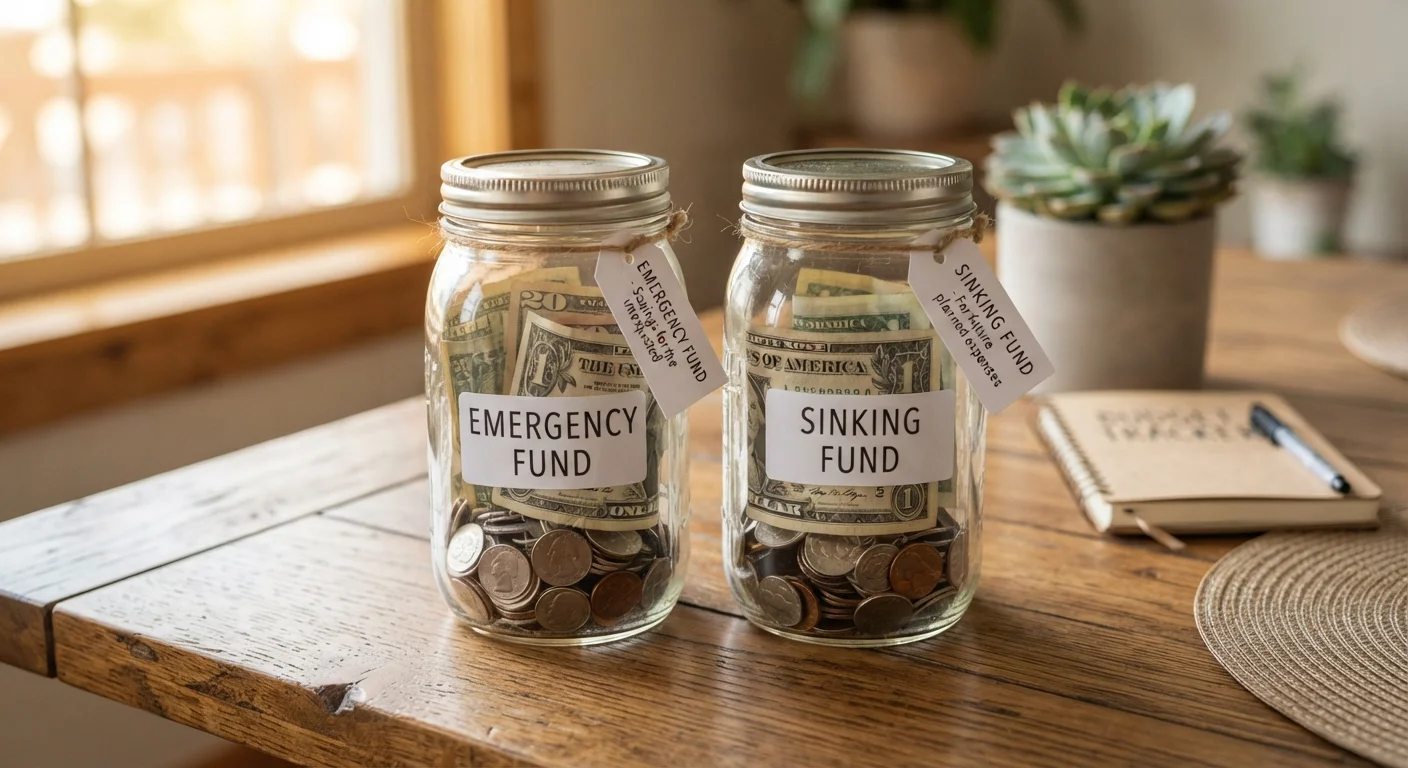
Giving each savings account a specific name — 'Emergency Fund' or 'Car Registration 2025' — reinforces its purpose every time you log in. Many online banks allow custom account nicknames at no cost. This small step makes it noticeably easier to leave the money alone until it's actually needed.
How to Build Both Without Overwhelming Your Budget
The most common mistake is treating these funds as an either/or choice. Most households need both running at the same time, which requires a bit of prioritization at the start.
A reasonable approach for many people:
- Start with a small emergency buffer. Even $500–$1,000 provides meaningful protection while you build toward a fuller reserve. This is not a rule, just a common starting point that many personal finance educators reference.
- Identify your sinking fund categories. List all predictable, irregular expenses for the next 12 months. Divide each by the number of months until it's due, then set that amount aside monthly. Building a budget that holds up through the whole year walks through this kind of annual planning in depth.
- Split contributions. Once you have a starter emergency buffer, you can divide your savings dollars between growing the emergency fund and funding your sinking fund categories simultaneously.
If you're also managing debt, the interplay between saving and paying down balances adds another layer. Emergency Fund vs. Paying Down Debt examines how to think through that trade-off. For a broader view of savings and credit together, see our Saving & Credit hub.
~27%
Americans with no emergency savings
Federal Reserve surveys have consistently found that a significant share of U.S. adults could not cover an unexpected $400 expense without borrowing or selling something.
3–6 months
Commonly cited emergency fund target
Financial educators and the CFPB commonly reference three to six months of essential living expenses as a target emergency fund size for most households.
Putting It Into Practice
Concrete structure helps these concepts move from theory to habit. Many people find that labeling sub-accounts — one for emergencies, then separate ones for each sinking fund category — makes it easier to track progress and resist the urge to combine funds. Some digital banks allow multiple savings buckets within a single account, which simplifies this approach.
The envelope budgeting method applies the same logic digitally: money is pre-assigned to a purpose before it can be spent on something else. Applying that mindset to both your emergency and sinking funds reinforces the discipline that makes either one work.
Neither fund needs to be fully funded before it becomes useful. A sinking fund with three months of contributions is still three months ahead of where you'd be without one. An emergency fund with $800 is still $800 that doesn't have to go on a credit card. Progress in the right direction is what matters.
This article is for general informational and educational purposes only. It does not constitute personalized financial, tax, or legal advice. Consult a qualified financial professional for guidance tailored to your individual situation.
The content on this site is for informational purposes only and is not a substitute for professional advice. Always consult a qualified professional for guidance specific to your situation.