

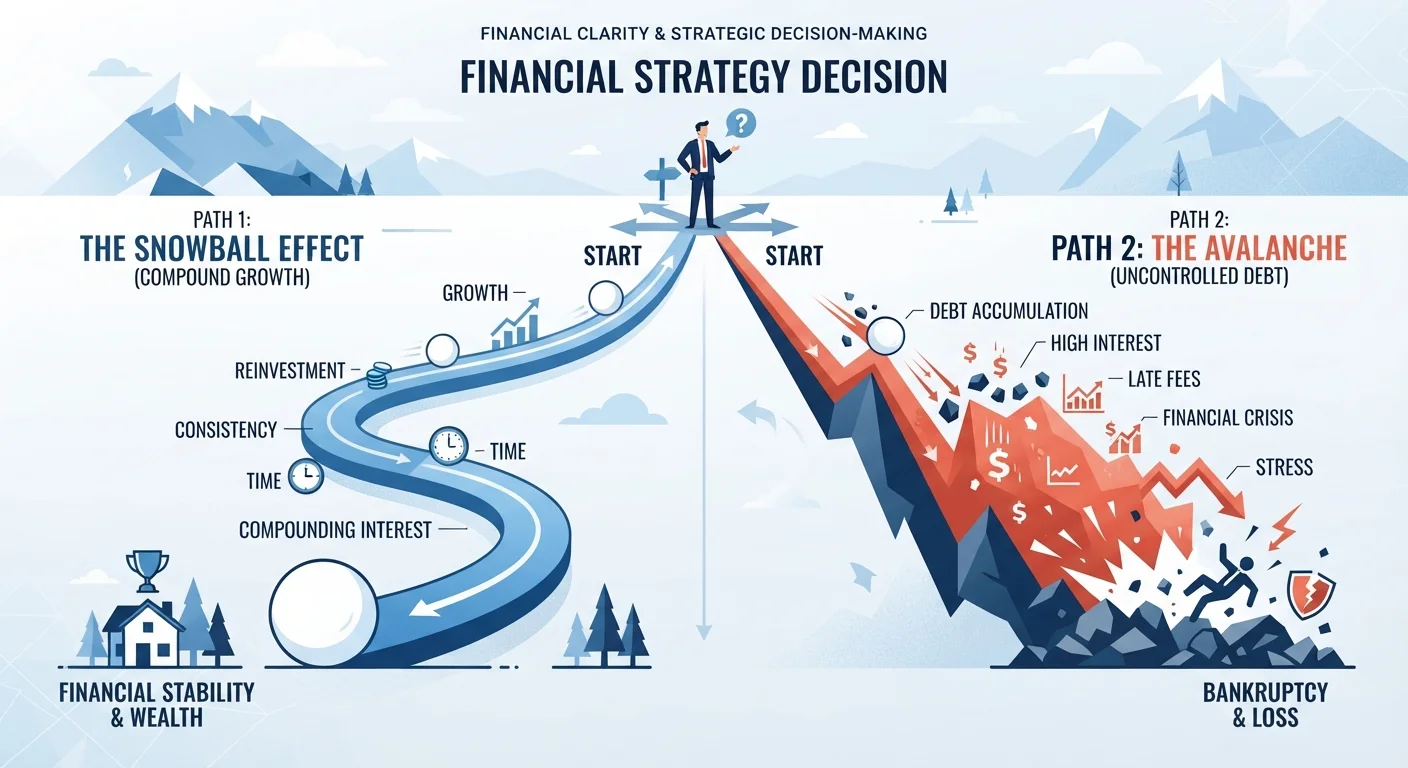
Option A
Debt Avalanche
The mathematically optimal approach to eliminating debt.
Best for: People who are motivated by long-term savings and want to minimize total interest paid over time.
Option B
Debt Snowball
The psychologically rewarding path to becoming debt-free.
Best for: People who need early wins and momentum to stay committed to a debt payoff plan.
How Each Method Works
Both the debt avalanche and the debt snowball follow the same basic structure: you make minimum payments on all your debts, then direct any extra money toward one target debt at a time. The difference is how you choose which debt to target first.
Debt Avalanche: List your debts from highest to lowest annual percentage rate (APR). Put every extra dollar toward the highest-rate balance. Once it's gone, roll that payment into the next highest-rate debt, and so on. This method minimizes the total interest you pay over the life of your debts.
Debt Snowball: List your debts from smallest to largest balance, regardless of interest rate. Attack the smallest balance first. When it's paid off, that freed-up payment amount gets added to the next-smallest debt. The idea is to clear individual accounts quickly and build momentum.
Both strategies require a consistent surplus — money left over after covering essential expenses — to work. If you're not sure where that surplus will come from, reviewing your household spending is a smart first step. The Budgeting Basics hub offers practical frameworks for finding room in a tight budget.
| Criterion | Debt Avalanche | Debt Snowball |
|---|---|---|
| Payoff order | Highest interest rate first | Smallest balance first |
| Total interest paid | Lower (mathematically optimal) | Potentially higher |
| Time to first win | Can take longer | Faster — small balances clear quickly |
| Motivational structure | Driven by long-term savings | Driven by quick visible progress |
| Best suited for | Disciplined, numbers-focused planners | Those who need momentum to stay on track |
| Complexity | Requires tracking APRs carefully | Simple balance-ranking, easy to follow |
The Real Trade-Off: Math vs. Motivation
On paper, the avalanche method wins every time. Because high-interest debt compounds faster, eliminating it first reduces the total amount you'll repay. For someone juggling credit card debt at 22% APR alongside a car loan at 6%, the difference in interest savings can be meaningful over several years.
But personal finance isn't purely mathematical. A 2016 study published in the Journal of Marketing Research found that consumers who focused on paying off smaller accounts first — the snowball approach — were more likely to eliminate their debt entirely. The behavioral lift from closing out an account can outweigh the marginal cost of slightly higher interest paid.
~$6,500
Average American household credit card balance
According to Federal Reserve data, average revolving credit card balances among those who carry them have remained in the thousands — making interest rate differences between payoff methods financially significant.
20%+
Typical credit card APR in recent years
The Federal Reserve's consumer credit data has shown average credit card interest rates exceeding 20% in recent periods, underscoring why targeting high-rate debt quickly can meaningfully reduce total repayment costs.
The honest answer is that the best method is the one you'll actually follow through on. If staring at a large, barely-budging high-rate balance causes you to abandon the plan, the mathematically superior approach produces zero benefit. On the other hand, if you're disciplined and motivated by seeing dollar figures, the avalanche's efficiency may keep you energized.
For a broader view of how debt payoff fits alongside other financial goals — including retirement savings — see our comprehensive overview of debt and long-term planning.
Putting a Strategy Into Practice
Whichever method you choose, the execution looks similar. Start by listing every debt: creditor, balance, interest rate, and minimum payment. Then identify your target debt using your chosen method, and calculate how much extra you can put toward it each month without creating new financial stress.
A few practical notes worth keeping in mind:
- Build a small buffer first. Most financial educators recommend having at least a modest emergency fund before aggressively paying down debt. Without it, an unexpected expense can force you to add new debt, undoing your progress. The emergency fund vs. debt payoff trade-off article walks through this decision in detail.
- Don't ignore student loans. Federal student loans carry unique repayment options that may affect how you prioritize them. Our article on balancing student loan repayment with other goals covers frameworks for weaving them into your overall plan.
- Consider whether consolidation fits. Consolidating multiple debts into one loan can simplify payments and potentially lower your rate — but it also has real trade-offs. Debt consolidation: what it actually does to your finances gives a balanced look at when it helps and when it doesn't.
Ready to build out a full payoff timeline? Our step-by-step guide to building a debt payoff plan walks you through the process from your first debt list to your last payment.
Hybrid Approaches Are Also Valid
Some people use a hybrid: they knock out one or two tiny balances first for a psychological boost, then switch to the avalanche method for the remainder. There's no rule requiring rigid adherence to one strategy. What matters most is that you have a consistent plan and stick to it. Talk with a nonprofit credit counselor (such as those accredited by the NFCC) if you need help structuring your approach.
This article is for general informational and educational purposes only and does not constitute personalized financial advice. Consult a qualified financial professional for guidance specific to your situation.
The content on this site is for informational purposes only and is not a substitute for professional advice. Always consult a qualified professional for guidance specific to your situation.