

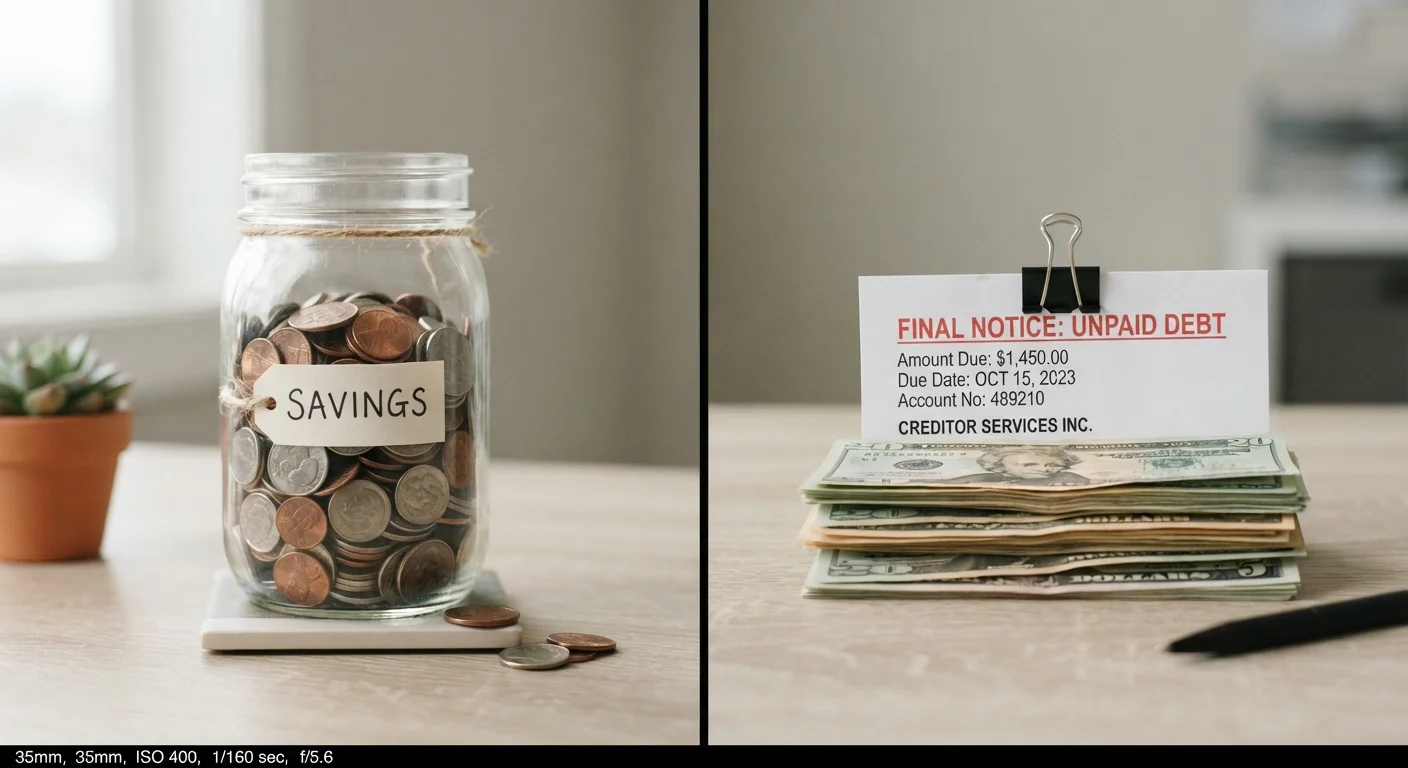
Option A
Building an Emergency Fund
The financial safety net that prevents small setbacks from becoming large crises.
Best for: Anyone without a cash cushion who relies on credit cards or loans when unexpected expenses hit.
Option B
Paying Off Debt Aggressively
The interest-eliminating strategy that reduces what you owe as fast as possible.
Best for: People carrying high-interest debt whose monthly interest charges are outpacing any savings growth.
Why This Trade-Off Feels So Difficult
Both goals matter — and that's exactly what makes this decision hard. Carrying debt while watching interest accumulate feels urgent. But living without any savings means one unexpected expense could send you further into debt. Neither path is obviously wrong, which is why so many households stay stuck doing neither effectively.
The core tension comes down to math versus security. Mathematically, paying off high-interest debt almost always produces a better return than keeping money in a savings account. But financial decisions don't happen in a vacuum. Job loss, medical emergencies, and car breakdowns don't wait for your balance sheet to be optimized.
For a fuller picture of how these two goals interact over time, see how saving and credit work together as a system. Understanding both sides helps you build a plan that's durable rather than just theoretically efficient.
| Criterion | Emergency Fund | Paying Off Debt |
|---|---|---|
| Primary benefit | Financial security buffer | Eliminates interest costs |
| Return on your dollar | 2–5% in high-yield savings | Equals your debt's interest rate |
| Risk of not acting | Forced into more debt during emergencies | Ongoing interest compounds quickly |
| Best debt rate context | Low-rate debt (under ~7%) | High-rate debt (above ~7–8%) |
| Income stability needed | More critical if income is variable | Easier to prioritize with stable income |
| Psychological effect | Reduces financial anxiety | Creates momentum and visible progress |
| Flexibility once complete | Cash available for any emergency | Freed monthly cash flow for new goals |
The Case for Building an Emergency Fund First
Without a cash cushion, unexpected costs get paid with credit — often high-interest credit. That means a $600 car repair that you can't cover in cash may end up costing significantly more once interest is added over several months of minimum payments. The emergency fund isn't competing with debt payoff; in many cases, it's protecting it.
Most personal finance frameworks suggest a starter emergency fund of $500 to $1,000 before aggressively paying down debt. This amount won't cover a major financial disruption, but it handles the minor crises that derail most budgets. Once your high-interest debt is gone, you can build that reserve up to a full 3–6 months of essential expenses.
If your income isn't stable — freelance work, hourly shifts, or seasonal employment — a larger buffer becomes even more important. Managing debt on a variable income requires a different approach, and that starts with having cash available when revenue dips. See also the difference between emergency funds and sinking funds to understand how each tool serves a separate purpose in your budget.
40%
Americans who can't cover a $400 emergency
According to Federal Reserve survey data, a significant share of U.S. adults report they would struggle to cover a $400 unexpected expense without borrowing or selling something.
20–29%
Typical credit card APR range
The Consumer Financial Protection Bureau (CFPB) has tracked average credit card interest rates rising well above 20% in recent years, making high-rate debt particularly costly to carry.
3–6 months
Recommended emergency fund size
Most widely cited personal finance guidelines suggest maintaining three to six months of essential living expenses in accessible, liquid savings.
The Case for Paying Off Debt First
High-interest debt — particularly credit card balances — carries rates that commonly range from 20% to 29% annually. No federally insured savings account offers returns anywhere close to that. Every dollar left sitting in a 4% high-yield savings account while a 24% credit card balance grows is, in net terms, a losing trade.
The real cost of minimum payments illustrates just how quickly interest compounds when only the minimum is paid each month. A $3,000 balance at 22% interest can take over a decade to eliminate at minimum payment levels — costing thousands in interest along the way.
When you prioritize debt payoff, you also free up monthly cash flow faster. Once a balance is gone, that payment no longer exists. That freed-up money can then fund your full emergency reserve, retirement contributions, or other goals. Strategies like the debt avalanche and debt snowball provide structured approaches for sequencing payoff when you carry multiple balances.
A Practical Framework for Making the Decision
Rather than choosing one path entirely, most households benefit from a sequenced approach:
- Build a starter emergency fund of $500–$1,000 before anything else.
- Pay off high-interest debt (generally above 7–8%) as aggressively as your budget allows.
- Grow your emergency fund to 3–6 months of essential expenses once high-rate debt is cleared.
- Address lower-interest debt while simultaneously building other financial goals like retirement contributions.
Your specific situation matters. If you have employer-matched retirement contributions available, many planners suggest capturing at least the full employer match before extra debt payments — since that match is effectively an immediate guaranteed return. Consult a qualified financial adviser to understand how this applies to your own circumstances.
For step-by-step help mapping out debt, building a realistic debt payoff plan from scratch offers a practical framework. And if you're thinking about how this fits into your broader financial picture decade by decade, financial milestones to plan for in your 30s, 40s, and beyond is a useful companion resource.
What About Employer 401(k) Matching?
If your employer offers a matching contribution to a retirement account, many financial planners recommend contributing at least enough to capture the full match — even while paying down debt. An employer match is effectively a 50–100% immediate return on contributed dollars, which is difficult to pass up. That said, how this fits your situation depends on your income, debt load, and timeline. A licensed financial adviser can help you weigh these trade-offs.
This article is for general informational and educational purposes only and does not constitute personalized financial advice. Consult a licensed financial adviser before making decisions specific to your situation.
The content on this site is for informational purposes only and is not a substitute for professional advice. Always consult a qualified professional for guidance specific to your situation.