

Why Interior Design Has Its Own Language
Walk into any showroom, scroll through a design blog, or talk to a decorator, and you'll quickly realize that interior design has a vocabulary all its own. Words like juxtaposition, sightline, and millwork can make a conversation feel inaccessible — but these terms exist for a practical reason. They let designers communicate precise ideas quickly.
The good news: you don't need a design degree to use them. Learning even a handful of these terms helps you describe what you like, understand what you're seeing, and make more confident choices in your own home. This glossary covers the words that come up most often — the ones that actually affect how a room looks and feels.
If you find yourself also navigating the language of homeownership, our plain-language real estate glossary can help decode the financial side of the process.
| Number of major interior design styles | Roughly 15–20 recognized styles (Interior design educators generally recognize this range) |
| What 'transitional' means | A blend of traditional and contemporary elements |
| Wainscoting standard height | Typically 32–36 inches from the floor (Common industry practice) |
| Rule of thirds in decor | Group objects in odd numbers for visual balance (Standard design principle) |
| Warm vs. cool lighting | Below 3000K is warm; above 4000K is cool (Kelvin scale, per standard lighting specifications) |
The Terms Designers Use Most
Below is a quick-reference glossary covering the interior design terms you're most likely to encounter — whether you're planning a renovation, shopping for furniture, or simply trying to communicate your vision to someone helping you decorate.
Wainscoting
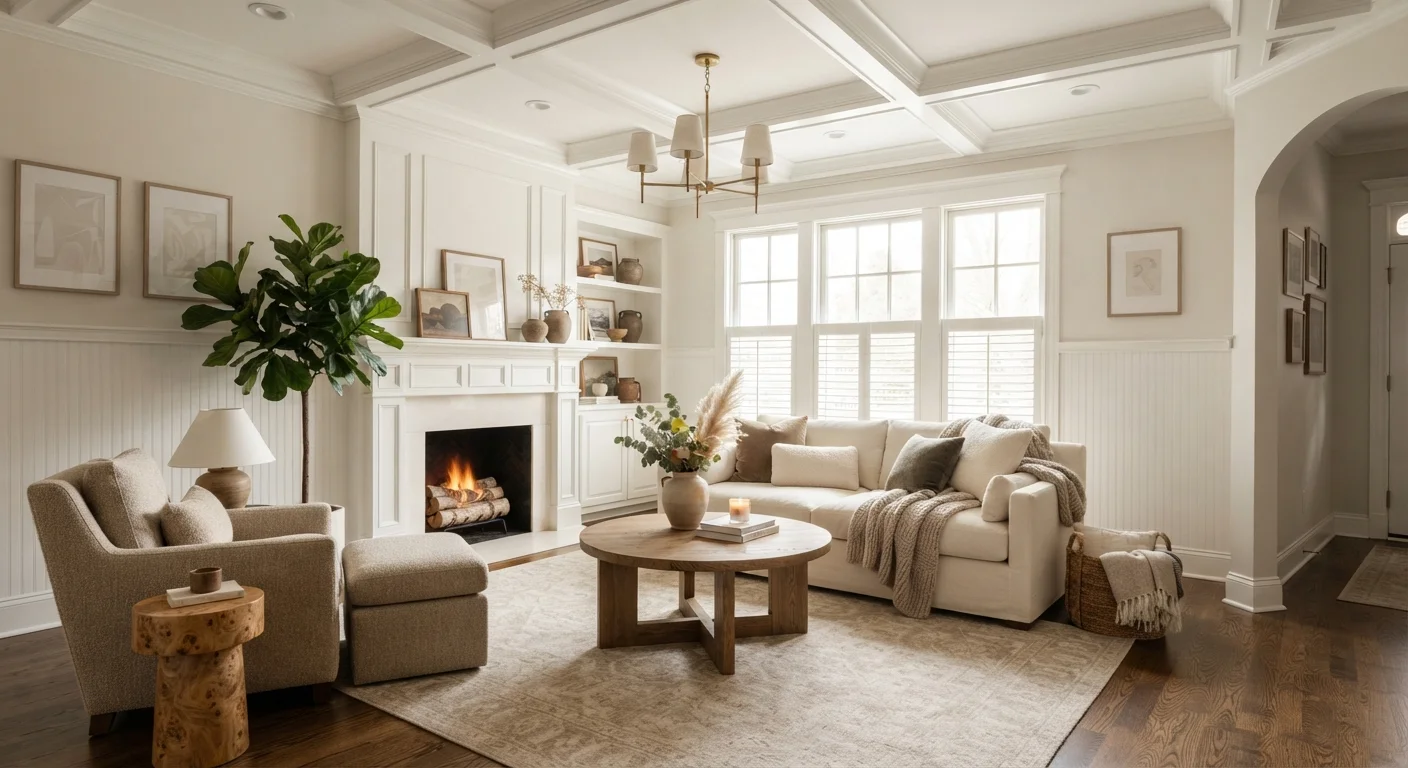
Decorative wood paneling applied to the lower portion of an interior wall, typically the bottom third. It adds texture and visual interest while protecting walls from scuffs and wear.
Coffered Ceiling
A ceiling with a grid of sunken square or rectangular panels, created by intersecting beams. Coffered ceilings add architectural depth and a sense of formality to a room.
Juxtaposition
Placing contrasting elements — such as rough and smooth, old and new, or dark and light — side by side intentionally. Juxtaposition creates visual tension and keeps a space feeling dynamic rather than flat.
Sightline
The unobstructed visual path from one point in a room to another. Designers use sightlines to guide where focal points, furniture, and artwork are placed.
Negative Space
Empty or undecorated areas within a room that are deliberately preserved. Negative space gives the eye somewhere to rest and keeps a space from feeling cluttered.
Color Temperature
A measure of whether a light source appears warm (amber, yellow) or cool (blue, white). Color temperature affects how paint colors and furnishings read in a room at different times of day.
Transitional Style
A design approach that blends traditional and contemporary elements — for example, classic furniture silhouettes paired with minimal ornamentation and neutral palettes.
Millwork
Architectural woodwork installed in a home, including trim, moldings, built-in shelving, cabinetry, and window casings. Millwork is a broad term covering both decorative and functional wood elements.
Focal Point
The dominant feature a room is designed around — often a fireplace, large window, or statement artwork. Every other element in the room is arranged to support or complement the focal point.
Scale
The size of objects in relation to one another and to the room itself. Proper scale ensures furniture and decor feel proportionate rather than oversized or dwarfed by their surroundings.
Layering
Building up visual richness by combining textures, patterns, and finishes — for example, a linen sofa over a jute rug under a velvet throw. Layering creates depth and warmth.
Flow
The ease with which a space moves from one area to the next, both visually and physically. Good flow means furniture arrangement and color choices guide movement naturally through a home.
Design Terms vs. Architecture Terms
Some terms — like coffered ceilings, wainscoting, and millwork — blur the line between interior design and architectural detail. These elements are built into a home's structure rather than added later with furniture or decor. Changing them typically requires a contractor, permits, or both. Always check local building codes before modifying structural or built-in features.
Once you're comfortable with the vocabulary, see our companion article on what interior design styles actually mean to learn how these concepts work together within specific aesthetics — from farmhouse to mid-century modern to transitional.
Putting the Terms to Work
Knowing the terminology is the first step; using it to make better decorating decisions is the goal. Here's how a few key concepts apply to everyday rooms:
- Scale matters more than style. A sofa that's too large for a room will feel wrong regardless of how beautiful it is. Before buying large furniture, measure not just the footprint but the visual weight relative to the room's ceiling height and wall space.
- Every room benefits from a focal point. If yours doesn't have a natural one — like a fireplace or large window — create one with a gallery wall, a statement light fixture, or a boldly colored piece of furniture.
- Negative space is not wasted space. Leaving breathing room between objects, on shelves, and along walls makes individual pieces stand out rather than compete for attention.
- Layering works on any budget. Mixing textures — a cotton pillow cover, a woven throw, a ceramic lamp base — adds depth without requiring expensive furniture upgrades.
Design vocabulary also helps when you're communicating with contractors or decorators. Saying "I'd like wainscoting on the dining room walls" is far more useful than trying to describe a photo you saw online.
If you enjoy learning terminology across different areas of home life, you might also find our home electronics glossary useful for making sense of the technical language that comes with today's devices and appliances.
The content on this site is for informational purposes only and is not a substitute for professional advice. Always consult a qualified professional for guidance specific to your situation.