

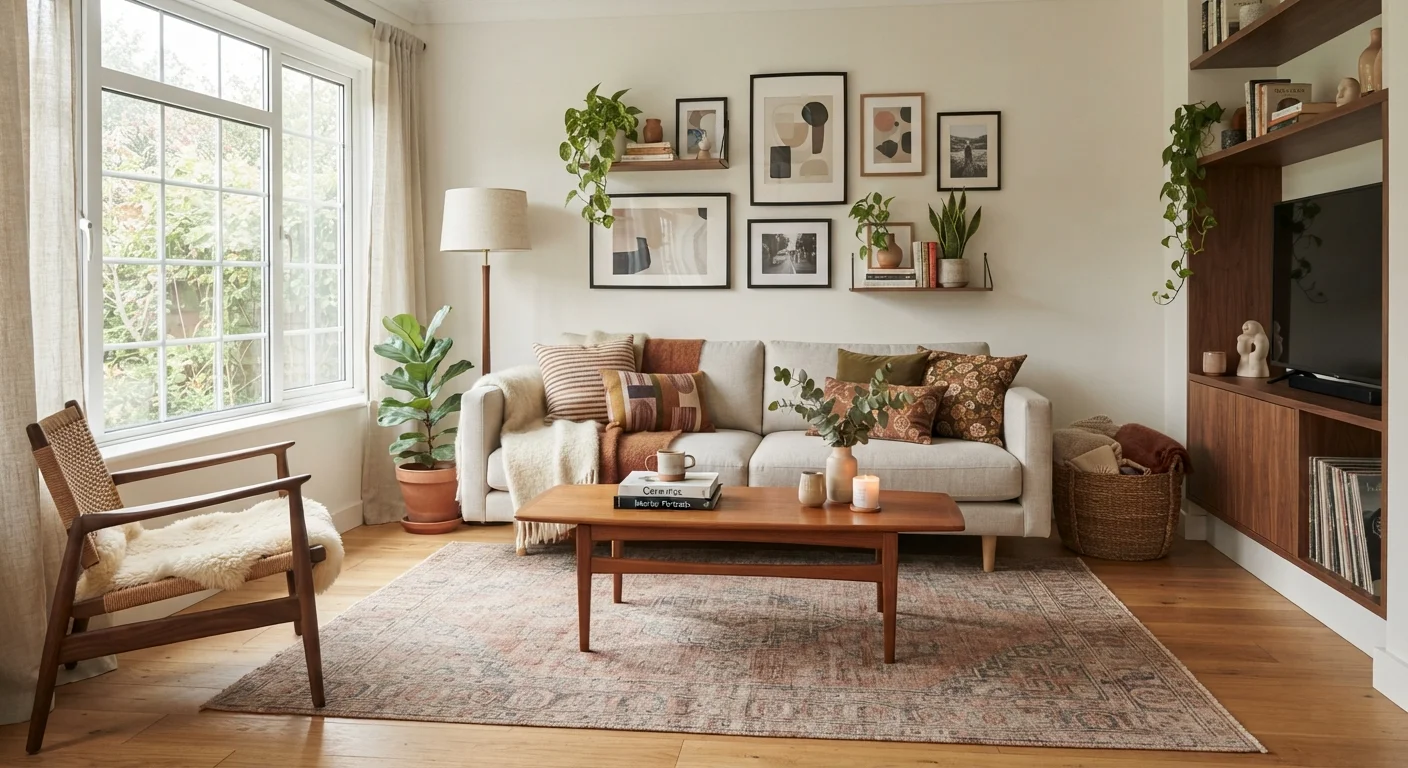
Why Design Style Vocabulary Matters
Walk into any home improvement store or scroll any décor site and you'll hit a wall of labels: farmhouse, Scandinavian, bohemian, mid-century modern, coastal. These aren't just marketing terms — they're shorthand for coherent sets of decisions about shape, texture, color, and scale. When you know what a label actually means, you stop buying things that look interesting in isolation and start building rooms that feel complete.
The goal here isn't to box you in. It's to give you a working vocabulary so you can identify what you already love, communicate it to others, and make more intentional choices. Think of styles as dialects, not straitjackets. For a deeper dive into the language designers use, see our plain-English glossary of interior design terms.
Style Labels Are Starting Points, Not Rules
The names attached to design styles are useful shorthand, not binding categories. A room labeled "Scandinavian" by one designer might be called "minimalist modern" by another. What matters is whether the underlying principles — materials, scale, palette — work together in your specific space. Use style names to search and communicate, not to judge whether a room is "correct."
The Major Style Families, Explained
Most popular American design styles fall into a few broad families. Here's what each one actually looks like in practice:
Traditional
Rooted in European — especially English and French — design, traditional style features symmetry, rich wood tones, upholstered furniture with curved legs, and layered window treatments. Color palettes lean toward warm neutrals, deep blues, and burgundy. Ornamentation is intentional: crown molding, wainscoting, and detailed hardware are common signatures.
Modern & Mid-Century Modern
"Modern" in design refers to the Modernist movement of the early-to-mid 20th century — think flat planes, minimal ornamentation, and the principle that form follows function. Mid-century modern (roughly 1945–1969) adds organic curves, tapered legs, and warm wood veneers to that clean foundation. Both favor uncluttered surfaces and let materials do the visual work.
Transitional
The most common style in American homes, transitional design splits the difference between traditional comfort and contemporary restraint. Expect neutral palettes, furniture with subtle curves but clean silhouettes, and a mix of textures that keeps things visually interesting without feeling busy. It's deliberately flexible — and that's the point.
Farmhouse
Farmhouse style pairs rustic, lived-in warmth (shiplap, reclaimed wood, open shelving) with a controlled, mostly white-and-neutral palette. Modern farmhouse in particular strips away clutter while keeping the cozy, unpretentious feeling. It's approachable precisely because it doesn't try too hard.
Scandinavian (Hygge-Influenced)
Defined by simplicity, functionality, and natural light, Scandinavian design uses pale woods, muted colors, and minimal furniture. The concept of hygge (roughly, cozy contentment) shows up in layered textiles and warm lighting rather than objects. Nothing is purely decorative — every piece earns its place.
Bohemian
Bohemian (or boho) style deliberately defies formula. It layers patterns, mixes global textiles, and welcomes collected objects and plants. The organizing principle is personal meaning over editorial perfection. Done well, it feels curated; done carelessly, it reads as cluttered.
~65%
U.S. homeowners who prefer transitional or traditional style
Industry surveys by the National Kitchen and Bath Association and similar trade organizations consistently find that traditional and transitional styles dominate American home preference data.
3–5
Design style families most American homes draw from
Interior designers broadly group residential American aesthetics into a handful of families; most homes blend elements from two or three rather than committing to one.
How to Identify Your Own Style
Knowing the styles is half the work. Knowing which resonates with you is the other half — and it's simpler than most people expect.
- Audit what you already have. Walk through your home and note the pieces you genuinely love, not just tolerate. Look for patterns in material, scale, and color.
- Collect images without editing yourself. Save rooms that appeal to you from any source. After 20–30 images, look at them together. You'll see recurring shapes and moods that reveal a preference you may not have articulated.
- Notice what makes you uncomfortable. If stark, minimal rooms feel cold to you, that's information. If heavily draped windows feel oppressive, that's information too. Your discomforts are as revealing as your affinities.
- Test with small commitments first. A throw pillow or a lamp costs far less than a sofa. Try a texture, color family, or silhouette before committing at scale.
Color plays a significant role in how a style lands emotionally. Understanding color temperature can help you see why the same shade looks completely different in a modern room versus a traditional one. And once you've identified your style, furniture arrangement principles can help you put it all together spatially.
Build a Simple Mood Board First
Before buying anything, assemble 10–15 images of rooms you genuinely want to live in — not rooms you think are impressive. Pin them together physically or digitally and step back. The colors, textures, and shapes that repeat across those images are your actual style preferences, even if you can't name them yet. This simple exercise saves more money than any shopping strategy.
Before you start shopping or repainting, it's worth running through a full planning checklist. Our guide on what to do before you redecorate a room walks through every consideration before you spend a dollar.
Mixing Styles Without Losing Cohesion
Real homes rarely belong to a single style, and they shouldn't have to. The most livable spaces tend to blend two or three compatible aesthetics, anchored by a consistent palette and a shared material story.
A few approaches that help:
- Choose one dominant style and one accent style. Let one framework carry about 70% of the visual weight; let the second add contrast and personality.
- Repeat materials across the room. If you use brass in a light fixture, echo it in a cabinet pull or a small tray. Repetition creates cohesion faster than matching furniture sets ever could.
- Watch your scale. Mixing a mid-century credenza with a traditional armchair works if both are appropriately scaled to the room. Scale mismatches are often what makes mixed-style rooms feel wrong.
- Textiles are your connective tissue. A well-chosen rug or a consistent approach to natural versus synthetic textiles can visually unify elements that wouldn't otherwise belong together.
Also worth keeping in mind: many commonly repeated style "rules" — never mix metals, never go dark in a small room — are oversimplifications. Our piece on interior design myths that keep rooms looking dated walks through the most persistent ones and what's actually true.
“A well-designed room should tell the story of who lives there — not who a catalog imagines might live there.”
— Albert Hadley, Influential American interior designer, co-founder of Parish-Hadley Associates
Frequently Asked Questions
Transitional style — a blend of traditional warmth and contemporary simplicity — is consistently cited as the most common choice in U.S. homes. It appeals broadly because it's livable and doesn't commit hard to either extreme.
Yes, and most successful rooms do. The key is finding a unifying thread — a shared color palette, material, or scale — that makes the combination feel intentional rather than accidental.
"Modern" refers to a specific mid-20th-century design movement characterized by function-first furniture and natural materials. "Contemporary" means what's current right now and shifts over time. The two overlap frequently but aren't interchangeable.
Start by collecting images of rooms that genuinely appeal to you — from anywhere. Look for recurring patterns: Do you gravitate toward raw wood or lacquered finishes? Curves or straight lines? Clutter-free surfaces or layered collections? Those patterns reveal your style.
They overlap but aren't identical. Farmhouse style blends rustic elements (raw wood, natural textures) with a cleaner, more curated look. Rustic style is broader and generally more unfinished, rugged, and nature-forward.
No. Many designers recommend a dominant style with supporting accents from complementary styles. Consistency in your color palette and material choices does more for cohesion than strict stylistic loyalty.
The content on this site is for informational purposes only and is not a substitute for professional advice. Always consult a qualified professional for guidance specific to your situation.