

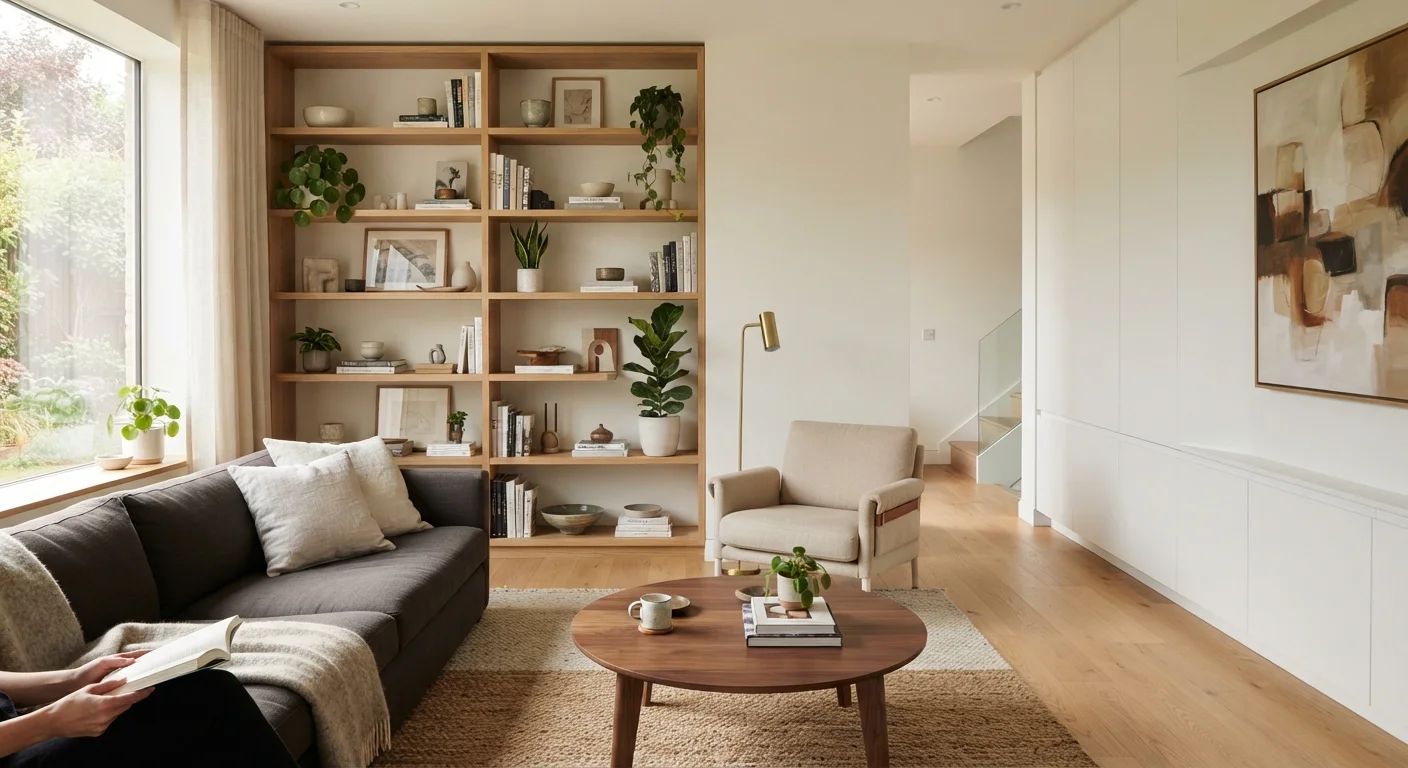
Option A
Open Shelving
The airy, display-forward approach.
Best for: Homeowners who enjoy curating décor, keep tidy collections, and want a room to feel open and personalized.
Option B
Closed Cabinets
The clean-lined, clutter-concealing solution.
Best for: Households with diverse storage needs, busy family routines, or a preference for a streamlined, low-maintenance look.
What Each Approach Actually Does for a Room
Storage isn't only a practical question — it shapes how a room feels to live in. Open shelving removes visual barriers, drawing the eye through the room and creating a sense of depth. When done thoughtfully, shelves loaded with a mix of books, greenery, and objects give a living space an inhabited, intentional quality that's hard to fake with art alone.
Closed cabinets work in the opposite direction: they compress visual information, presenting a flat, unified surface. That can be genuinely calming in rooms that have a lot going on — patterned rugs, bold furniture, or busy architectural details. The tradeoff is that solid cabinet fronts do occupy visual mass, which in smaller rooms can feel like walls closing in.
Neither approach is universally better. What matters is how each interacts with your room's proportions, your household's rhythms, and how much mental energy you're willing to invest in keeping things looking organized. For a deeper look at managing proportion and visual weight in tighter spaces, see our guide to decorating small living rooms.
| Criterion | Open Shelving | Closed Cabinets |
|---|---|---|
| Visual effect | Open, airy, depth-creating | Clean, uniform, contained |
| Clutter visibility | Always visible — requires tidiness | Hidden behind doors |
| Dust management | Frequent dusting of objects needed | Easier to wipe exterior surfaces |
| Installation complexity | Generally DIY-friendly | Built-ins require professional work |
| Flexibility | Easy to adjust or remove | Built-ins are permanent; freestanding units portable |
| Cost range | Lower upfront cost typical | Wider range; built-ins cost more |
| Best room size fit | Works well in smaller rooms | Better suited to larger rooms |
The Real Maintenance Difference
One of the most underestimated factors in the open-vs-closed debate is ongoing upkeep. Open shelving is an always-visible display — meaning any disorder is immediately apparent to you and anyone who walks through the door. Dust settles on objects and shelf surfaces consistently, typically requiring a wipe-down every one to two weeks depending on your home's airflow and whether you run forced-air systems.
Closed cabinets shift that maintenance burden substantially. Dust still accumulates, but it does so on exterior surfaces that can be wiped quickly, rather than around dozens of individual objects. The interior only needs attention when you're actively using or reorganizing storage. For households where deep cleaning is occasional rather than routine, that's a meaningful practical advantage.
1–2×/week
Typical dusting frequency for open shelving
Interior design maintenance guides generally recommend dusting open shelves at least weekly in homes with forced-air heating or cooling systems.
~60%
Homeowners preferring mixed storage solutions
Surveys on home organization consistently find that a majority of homeowners use some combination of open and closed storage rather than committing to one approach exclusively.
The flip side: inside closed cabinets, organization can quietly deteriorate. Without the visible accountability of open shelving, it's easy for drawers and cabinet interiors to become disorganized over time. Building in simple interior organizers — dividers, labeled bins, or pull-out trays — helps counteract that tendency without adding expense.
Cost, Installation, and Flexibility
From a budget standpoint, open shelving tends to have a lower barrier to entry. Floating shelf brackets and boards are widely available, and installation is typically a manageable DIY project for solid walls — though it's worth confirming that anchors are secured into studs or using appropriate wall anchors for the expected load. Keep weight limits in mind: heavy books or stacked objects require robust support.
Built-in closed cabinetry, by contrast, represents a more significant investment in both materials and labor. Freestanding cabinet units offer a middle ground — they don't require professional installation and can move with you if you rent or relocate. That portability is worth weighing against the more polished, custom look of built-ins.
A Note on Rental and Lease Situations
If you rent your home, check your lease before installing any wall-mounted shelving. Most landlords allow floating shelves with proper patching on departure, but some leases prohibit wall modifications entirely. Freestanding bookcases and media units provide open-storage aesthetics without any anchoring, making them a renter-friendly alternative worth considering.
A practical strategy many homeowners settle on: use closed cabinetry at lower heights for everyday storage, and open shelving above for display. This keeps the clutter of daily life out of sight while preserving the airy, personal quality that open shelving brings to a room at eye level and above.
The content on this site is for informational purposes only and is not a substitute for professional advice. Always consult a qualified professional for guidance specific to your situation.