

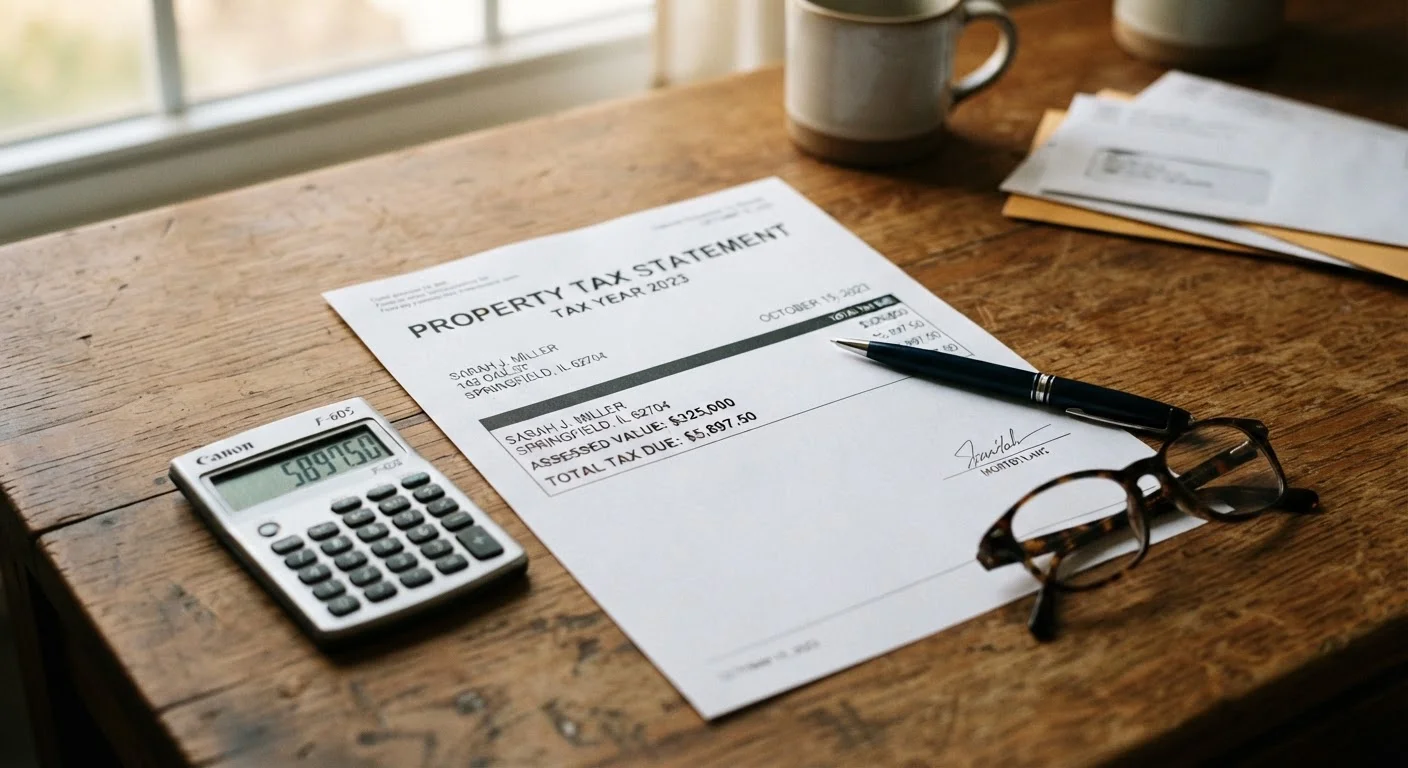
What You'll Need Before You Start
Pull out your most recent property tax bill — the paper notice mailed by your county assessor or tax collector, or the digital version available through your local government's online portal. You'll also want access to your county's assessor website, which typically lets you look up your property record and comparable assessments. Keep a calculator handy for verifying figures.
What you will need
County Assessor's Website
Lets you verify your property's assessed value, review comparable assessments, and find exemption applications.
Prior-Year Tax Bill
Provides a baseline for spotting year-over-year changes in assessed value, mill rate, or applied exemptions.
Mortgage Escrow Statement
Confirms how much your servicer is collecting for taxes each month so you can reconcile against the actual bill.
How to Read Your Property Tax Bill Line by Line
Property tax bills vary by county and state, but most share a consistent structure. Working through each section in order makes the document far less intimidating.
Locate the Property Identification Number
At the top of your bill you'll find a parcel number (also called a parcel identification number or APN — Assessor's Parcel Number). This is the unique ID your county uses to track your property in its records. Write it down; you'll need it to look up your property record online and to reference any correspondence with the assessor's office.
Find the Market Value vs. Assessed Value
Your bill will typically show two distinct values. Market value (sometimes called appraised value) is the assessor's estimate of what your property would sell for. Assessed value is the figure actually used to calculate your tax — in many states it's a fixed percentage of market value, often called the assessment ratio. For example, if your home has a market value of $300,000 and your state's assessment ratio is 80%, your assessed value would be $240,000.
Identify Any Applied Exemptions
Most bills list exemptions that reduce your taxable assessed value before the tax rate is applied. A homestead exemption — available in most states for a primary residence — is the most common. The bill may show your assessed value, then subtract the exemption amount to arrive at a lower taxable value. If you believe you qualify for an exemption that isn't reflected, contact your assessor's office before the application deadline.
Understand the Mill Rate
The mill rate (or millage rate) is the tax rate applied to your taxable assessed value. One mill equals $1 in tax per $1,000 of taxable value. Your bill may express this as a decimal (e.g., 0.02150) or as mills (e.g., 21.50 mills). To verify your tax calculation: multiply your taxable assessed value by the mill rate. A taxable value of $200,000 at 21.50 mills would produce a tax of $4,300. Your bill may show multiple mill rates — one for the county, one for the school district, and others for special districts — that combine into a total rate.
Review the Payment Schedule and Due Dates
Most jurisdictions bill property taxes either annually or semi-annually, though some use quarterly schedules. Your bill will list the due date(s) and any penalties for late payment — typically a percentage added per month. If your mortgage includes an escrow account, your lender collects a portion of your estimated annual tax bill with each mortgage payment and remits it on your behalf. In that case, confirm the payment was made on time by checking your county's payment records online.
Check for Special Assessments
Below the main tax figures, many bills include special assessments — charges for specific local improvements or services such as sidewalk repair, street lighting districts, or sewer upgrades. These are separate from your general property tax and are tied to your parcel specifically. They are not negotiable in the same way assessed value is, but it's worth knowing what each one funds. Contact your local government if a special assessment appears that you don't recognize.
Cross-Check Comparable Properties
Most county assessor portals let you search nearby properties and view their assessed values. If similar homes on your street are assessed notably lower than yours, that discrepancy is often the strongest evidence to include in an appeal. Gather at least three to five comparable records before contacting your assessor.
Once you've worked through all the line items, compare the total to what your mortgage servicer is collecting in escrow each month. If there's a gap, contact your servicer — escrow shortfalls often lead to unexpected payment increases. You can also review your broader ownership picture with our annual homeowner review checklist.
Appeal Deadlines Are Strict
Most counties set a hard deadline for assessment appeals — commonly 30 to 90 days after the notice is mailed — and very few exceptions are granted. If you suspect an error in your assessed value, act quickly. Missing the window typically means you must wait until the next assessment cycle to challenge the figure.
When Something Looks Wrong
If your assessed value seems significantly higher than what comparable homes in your area have sold for recently, you likely have grounds to file an appeal with your county assessor's office. Most jurisdictions have a formal appeal window — typically 30 to 90 days after assessment notices are mailed — and the process usually involves submitting comparable sales data or a licensed appraisal.
Also check whether you're receiving every exemption you're entitled to. Many eligible homeowners simply never apply. The homestead exemption guide explains what most states offer and how the application process generally works. Other common exemptions include senior citizen discounts, veteran exemptions, and disability-related reductions — each with its own eligibility rules.
Understanding the boundaries of what you own and how local rules affect your property goes hand in hand with tax literacy. See our overview of easements, setbacks, and zoning to round out your knowledge of property rights and responsibilities.
This article is for general informational and educational purposes only and does not constitute legal, tax, or financial advice. Tax rules and procedures vary significantly by jurisdiction. Consult a qualified tax professional or your local assessor's office for guidance specific to your situation.
The content on this site is for informational purposes only and is not a substitute for professional advice. Always consult a qualified professional for guidance specific to your situation.