

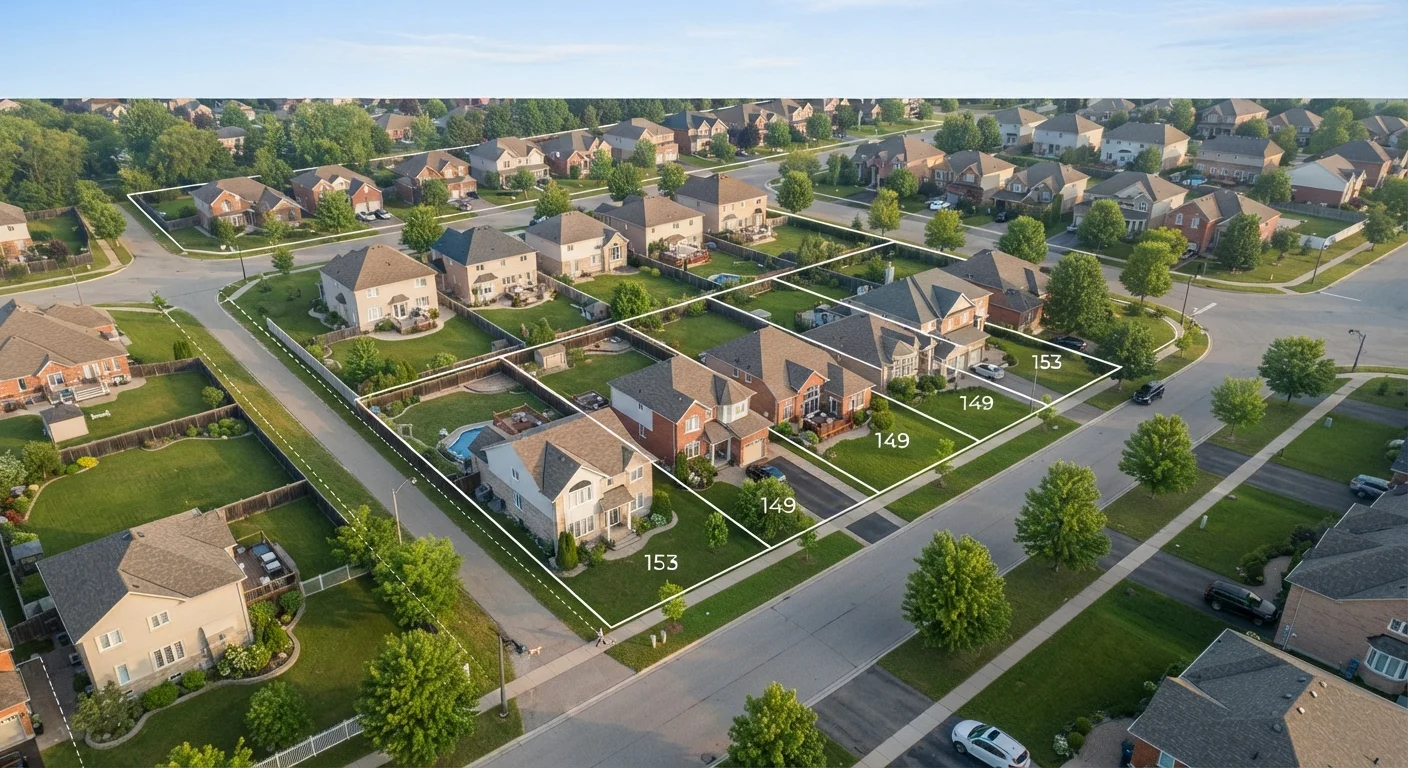
What You Actually Own — and What Others Can Claim
Buying a home conveys a bundle of rights over land and structures — but that bundle has edges. To understand the full picture of ownership, it helps to read our overview of what property ownership actually includes, which covers concepts like fee simple title and air rights.
Three overlapping categories of legal restriction shape nearly every parcel in the United States: easements, setbacks, and zoning. Each operates independently, and all three can apply simultaneously to a single lot.
~36%
U.S. land affected by conservation easements
According to the Land Trust Alliance, tens of millions of acres across the U.S. are protected through voluntary conservation easements held by land trusts.
75%+
U.S. municipalities with zoning codes
The vast majority of incorporated U.S. cities and towns have adopted formal zoning ordinances, according to the American Planning Association.
Easements: When Someone Else Has a Right to Your Land
An easement is a legal right that allows a party other than the property owner to use a specific portion of your land for a defined purpose. Easements don't transfer ownership — they grant limited, lawful access.
Common types include:
- Utility easements: Allow electric, gas, water, or telecom companies to install and maintain infrastructure crossing your lot.
- Drainage easements: Reserve land for stormwater flow or retention, restricting what you can place there.
- Access easements: Grant a neighboring property owner the right to cross your land to reach a road or shared amenity.
- Conservation easements: Voluntarily restrict development in exchange for tax benefits, often in perpetuity.
Easements are typically recorded in the public land records and should appear in a title search. For a closer look at the documents that track property rights and encumbrances, see our guide on deeds, titles, and what each one does.
“Easements are one of the most commonly misunderstood aspects of property ownership. Buyers often don't realize an easement exists until they try to build something — and by then, it's too late to negotiate.”
— American Land Title Association, National trade organization representing the title insurance and settlement services industry
Setbacks: How Close to the Edge Can You Build?
A setback is the minimum required distance between a structure and a property boundary, road, or natural feature like a stream. Setback rules are set by local governments — typically through zoning ordinances — and they vary widely by municipality, zone type, and structure type.
Front setbacks affect how close a house or addition can be to the street. Rear and side setbacks govern accessory structures like garages, sheds, and decks. Shoreline or riparian setbacks protect waterways from development. Violating a setback — even unintentionally — can require costly remediation and may surface as a problem during a future sale.
Check Before You Build Anything
Even small projects — a garden shed, a fence, a patio — can run afoul of setback rules. Contact your local planning or building department before starting any exterior improvement. Unpermitted work can surface during a home sale and may require expensive correction.
Before adding a fence, deck, or accessory dwelling unit, contact your local building or planning department to confirm applicable setbacks. Permit requirements generally exist for this reason.
Zoning: The Rules That Define a Neighborhood's Character
Zoning is the system local governments use to divide land into districts — residential, commercial, industrial, agricultural, mixed-use — and regulate what can be done within each. Zoning codes specify permitted uses, building heights, lot coverage limits, and density allowances.
For homeowners, zoning most commonly affects:
- Whether a home-based business is allowed
- Whether an accessory dwelling unit (ADU) or garage apartment is permitted
- How many unrelated people can occupy a dwelling
- What signage, if any, is allowed
Zoning maps are public records. Most municipalities publish them online. If you're planning a significant change to how you use your property, consulting a local land use attorney or your planning department before proceeding can save significant time and expense.
How to Research Your Own Property's Restrictions
A proactive approach to understanding your property's legal constraints serves you in two ways: it prevents costly mistakes and strengthens your position if disputes arise. Consider building this research into your annual property ownership review.
Key steps:
- Review your deed and closing title report for recorded easements and covenants.
- Look up your parcel on your county assessor or recorder's website.
- Check your municipality's zoning map and code for your district's permitted uses and dimensional standards.
- Order a current survey if your boundary lines or easement locations are unclear.
If a lien or other encumbrance has already attached to your property, that's a separate issue worth understanding — see our article on what happens when a lien lands on your property.
This article is for general informational purposes only and does not constitute legal or financial advice. Consult a licensed real estate attorney or your local planning authority for guidance specific to your property.
Frequently Asked Questions
Start with your property deed and the title report from your closing documents. Easements are typically recorded with the county recorder or register of deeds. A licensed surveyor can also identify them on a plat survey.
Usually not. Local setback rules typically require structures to be a minimum distance from lot lines. Check with your local planning or zoning department before breaking ground on any improvement.
Consequences range from fines and stop-work orders to mandatory removal of unpermitted structures. Repeated violations can complicate future sales or refinancing.
Yes. Local governments can rezone areas over time, though existing uses that predate a zone change are sometimes protected as 'nonconforming uses.' Consult a local land use attorney if rezoning affects your plans.
It depends on the type and location. A utility easement along a rear lot line may have little practical impact, while an easement that limits a prime buildable area could meaningfully affect value.
Most municipalities publish zoning maps online through their planning or building department. Your county assessor's website may also list the zoning code for individual parcels.
The content on this site is for informational purposes only and is not a substitute for professional advice. Always consult a qualified professional for guidance specific to your situation.