

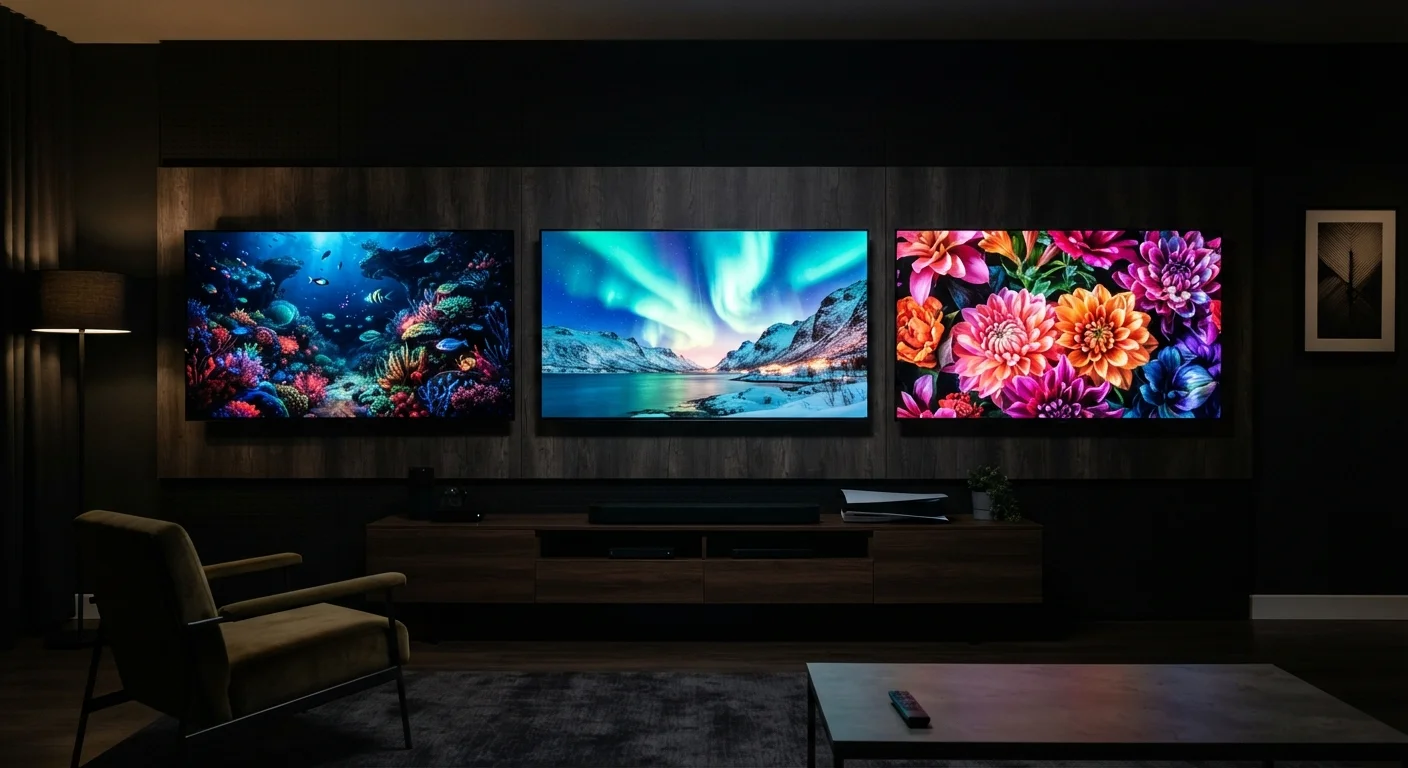
Our Verdict
LED TVs offer reliable, affordable performance for well-lit rooms. QLED improves on that with richer colors and higher brightness, making it well-suited to bright living spaces. OLED delivers the most precise contrast and color accuracy, excelling in darker viewing environments and for cinematic content. The right choice depends on how and where you watch.
| Best for | Recommended |
|---|---|
| Budget-conscious shoppers or brightly lit rooms | LED |
| Bright living rooms with varied content including sports and gaming | QLED |
| Dedicated home theater setups or dark viewing rooms | OLED |
| Viewers prioritizing cinematic picture accuracy and deep blacks | OLED |
The Foundation: How Each Technology Produces Light
Every TV picture ultimately comes down to light — how it's created, controlled, and colored. The three major display technologies approach this differently, which is why they produce noticeably different images even when showing identical content.
LED TVs use a liquid crystal display (LCD) panel that cannot produce its own light. Instead, a layer of LED (light-emitting diode) bulbs sits behind the panel and shines through it. The LCD layer controls which pixels let light pass and which block it. The limitation: blocking light is imperfect, so even a "black" pixel on an LED TV often lets some light bleed through, reducing contrast.
QLED TVs are fundamentally still LED/LCD televisions, with an added layer: a quantum dot film positioned between the backlight and the LCD panel. Quantum dots are microscopic semiconductor particles that convert light into very precise colors when energized. This gives QLED sets a wider color range and typically higher peak brightness than standard LED TVs, but they share the same backlight-based contrast limitations.
OLED TVs use an entirely different approach. Each pixel in an OLED (organic light-emitting diode) panel generates its own light independently. When a pixel needs to display black, it simply turns off completely. This produces what's called "infinite contrast" — a measurable, visible difference in dark scenes. For a deeper look at display terminology, see our home electronics glossary.
Comparing Performance Where It Matters
| LED | QLED | OLED | |
|---|---|---|---|
| Light source | LED backlight behind LCD | LED backlight + quantum dot film | Each pixel self-lit |
| Black level / Contrast | Limited by backlight bleed | Improved with local dimming | True black, infinite contrast |
| Peak brightness | Moderate | High | Lower ceiling than QLED |
| Color volume | Standard | Wide, vibrant | Accurate, excellent at lower brightness |
| Viewing angle | Narrows noticeably | Moderate to narrow | Consistent and wide |
| Burn-in risk | None | None | Low but present with static images |
| Best environment | Bright rooms, everyday use | Bright rooms, varied content | Dark rooms, cinema viewing |
Contrast is where the gap between OLED and the backlit technologies is most obvious. In a dark room, OLED's per-pixel dimming makes shadow detail and deep blacks immediately noticeable. QLED and LED TVs compensate through a feature called local dimming — dividing the backlight into zones that can be dimmed independently — but zone edges can produce a "halo" glow around bright objects on dark backgrounds.
Brightness works in the opposite direction. OLED panels have a ceiling on how bright they can get before risking pixel wear. QLED TVs, backed by powerful LED arrays, can reach considerably higher peak brightness — an advantage in sun-filled living rooms where a dimmer screen washes out. Standard LED TVs fall between these two in practical brightness.
Color volume — the ability to display accurate, saturated colors at different brightness levels — is a QLED strength. OLED displays exceptional color accuracy, particularly at lower brightness levels. Both surpass basic LED for color quality in most real-world conditions. See how TV resolution interacts with panel type when evaluating overall picture quality.
Test in Your Own Lighting Conditions
When evaluating TVs in a store, showroom lighting is almost always brighter and more controlled than a typical living room. If possible, look for stores that demo TVs in different lighting setups, or ask to see the same content with room lights on versus off. The technology that looks best in a bright showroom may not be the right choice for your dimmer home environment.
Burn-In, Longevity, and Practical Considerations
One concern specific to OLED is image retention, sometimes called burn-in — where a static image displayed for extended periods leaves a faint permanent ghost on the panel. Modern OLED TVs include software features that shift the image slightly and run periodic pixel refreshes to reduce this risk. For most typical TV use (streaming, movies, varied programming), burn-in is rarely a practical concern, but it's worth noting for anyone who watches content with persistent static elements like news tickers or channel logos for many hours daily.
LED and QLED TVs are not susceptible to burn-in in the same way. Their longevity is well-established, and they tend to maintain consistent brightness over years of use without the pixel-degradation risk inherent to organic materials.
Viewing angle is another real difference. OLED panels maintain consistent color and contrast when viewed from the side. Most LED and QLED displays show color shift and contrast loss at wider angles — though higher-end sets use panel treatments to reduce this effect.
Static Images and OLED: Know the Risk
Leaving any single static image on an OLED screen for many consecutive hours — such as a paused video game HUD or a news channel with a persistent ticker — can accelerate uneven pixel wear over time. For most mixed-use viewing, this is not a day-to-day concern, but those who leave a single channel on for extended periods should be aware. Use your TV's built-in screen saver or automatic shutoff feature as a precaution.
For a broader look at TV purchasing misconceptions — including which specifications matter less than they appear — visit our piece on common TV myths shoppers encounter.
Matching the Technology to Your Viewing Environment
The panel type that performs best is heavily influenced by where and how you watch television.
- Bright rooms with lots of natural light: QLED's high peak brightness fights glare more effectively. Standard LED is a reasonable alternative at lower price points.
- Dark or controlled-light rooms: OLED's contrast and black levels are most visually impactful here. The technology was essentially designed for this environment.
- Large family seating arrangements: OLED's wider viewing angles keep the picture consistent for viewers sitting off to the side.
- Gaming: Many current OLED TVs support low input lag and high refresh rates well, though QLED options have closed this gap significantly. Input lag and refresh rate specs matter more for gaming than panel type alone.
Once you've chosen a display, getting content onto it is its own topic — from streaming to cable to gaming consoles. Our guide to every way to get content on your TV screen covers all the options clearly.
~1,000,000:1
Typical OLED contrast ratio
OLED panels achieve contrast ratios far beyond LCD-based displays due to per-pixel light control, compared to roughly 3,000:1–5,000:1 for standard LED sets.
2,000+ nits
Peak brightness of high-end QLED sets
High-end QLED televisions can achieve peak brightness above 2,000 nits, giving them a clear advantage in rooms with significant ambient light.
The content on this site is for informational purposes only and is not a substitute for professional advice. Always consult a qualified professional for guidance specific to your situation.