

Why Medication Rules Differ by Country
Crossing an international border with prescription medications isn't automatically straightforward. What's legally dispensed at your local pharmacy may be a controlled substance — or even outright prohibited — in your destination country. Rules vary widely, and ignorance of local law is rarely a defense at customs.
Some countries restrict opioids, benzodiazepines, ADHD medications, and certain sleep aids far more strictly than the United States does. Others regulate common over-the-counter drugs like pseudoephedrine (found in many cold remedies) or codeine. Travelers who don't verify the rules in advance can face confiscation, fines, or worse.
The safest starting point is always an official one. The U.S. Embassy or Consulate website for your destination country and that country's health ministry or customs agency are the authoritative sources — not travel forums or well-meaning friends. See our first-time international traveler's guide for broader customs guidance.
Documentation That Can Help at the Border
Carrying the right paperwork doesn't guarantee smooth passage, but it meaningfully reduces risk. Before you travel, consider gathering the following:
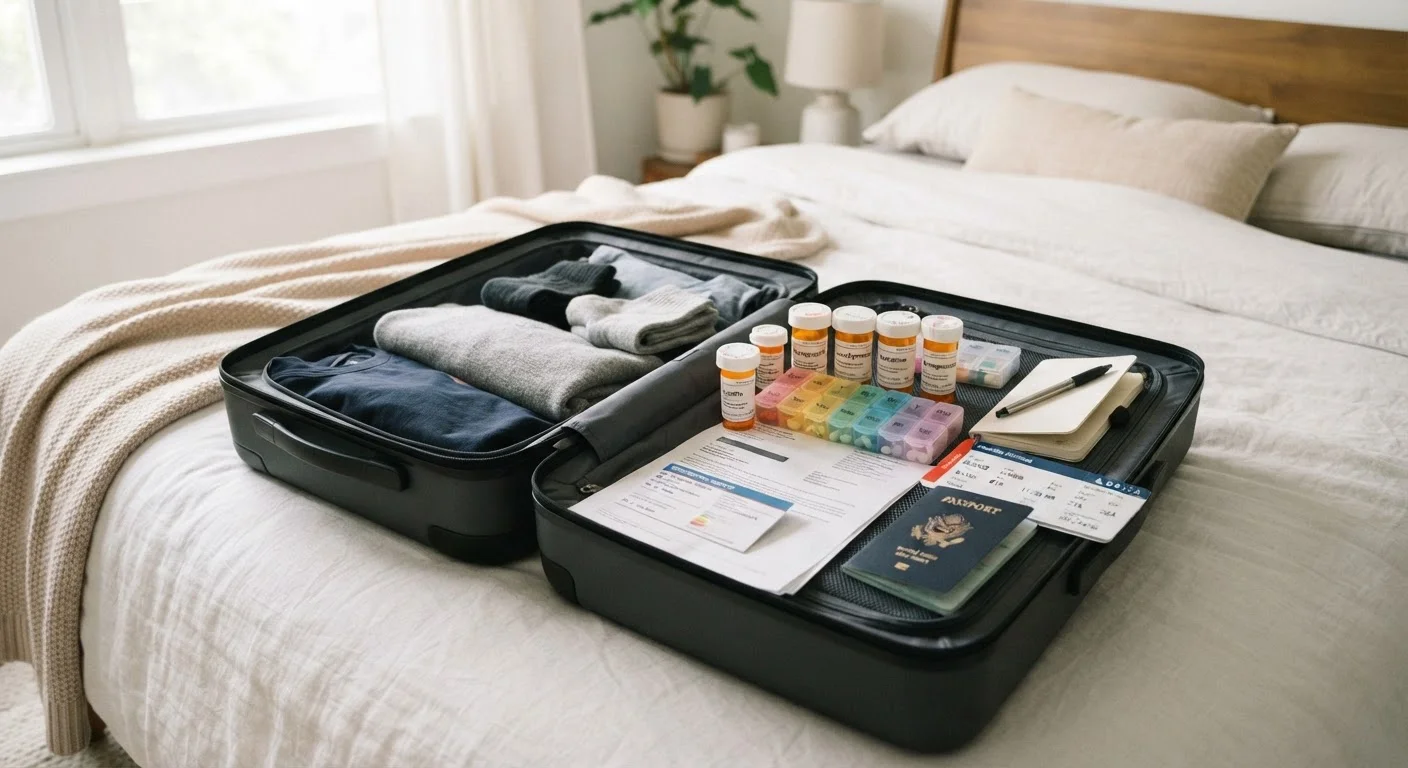
- Original pharmacy-labeled containers — Most customs officials expect medications to be in their original, labeled bottles. Pill organizers alone are rarely sufficient documentation.
- A letter from your prescribing physician — This should list your diagnosis (in general terms), the medication name, dosage, and the medical necessity. Ask your doctor to print it on official letterhead.
- Copies of the actual prescription — A printed or digital copy of the prescription itself adds another layer of proof.
- Translation support — For non-English-speaking destinations, a translated version of your documentation can help customs officers process your situation more quickly.
If you're traveling with a controlled substance, some countries require advance import permits — an application process that can take weeks. Check requirements early, ideally when you begin trip planning.
Controlled substance
A drug regulated by law due to its potential for abuse or dependency. What qualifies as controlled varies significantly from country to country.
Import permit
Official government authorization required in some countries to bring certain medications across the border. Must typically be obtained before travel.
Personal supply
The quantity of medication a traveler is permitted to bring for their own use, as opposed to distribution. Most countries define this as a 30- to 90-day supply, but limits vary.
Pharmacy-labeled container
The original dispensing bottle or package from a pharmacy, bearing the patient's name, prescriber, drug name, dosage, and dispensing date.
Quantity Limits and Storage Considerations
Many countries permit travelers to bring a personal supply of medication — commonly defined as a 30- to 90-day supply — but these limits are not universal. Bringing more than what appears to be a personal supply can raise questions about intent to distribute.
Temperature-sensitive medications (such as insulin) add another layer of planning. Long flights, layovers, and checked-baggage holds can expose medications to heat or cold that degrades their effectiveness. The Transportation Security Administration (TSA) permits medically necessary liquids in quantities exceeding the standard 3.4-ounce limit, but they must be declared at screening. Verify current TSA guidance directly at tsa.gov before you fly.
Temperature-Sensitive Medications Need Extra Planning
Insulin, biologics, and some other medications require refrigeration or protection from extreme heat. During long flights and layovers, standard luggage conditions may not be adequate. Ask your pharmacist about travel-safe storage options and check your airline's policy on carrying medical supplies in the cabin before you fly.
For families managing medications for children, planning complexity multiplies. Our article on traveling with kids covers additional considerations worth reviewing alongside medication prep.
For a comprehensive pre-departure checklist that includes medications alongside documents and home security, see Before You Board.
This article is for general informational purposes only and does not constitute medical, legal, or travel-regulatory advice. Medication laws change; always verify current requirements with official government sources, your prescribing healthcare provider, and your country's customs authority before travel.
The content on this site is for informational purposes only and is not a substitute for professional advice. Always consult a qualified professional for guidance specific to your situation.