

Start here
Getting Your Passport in Order
Next
Visas, Entry Requirements, and Health Documentation
Then
Navigating the International Airport Experience
At the border
Customs, Declarations, and Arriving in a Foreign Country
On the ground
Money, Communication, and Staying Connected Abroad
Getting Your Passport in Order
Your passport is the single most important document you'll carry internationally — it's your identity, your entry key, and your proof of citizenship all in one. If you don't have one yet, apply as early as possible. US passport applications go through the Department of State, and standard processing routinely takes six to eight weeks, sometimes longer during peak travel periods.
First-time applicants need to apply in person at an acceptance facility (many post offices and courthouses serve this function), bringing proof of US citizenship, a valid photo ID, a passport photo, and the application fee. Renewals can often be completed by mail if your previous passport meets certain conditions.
Check Your Passport Expiration Early
Apply for or renew your passport as soon as you decide to travel internationally — don't wait until a few months out. Many countries require at least six months of passport validity beyond your return date, and processing times can stretch unexpectedly. Building in extra lead time costs nothing and removes a major source of pre-trip stress.
Once your passport arrives, check the expiration date carefully. Many countries require your passport to be valid for at least six months beyond your planned return date. A passport expiring two months after your trip could get you turned away at the border.
For a broader look at how passports fit into the full planning picture, see The Anatomy of a Well-Planned Trip.
Visas, Entry Requirements, and Health Documentation
A passport gets you out of the US — a visa (when required) gets you into your destination. The US has visa-free or visa-on-arrival agreements with dozens of countries, but many destinations require Americans to apply for a visa in advance, sometimes weeks before departure.
Always verify requirements directly through the destination country's official embassy or consulate website, or through the US Department of State's travel portal. Requirements can change with little notice due to political shifts, public health situations, or reciprocal policy changes.
Passport
An official government document that proves your identity and citizenship, required for international travel. US passports are issued by the Department of State.
Visa
An official permission — usually a stamp or sticker in your passport — granted by a foreign country allowing you to enter for a specific purpose and duration.
Customs declaration
A form you complete when arriving in a foreign country listing goods, purchases, and currency you're bringing in, so authorities can verify compliance with import rules.
Immigration (passport control)
The checkpoint at the border or airport where officers verify your identity and travel documents and confirm you're authorized to enter the country.
Transit visa
A special visa required in some countries just to pass through their airport during a layover, even if you never officially enter the country.
Foreign transaction fee
A surcharge your bank or credit card issuer adds to purchases made in a foreign currency or processed through a foreign bank, typically 1–3% of the transaction.
Health documentation has grown in relevance in recent years. Some countries require proof of specific vaccinations; others have entry health forms. Consult your healthcare provider well before departure and check CDC travel health notices for your destination — some vaccines require a series of doses spread over weeks.
If you're bringing prescription medications, rules differ dramatically by country. Our guide on traveling with medications across borders covers what to prepare.
Navigating the International Airport Experience
International departures feel busier and more layered than domestic ones. Plan to arrive at least three hours before your international flight. After standard security, international terminals often have additional checkpoints — sometimes a passport control exit screening before you even reach your gate.
If your itinerary includes a layover in another country, you may need to clear that country's customs and immigration before connecting — even if you're not staying. Our guide on airport layovers and transit time walks through how to handle connection scenarios confidently.
Keep Documents Accessible, Not Just Packed
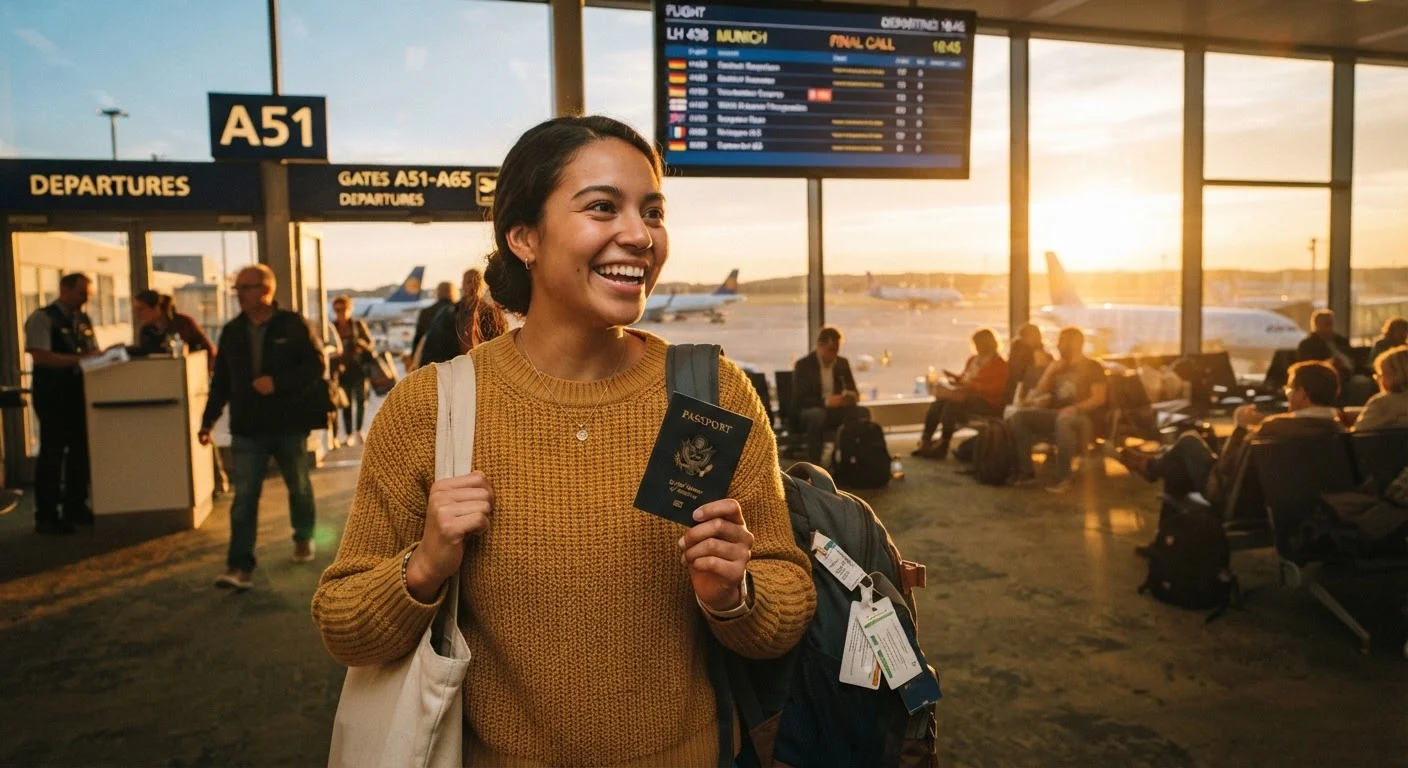
At international airports, you'll be asked to show your passport and boarding pass multiple times — at check-in, security, passport control, and the gate. Keep these documents in a dedicated, easy-to-reach spot rather than buried in your carry-on. A slim travel wallet or document pouch worn close to your body keeps things organized and reduces the risk of loss or theft in busy terminal environments.
Keep your passport and boarding passes easily accessible throughout the airport — not buried in a checked bag. A travel document wallet worn under your clothing adds security against pickpockets in crowded terminals.
Customs, Declarations, and Arriving in a Foreign Country
Landing internationally means two new queues: immigration (passport control) and customs. At immigration, an officer checks your passport and, if applicable, your visa. They may ask about your purpose of travel, how long you're staying, and where you'll be staying — straightforward questions that a little preparation makes easy to answer confidently.
Customs follows. Most countries require you to complete a declaration form listing items you're bringing in, including purchases, food, plants, and any amounts of currency above a declared threshold. Thresholds and restricted items vary by country — review the destination's customs authority website before you pack.
Declare everything honestly. Customs officers are experienced at identifying anomalies, and penalties for under-declaring or smuggling prohibited items can be severe — including fines, confiscation, or being denied entry. Once you clear customs, you're officially in your destination country. The hard part is behind you.
Cultural awareness begins the moment you step outside the airport. Our companion piece on traveling respectfully in another country is worth reading before you go.
Money, Communication, and Staying Connected Abroad
Two practical details that catch first-timers off guard: money and phone access. Before you fly, notify your bank and credit card issuers that you'll be traveling internationally. Without notification, overseas transactions may trigger fraud alerts that freeze your cards at the worst possible moment.
Understand how foreign currency and exchange rates work so airport kiosks don't catch you off guard — our piece on how currency exchange works when you travel abroad breaks this down clearly. As a general rule, ATMs affiliated with established local banks tend to offer more transparent rates than currency exchange booths in tourist areas, though fees vary.
Watch Out for Roaming Charges
International roaming fees on a standard US phone plan can be shockingly high — sometimes several dollars per minute for calls and steep per-megabyte data charges. Contact your carrier before your trip to understand your options. Failing to set up an international plan or alternative in advance is one of the most common and costly surprises for first-time international travelers.
For your phone, check with your carrier before departure. Standard domestic plans almost never include international data or calls at domestic rates — surprise roaming charges can reach hundreds of dollars. Options include adding a temporary international plan, purchasing a local prepaid SIM card on arrival, or using a Wi-Fi calling app wherever free Wi-Fi is available.
Finally, make photocopies — or encrypted digital scans — of your passport, visa, travel insurance policy, and any critical reservations. Store copies separately from the originals. If a document is lost or stolen abroad, having copies dramatically speeds up the replacement process at your nearest US embassy or consulate.
Frequently Asked Questions
Apply at least six months before your travel date. Standard processing can take 6–8 weeks, and rush processing adds cost. Renewing or applying for the first time during busy seasons can take longer, so earlier is always safer.
It depends on the destination. The US participates in visa-free or visa-on-arrival arrangements with many countries, but others require advance applications. Always check requirements on the destination country's official embassy or consulate website before booking.
You'll complete a customs declaration form listing items you're bringing into the country, including purchases and restricted goods. An officer reviews your form and may ask questions or inspect your bags. Honesty and preparation make this process straightforward.
Most modern smartphones work internationally, but standard domestic plans typically charge steep roaming fees. Before you travel, contact your carrier about an international plan, or consider purchasing a local SIM card at your destination.
For most first-time international travelers, yes. Travel insurance can cover trip cancellations, medical emergencies abroad, lost luggage, and other disruptions. Review policies carefully so you understand exactly what is and isn't covered.
Generally yes, but rules vary by country. Carry medications in original labeled containers and bring documentation from your prescribing physician. Some substances legal in the US may be controlled or prohibited elsewhere. See our guide on <a href="/travel/travel-tips/traveling-with-medications-what-you-should-know-before-crossing-borders">traveling with medications across borders</a> for detailed guidance.
The content on this site is for informational purposes only and is not a substitute for professional advice. Always consult a qualified professional for guidance specific to your situation.