

Option A
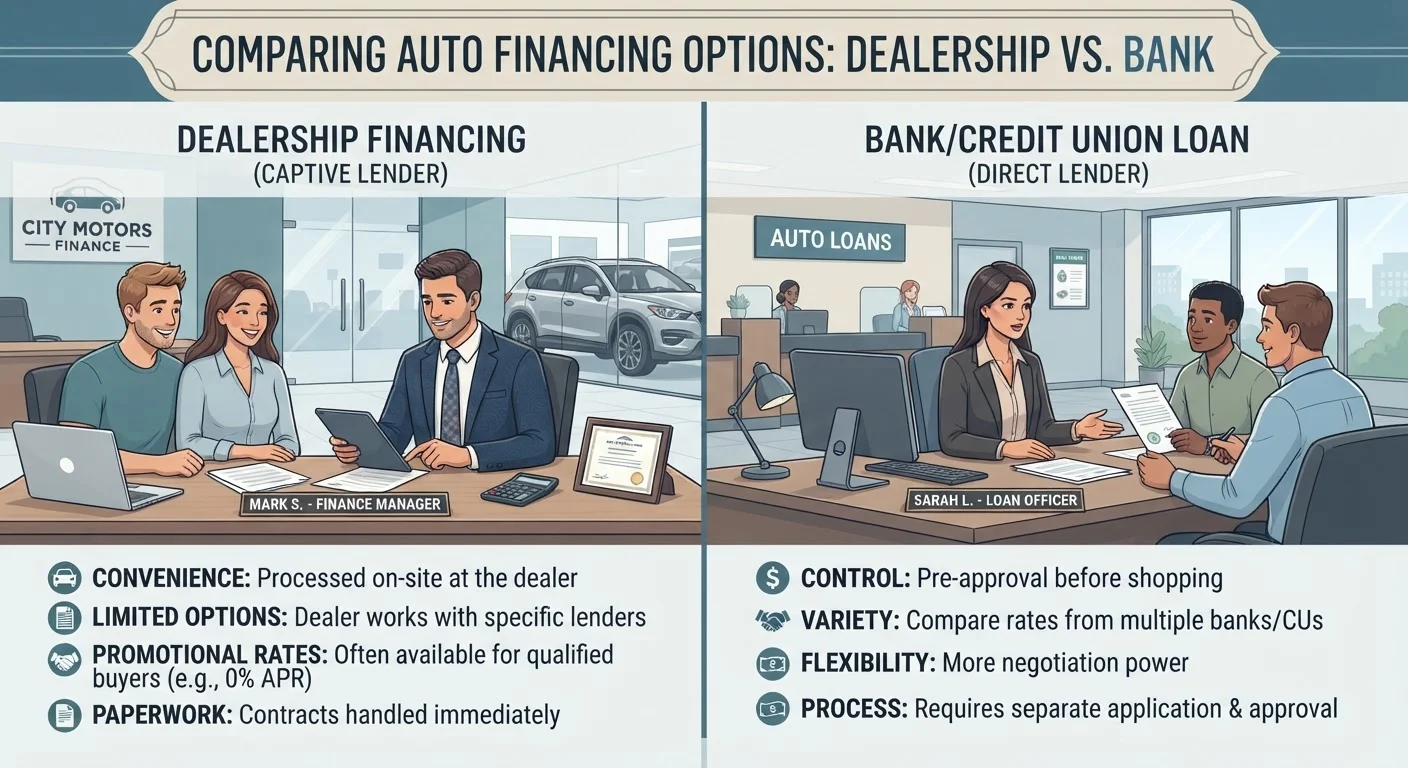
Dealer Financing
The convenient, one-stop-shop option built into the buying process.
Best for: Buyers who want to handle everything in one place and may qualify for manufacturer-subsidized rates.
Option B
Bank or Credit Union Financing
The independent route that puts rate-shopping in your hands before you arrive.
Best for: Buyers who want to negotiate from a position of strength and have an existing relationship with a lender.
How Each Financing Path Actually Works
When you finance through a dealership, the dealer submits your credit application to one or more of its lending partners - often banks, credit unions, or the automaker's own financing arm. The lender approves a rate, and the dealer may add a markup (sometimes called a "dealer reserve") before presenting the offer to you. That spread is compensation the dealer earns for arranging the loan.
When you go directly to your own bank or credit union, you apply for a pre-approval before you shop. The lender reviews your credit and income, then issues a commitment letter stating the maximum loan amount and interest rate they'll extend. You bring that to the dealership like a cash offer and pay the dealer directly from those loan funds.
Before diving into either route, it helps to understand the terminology involved. Our auto loan terms glossary breaks down APR, LTV, GAP coverage, and other financing terms in plain language.
| Criterion | Dealer Financing | Bank / Credit Union Financing |
|---|---|---|
| Where you apply | At the dealership | Directly with your lender |
| When you apply | During the purchase | Before you shop |
| Rate transparency | Dealer may mark up lender's rate | Rate quoted directly to you |
| Promotional offers | May include 0% APR specials | No manufacturer promotions |
| Negotiating position | Financing bundled with purchase | Financing separated from purchase |
| Speed of approval | Same-day, in most cases | Takes a day or more upfront |
| Lender relationship | Third-party lender chosen by dealer | Institution you already know |
The Real Advantages and Trade-Offs
Dealer financing advantages: Speed and convenience are genuine benefits. Dealers process applications quickly, and manufacturer-sponsored promotions - sometimes as low as 0% APR for well-qualified buyers - can be hard to beat. These offers are tied directly to specific models and require strong credit, but when you qualify, they represent real savings.
Dealer financing trade-offs: Because you may not know the lender's actual approved rate, it's harder to tell whether the dealer marked it up. Bundling financing with the car purchase can also make it easier to lose track of the total cost by focusing on monthly payments rather than the loan's full price.
Bank or credit union advantages: A pre-approval gives you a firm number to compare against. It also separates the two negotiations - vehicle price and financing - so you can focus on each independently. Credit unions in particular are member-owned and often offer competitive rates with lower fees.
Bank or credit union trade-offs: It takes more legwork upfront. You'll need to apply before shopping, and pre-approvals typically expire within 30 to 60 days. Your own bank may also not be the lowest-rate option, so shopping more than one institution matters.
Your credit profile shapes the offers you'll receive from either source. See how your credit score affects auto loan terms for a closer look at that relationship.
~80%
New car buyers who finance through the dealership
According to the National Automobile Dealers Association, the large majority of financed vehicle purchases are arranged at the point of sale.
0.5-2.5%
Typical dealer rate markup range
The Consumer Financial Protection Bureau has noted that dealer reserve markups commonly add between half a point and several percentage points to a buyer's interest rate.
68 months
Average new-car loan term in recent years
Experian's State of the Automotive Finance Market reports have tracked average loan terms creeping toward and past the five-year mark.
How to Approach the Decision
The most practical approach for most buyers is to get pre-approved through at least one outside lender before stepping into a dealership. That gives you a baseline rate. If the dealer can match or beat it - especially with a promotional offer - take the better deal. If not, you already have financing in place.
When comparing offers, always use the APR rather than the monthly payment as your reference point. A longer loan term lowers your monthly payment but increases the total interest you pay. Staying focused on the full cost of the loan over its life is the clearer measure.
Also consider what you're financing relative to your broader financial picture. Taking on a large auto loan while carrying high-interest debt deserves careful thought - our article on balancing debt payoff and savings goals can help you think through that trade-off. And for a full picture of what car ownership will cost beyond the loan itself, see the real cost of owning a car.
Pre-Approval Doesn't Lock You In
Getting pre-approved by your bank does not obligate you to use that loan. It simply gives you a rate benchmark and a backup plan. If the dealer's offer turns out to be better, you can decline your bank's offer at no cost. Most pre-approvals involve only a soft or limited hard credit inquiry, so shopping a few lenders in a short window typically has a minimal effect on your credit score - bureaus generally treat multiple auto loan inquiries within a 14-to-45-day window as a single inquiry.
This article is for general informational purposes only and does not constitute financial or lending advice. Consult a qualified financial professional for guidance specific to your situation.
The content on this site is for informational purposes only and is not a substitute for professional advice. Always consult a qualified professional for guidance specific to your situation.