

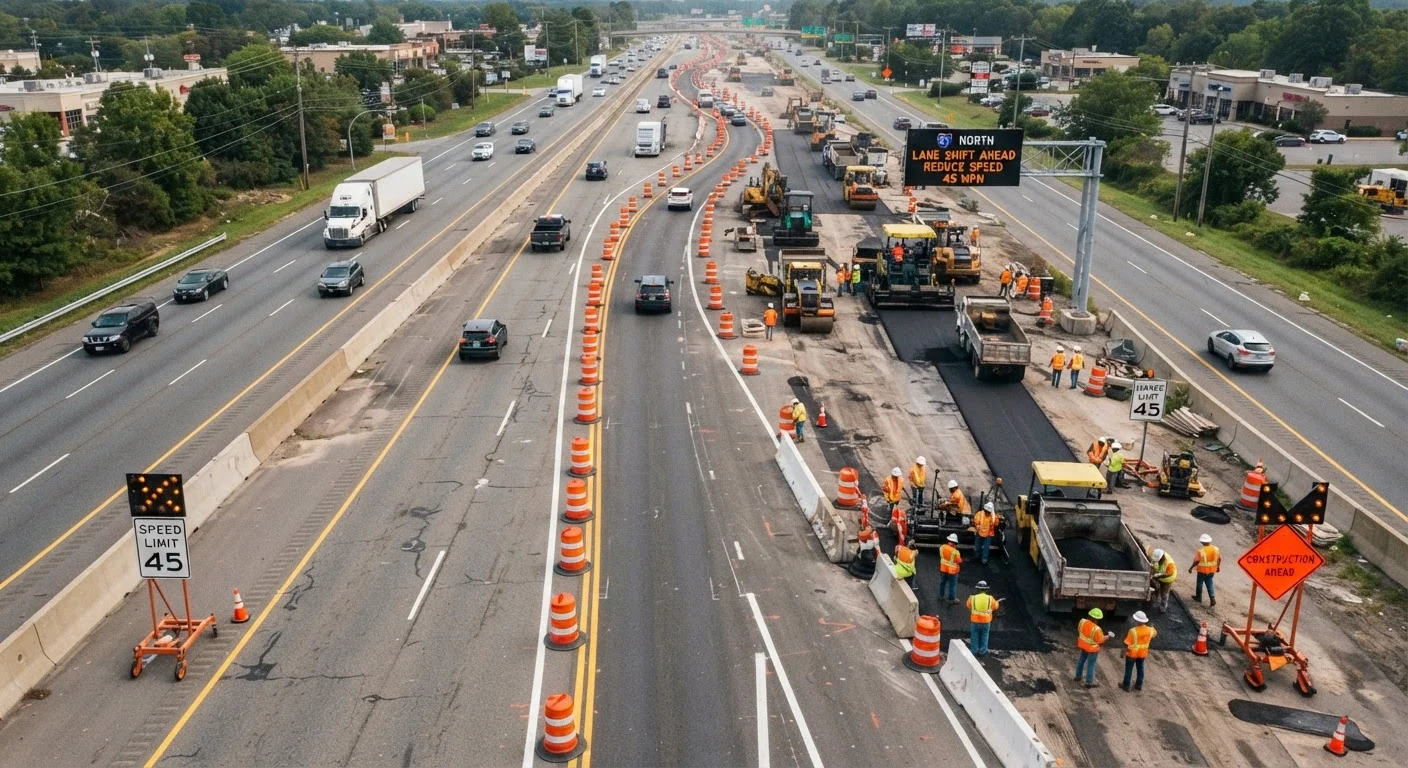
Why Construction Zones Demand a Different Mindset
Work zones aren't just an inconvenience — they're among the most dangerous stretches on American roads. According to the Federal Highway Administration, thousands of crashes occur in work zones every year, injuring drivers, passengers, and highway workers alike. The conditions that make these areas risky are predictable: narrowed lanes, abrupt speed changes, unfamiliar traffic patterns, and workers operating feet from moving vehicles.
What separates drivers who navigate work zones safely from those who don't usually comes down to preparation and attention. Speeding, tailgating, and distracted driving are consistently cited as leading causes of work-zone crashes. Understanding what the law requires — and why those requirements exist — gives you a solid foundation before you even see the first orange barrel.
The Legal Framework: What Drivers Are Required to Do
Every U.S. state has enacted some form of work zone law, though specific rules vary. These are the most widely applied requirements:
- Posted speed limits apply immediately. When you see a reduced speed limit sign at the start of a work zone, it is legally enforceable at that point — not at some arbitrary distance down the road.
- Move Over laws extend to work zones. Most states require drivers to move to a non-adjacent lane when workers, vehicles, or equipment are present on or near the shoulder. If a lane change isn't possible, you must slow to a safe speed.
- Fines are typically doubled. Nearly all states double standard traffic fines for violations that occur inside marked work zones. Some states impose mandatory minimum fines or add points to your license regardless of other circumstances.
- Flaggers have the same authority as traffic control devices. A flagger's signal — stop, slow, or proceed — carries the same legal weight as a red light. Ignoring a flagger is a traffic violation in every state.
Understanding what road signs communicate at a glance can help you recognize work zone signage before you're deep inside one.
Work Zone
A designated area of roadway where construction, maintenance, or utility work is being performed. Work zones are typically marked with orange signs, cones, or barrels and may have reduced speed limits and altered traffic patterns.
Taper
The section of a work zone where traffic lanes narrow or merge. Cones or barrels are placed in a diagonal pattern to guide drivers from a wider lane configuration into a narrower one.
Flagger
A trained worker who uses a sign or hand signals to direct traffic through or around a work zone. Their instructions are legally enforceable, the same as a traffic control device.
Move Over Law
A state law requiring drivers to vacate the lane nearest to stopped emergency vehicles, tow trucks, or roadside workers. Most states extend this requirement to active work zones.
MUTCD
Manual on Uniform Traffic Control Devices — the federal document that establishes standards for all road signs, signals, and pavement markings in the United States, including those used in work zones.
Practical Driving Behavior Inside a Work Zone
Laws set the floor; smart driving goes further. Here's what attentive behavior actually looks like once you're in the zone:
- Merge early and predictably. If a lane is closing ahead, move over as soon as it's safe — don't race to the merge point. That said, zipper merging (alternating from two lanes into one at the taper point) is often the most efficient approach when traffic is heavy. See our guide to the zipper method for how it works.
- Increase your following distance. Aim for at least a four-second gap between your vehicle and the one ahead. Sudden braking is common in work zones, and short gaps leave no margin.
- Expect the unexpected. Lane widths shrink, road surfaces change, and equipment may partially block sightlines. Treat every curve or obstruction as a potential hazard.
- Put the phone down entirely. Distraction is especially dangerous where lane margins are thin and workers are present. Many states have hands-free laws with enhanced penalties in work zones.
- Watch for workers, not just signs. Workers may be closer to traffic than you expect. Slow down when you see anyone in a high-visibility vest, regardless of whether a speed limit sign is visible yet.
Night construction adds another layer of risk. The habits that reduce night driving risk apply directly here — especially eye adjustment and headlight management.
Work Zones Don't Always Have Active Workers
Many drivers assume that if no workers are visible, the reduced speed limit doesn't apply. That's incorrect. Posted work zone speed limits are enforceable 24 hours a day, seven days a week, for the entire duration the zone is marked — whether workers are present or not. Equipment, uneven pavement, and narrowed lanes remain hazards even when the crew is off the clock.
The content on this site is for informational purposes only and is not a substitute for professional advice. Always consult a qualified professional for guidance specific to your situation.