

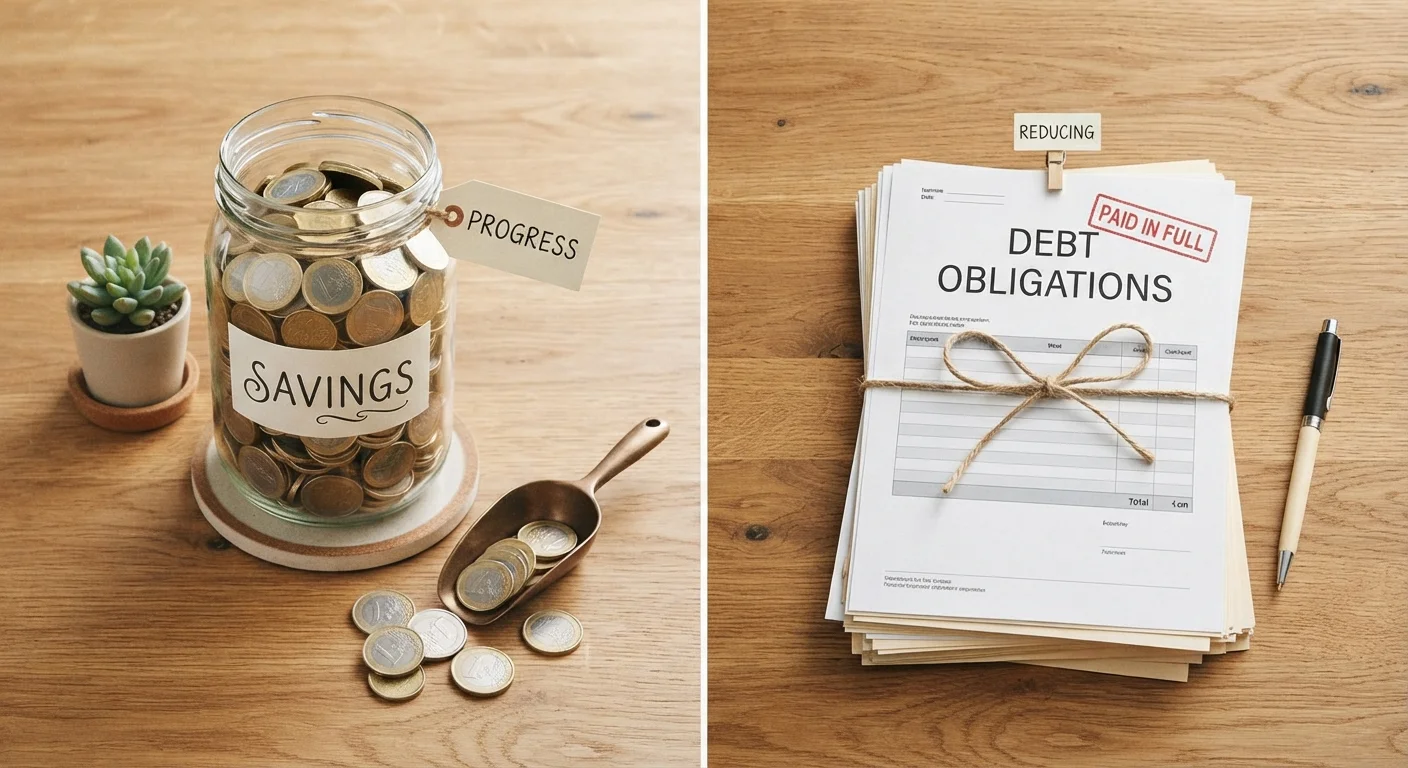
Option A
Building an Emergency Fund
The financial safety net that keeps one setback from becoming a crisis.
Best for: Anyone without a cash cushion who is vulnerable to income disruption, unexpected expenses, or high-interest borrowing if something goes wrong.
Option B
Paying Down Debt
The interest-erasing strategy that frees up permanent cash flow over time.
Best for: Anyone carrying high-interest debt whose interest charges are outpacing what savings could realistically earn.
Why This Decision Is Harder Than It Looks
Most personal finance advice makes the emergency fund vs. debt payoff question sound simple. In reality, it sits at the intersection of math, psychology, and personal risk — and there is no single right answer for everyone.
The core tension is this: every dollar parked in a savings account earns a modest return, while every dollar left on a high-interest debt keeps accruing charges. Mathematically, eliminating a 20% APR credit card balance beats earning 4–5% in a high-yield savings account. But math alone ignores what happens when your car breaks down and you have no cash — you borrow again, potentially at an even higher rate.
Understanding your own situation requires looking honestly at three variables: your interest rates, your income stability, and your existing savings balance. The factors that shape this trade-off are worth examining carefully before committing to either path.
This article is for general informational and educational purposes only and does not constitute personalized financial advice. Consult a qualified financial professional for guidance specific to your circumstances.
The Case for Building Your Emergency Fund First
An emergency fund is essentially insurance against debt. Without one, every unexpected expense — a medical copay, a broken appliance, a gap between jobs — becomes a potential borrowing event. That borrowing usually costs far more than the original expense.
Financial educators and consumer advocates frequently cite a common starting target of approximately $1,000 as a meaningful first milestone, enough to handle many common emergencies without reaching for a credit card. The full conventional target — three to six months of essential living expenses — is a longer-term goal.
~40%
Americans who cannot cover a $400 emergency with cash
According to Federal Reserve research on household economic well-being, a significant share of U.S. adults would struggle to cover a modest unexpected expense without borrowing.
3–6 months
Conventional emergency fund target (living expenses)
Consumer financial education resources, including those from the CFPB, commonly recommend saving three to six months of essential expenses as a fully funded emergency reserve.
20%+
Typical credit card APR range
Federal Reserve consumer credit data tracks average credit card interest rates, which have historically sat well above what low-risk savings accounts offer.
The argument for saving first is strongest when you have no existing emergency buffer, work in an industry with high layoff risk, or are self-employed with variable income. The challenges of irregular income make a cash reserve especially critical, since a lean month without savings can quickly spiral into missed minimum payments and penalty fees.
There is also a psychological argument: having even a small cushion reduces financial anxiety and makes it easier to stick to a debt payoff plan without panicking when something goes wrong.
The Case for Paying Down Debt First
When interest rates on your debt are high, every month you delay payoff is money lost. Credit card APRs commonly range from 18% to 29% or higher, according to Federal Reserve consumer credit data. No federally insured savings account currently matches that return. Paying down a 22% APR balance is, in effect, a guaranteed 22% return on that dollar — something no low-risk savings vehicle can offer.
The real cost of minimum payments illustrates how quickly interest accumulates. A $5,000 balance at 20% APR, paid with only minimum payments, can take over a decade to eliminate and cost thousands in interest charges alone.
| Criterion | Building an Emergency Fund | Paying Down Debt |
|---|---|---|
| Primary benefit | Protects against new debt from surprises | Eliminates ongoing interest charges |
| Financial return | Modest (savings account yield) | Equals the debt's interest rate (guaranteed) |
| Best when debt interest rate is | Low (below ~7–8%) | High (above ~7–8%) |
| Income stability needed | Lower — cushion compensates for risk | Higher — assumes no emergency backup needed |
| Psychological benefit | Reduces anxiety and financial vulnerability | Reduces total obligations and monthly pressure |
| Risk if skipped | One emergency creates new high-interest debt | Interest compounds, total debt grows over time |
| Ideal starting point | When no savings buffer exists at all | When a basic emergency fund is already in place |
The debt-first argument is most compelling when your emergency fund already covers at least one month of expenses, your employment is stable, and your debt carries an interest rate well above what savings could realistically earn. For those managing student loans alongside other goals, the calculus shifts — see the framework for balancing student loan repayment with other priorities.
The Middle Path: Doing Both at Once
For many households, the most practical answer is neither purely one nor the other. A split approach — directing a portion of extra dollars to savings and a portion to debt — captures benefits from both strategies simultaneously.
A common framework is to build a starter emergency fund first (around $1,000), then focus heavily on high-interest debt payoff, then return to building the full emergency fund to three to six months of expenses. This sequence limits vulnerability while still attacking costly debt efficiently.
The pay-yourself-first budgeting approach can support a split strategy by automating both a savings transfer and an extra debt payment each month before discretionary spending begins. If budgeting frameworks help you structure this, the 50/30/20 rule offers one starting point — though it works better for some income levels than others.
When to Revisit Your Balance
Life changes — a new job, a raise, a family addition — should trigger a review of how you split extra dollars between saving and debt. What made sense at one income level or debt load may not be optimal six months later. Building a brief quarterly check-in into your budgeting routine helps keep the strategy aligned with your current reality. A licensed financial planner can also help you model specific scenarios if the decision feels complex.
Once your emergency fund and debt payoff plan are operating together as a system, you may find that saving and credit reinforce each other in ways that accelerate overall financial progress.
Making the Decision for Your Situation
There is no universal formula, but the following questions can help you clarify your own priorities:
- What is the interest rate on your debt? Rates above roughly 7–8% generally favor aggressive payoff over saving in a standard account.
- How stable is your income? Variable or uncertain income argues strongly for a larger emergency buffer before accelerating debt payments.
- Do you have any savings at all? If the answer is no, a small starter fund — even $500 to $1,000 — is typically the first move.
- Is your debt growing? If minimum payments are barely covering interest charges, that demands immediate attention before savings goals can progress meaningfully.
Once you have a direction, a realistic debt payoff plan can help you map specific balances, interest rates, and timelines. For comparing the two major payoff methods available, the debt avalanche and debt snowball strategies each suit different personality types and debt structures.
The most important step is to make a deliberate choice rather than letting inertia decide — which is how most households end up with neither meaningful savings nor meaningful debt reduction.
The content on this site is for informational purposes only and is not a substitute for professional advice. Always consult a qualified professional for guidance specific to your situation.