

The Mental Model Most People Start With — and Why It's Wrong
Ask most Americans what a household budget is and they describe something like a punishment: a rigid list of rules that eliminates every enjoyable purchase. Under this mental model, budgeting means deprivation. It's no surprise, then, that many people resist it.
This framing is fundamentally mistaken. A budget does not decide what you cannot spend money on. It decides — in advance, deliberately — what you will spend money on. That's a meaningful difference. One framing takes away control; the other gives it back.
A second widespread misconception is that budgeting is only for households struggling with debt or living paycheck to paycheck. In reality, a budget is a neutral planning tool, the same way a calendar is a neutral scheduling tool. It has nothing to do with how much money you have — only with how intentionally you direct it.
Budgets and Spending Logs Are Different Tools
A spending log records past transactions; a budget projects future ones. Both are valuable, but they serve different purposes. Use your spending history as data to build a realistic budget — then let the budget guide your decisions going forward. Conflating the two is one of the most common reasons people feel their budget 'isn't working.'
For a full fact-check of the most stubborn budgeting myths, see Budgeting Myths That Keep People Stuck.
What a Household Budget Actually Consists Of
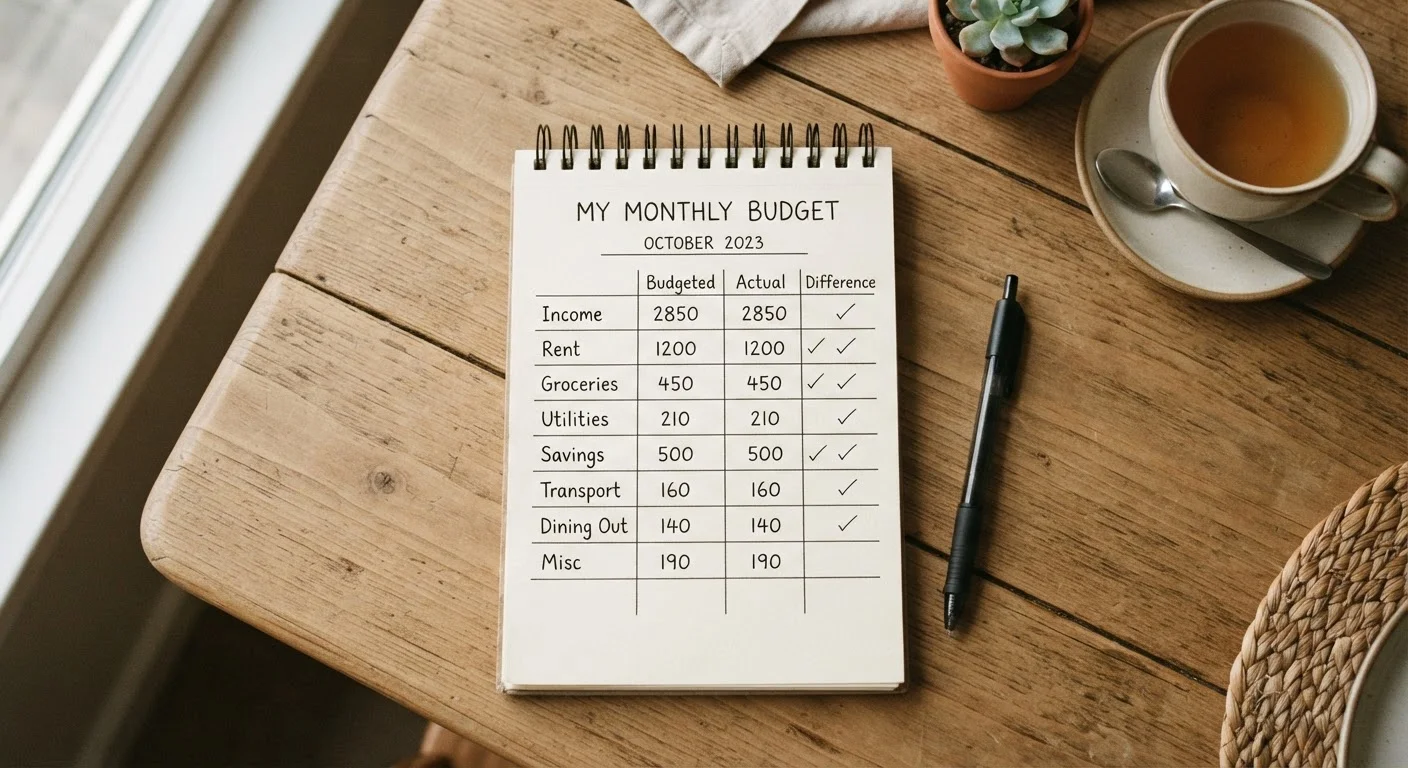
A functional household budget has three components: income, expenses, and the gap between them.
- Income includes every reliable source of money coming in — wages, freelance earnings, government benefits, rental income, or other regular receipts.
- Expenses are divided into fixed costs (rent, loan payments, insurance premiums — amounts that don't change month to month) and variable costs (groceries, utilities, fuel, dining — amounts that fluctuate).
- The gap is what remains after expenses are subtracted from income. A positive gap is your opportunity to save or pay down debt. A negative gap means expenses exceed income and adjustments are necessary.
The gap is where a budget does its most important work. Without calculating it, most households never know whether they are building financial ground or slowly losing it.
~33%
Americans with a written monthly budget
Surveys by organizations including Gallup have consistently found that fewer than one in three American adults maintains a detailed written household budget.
$6,081
Average monthly household expenditure
According to the U.S. Bureau of Labor Statistics Consumer Expenditure Survey, the average American consumer unit spends roughly this amount monthly, underscoring the scale of spending a budget is designed to manage.
78%
Workers living paycheck to paycheck at some income level
Research from multiple financial wellness surveys has found high rates of paycheck-to-paycheck living even among workers earning six figures, suggesting income alone does not resolve cash-flow challenges that budgeting addresses.
Understanding your spending categories in detail is the foundation of any honest budget. Where Your Money Is Actually Going Each Month provides a practical breakdown of the spending categories that make up a typical American household.
A Budget Is a Plan, Not a Record
One of the most common operational errors is confusing a budget with an expense log. An expense log records what you already spent. A budget projects what you intend to spend. They serve opposite directions in time.
This distinction matters because a record of past spending cannot change behavior — it can only describe it. A plan for future spending, by contrast, creates a decision framework you can consult before spending happens. The question shifts from "how did I spend?" to "how will I spend?"
“A budget is telling your money where to go instead of wondering where it went.”
— Dave Ramsey, Personal finance author and radio host
Tracking past spending is excellent input data for constructing a budget, but it is not the budget itself. Your budget should be built before the month begins, not assembled from receipts after it ends.
Once you understand the structure, building your first formal plan is straightforward. Your First Budget in Seven Steps walks through the process from income to final targets in clear, manageable steps.
Why Budgets Often Underperform — and How to Avoid It
Even households that build an accurate budget often abandon it within weeks. The failure is rarely mathematical. It typically comes from a few predictable planning errors: underestimating variable expenses, ignoring irregular costs like annual subscriptions or car registration, or treating the budget as a fixed document rather than a flexible monthly plan.
Account for Irregular Expenses Upfront
Annual costs like car registration, holiday gifts, or insurance premiums can derail a budget that only plans month to month. Divide each irregular annual expense by 12 and include that amount as a monthly line item. This spreads the cost evenly and eliminates unpleasant surprises.
One category consistently catches households off guard: discretionary spending. Dining out, streaming services, impulse purchases — these costs accumulate quickly in the gaps between fixed bills. Discretionary Spending: The Budget Category People Underestimate Most covers how to track and manage them honestly.
A budget that accounts for real life — including occasional extras and irregular expenses — is far more durable than a perfect-on-paper plan that ignores how people actually live. If early budgets fail to stick, Why Budgets Fail in Month Two identifies the specific planning errors behind most early dropouts and how to correct them.
This article is for general informational and educational purposes only and does not constitute personalized financial advice. Consult a qualified financial professional for guidance specific to your situation.
Frequently Asked Questions
A household budget's core purpose is to align your spending decisions with your financial priorities before money is spent. It helps you avoid running out of money unexpectedly, save toward goals, and reduce financial stress. Without a plan, spending tends to expand to fill available income.
Yes. Higher income does not automatically produce financial security — lifestyle inflation can absorb raises quickly. A budget helps anyone, regardless of income, ensure money is directed toward goals like saving, investing, or debt payoff rather than disappearing into untracked spending.
No, though they work together. Tracking records where money already went; a budget plans where money will go. Tracking past spending is useful data for building a budget, but the plan itself is always forward-looking.
At minimum, revisit your budget every month, since income and expenses change regularly. Major life changes — a new job, a move, a new family member — warrant an immediate review. Treating a budget as a living document, not a one-time task, is what makes it sustainable.
Going over in one category simply means adjusting another category to compensate — money is finite, so a change somewhere requires a change elsewhere. This is normal and expected. The goal is not perfect adherence but honest awareness and deliberate adjustment.
The content on this site is for informational purposes only and is not a substitute for professional advice. Always consult a qualified professional for guidance specific to your situation.