

Why Minimum Payments Feel Manageable But Aren't
Credit card minimum payments are intentionally designed to be affordable. A $3,000 balance at a 20% APR might carry a minimum payment of just $60–$75 per month — a figure that fits comfortably into most household budgets. But that apparent comfort comes at a steep hidden price.
When you pay only the minimum, the bulk of that payment goes toward interest charges, not the principal you actually owe. In the early months of repayment, the vast majority of your payment can be consumed by interest alone, leaving only a small fraction to chip away at the balance itself. This slow-motion payoff is precisely how issuers earn revenue from revolving debt.
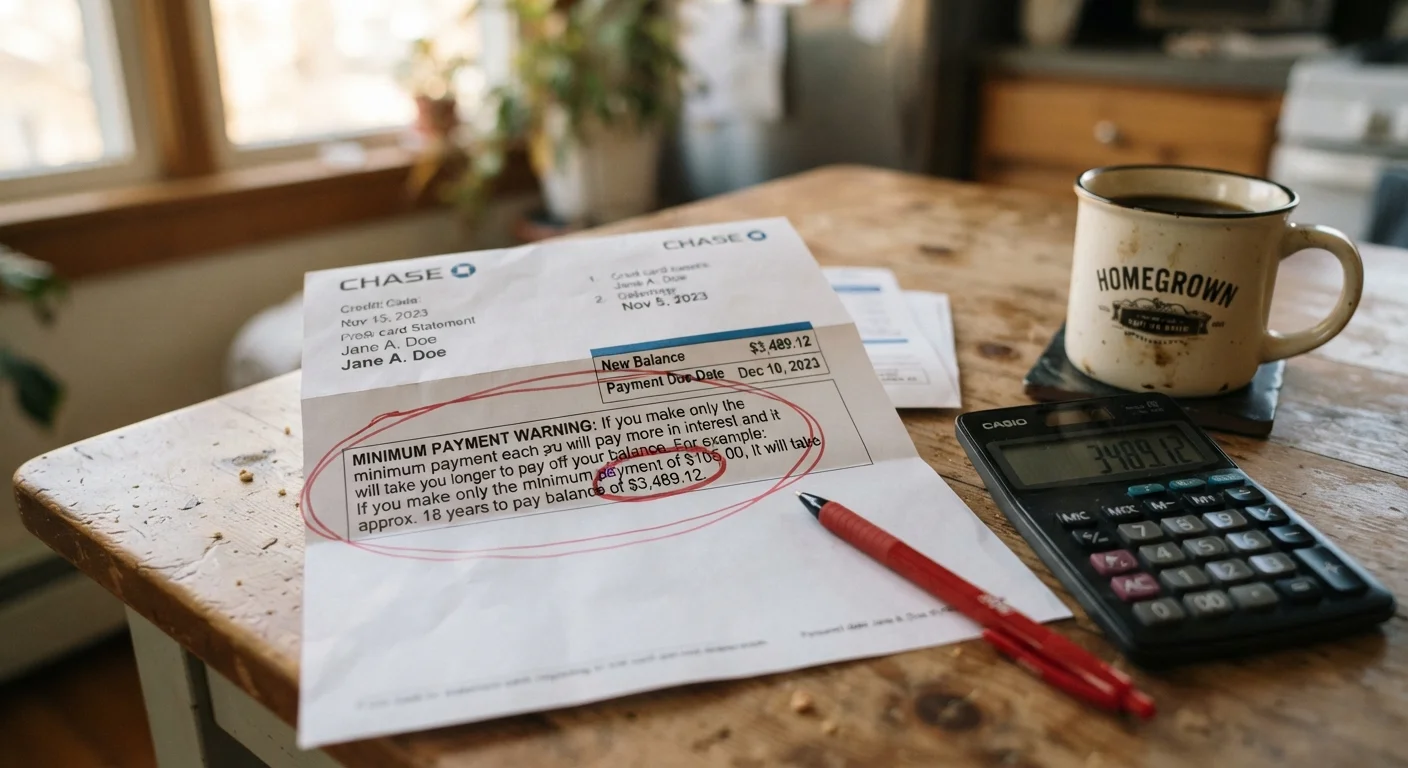
Check Your Statement's Minimum Payment Warning
Federal law requires credit card issuers to include a minimum payment disclosure on every statement. This box shows how long repayment will take and the total interest cost if you pay only the minimum. It's one of the most actionable pieces of information on your entire statement — and one of the most overlooked.
To see this dynamic clearly, consider a concrete scenario: a $3,000 balance at 20% APR, paying the minimum each cycle as it decreases. According to standard amortization math, repayment could stretch beyond 10 years, and total interest paid could approach or exceed the original balance — sometimes more than doubling what you actually spent.
How Interest Accumulates on a Revolving Balance
Credit card interest is typically calculated using a daily periodic rate — your annual APR divided by 365 — applied to your average daily balance each billing cycle. Because credit card APRs in the United States have trended well above 20% in recent years (according to Federal Reserve consumer credit data), even a few months of minimum-only payments can add up quickly.
20%+
Average U.S. credit card APR in recent years
Federal Reserve consumer credit data has shown average credit card interest rates exceeding 20% annually in the current rate environment.
~1–3%
Typical minimum payment as a percentage of balance
Most major card issuers set minimum payments at 1–3% of the outstanding balance or a flat minimum fee, whichever is greater.
10+ years
Estimated payoff time on $3,000 balance at minimum payments
Standard amortization calculations show a $3,000 balance at approximately 20% APR can take a decade or longer to repay if only minimum payments are made.
Here's the structural problem: as your balance decreases slightly each month, your minimum payment also decreases. This means you're paying less and less toward principal over time. The slower the paydown, the longer interest has to compound. It's a cycle that keeps balances alive far longer than most cardholders expect.
This is why the Consumer Financial Protection Bureau (CFPB) requires credit card statements to include a minimum payment warning — a disclosure showing how long repayment will take and the total cost if you pay only the minimum each month. Many cardholders skip over this box, but it contains genuinely useful information worth reading.
The Real Dollar Cost: What You're Actually Paying
To make this tangible, consider two approaches to a $5,000 balance at 22% APR:
- Minimum payments only: Repayment could stretch 15 or more years, with total interest paid potentially exceeding $4,000 — nearly doubling the original debt.
- Fixed payment of $150/month: The balance could be cleared in roughly 4 years, with total interest closer to $1,500 — a savings of more than $2,500.
That gap — thousands of dollars and over a decade of payments — is the true cost of defaulting to the minimum. And it doesn't require a dramatic change in behavior to close. Paying even $20–$30 more than the minimum each month meaningfully accelerates the payoff timeline.
For those weighing how to allocate limited dollars, it's worth exploring the trade-offs between paying down debt and building savings. See our guide on emergency funds versus debt payoff for a framework to help you decide.
A Simple Rule: Always Pay More Than the Minimum
If you can only afford a small increase, even $10–$20 above the minimum each month makes a measurable difference over time. Set that higher amount as a recurring auto-pay and treat it like a fixed bill. Over months and years, the compounding benefit of consistent overpayment adds up significantly.
Practical Steps to Break the Minimum Payment Cycle
Understanding the cost is the first move. Taking action is the second. Here are evidence-based approaches to reduce what you'll ultimately pay:
- Pay a fixed dollar amount, not the minimum. Set a payment amount based on what you can realistically afford — and keep it fixed even as the minimum drops. This single change accelerates principal reduction substantially.
- Use the debt avalanche or snowball method. The avalanche method targets the highest-APR balance first, minimizing total interest. The snowball method pays off the smallest balance first for psychological momentum. Both outperform minimum-only payments by a wide margin.
- Explore consolidation carefully. Transferring balances or consolidating debt may lower your effective interest rate, but comes with trade-offs. Our overview of debt consolidation explains when it helps and when it doesn't.
- Build a structured payoff plan. If you're unsure where to start, a step-by-step framework can help. See our guide to building a debt payoff plan for a practical approach.
For a deeper look at why this pattern is so common — and the psychology behind it — why minimum payments keep people in debt longer than expected is worth reading alongside this article.
This article is for general informational and educational purposes only and does not constitute personalized financial or legal advice. Consult a qualified financial professional for guidance tailored to your specific situation.
Frequently Asked Questions
Most issuers use one of two methods: a flat dollar amount (often $25–$35) or a percentage of your outstanding balance (typically 1–3%), whichever is greater. Some also add any fees or interest charged that cycle to ensure the account doesn't fall further behind.
Paying at least the minimum on time keeps your account in good standing and avoids late-payment marks on your credit report. However, consistently carrying a high balance relative to your credit limit — known as a high credit utilization ratio — can negatively affect your score over time.
Any amount above the minimum goes directly toward reducing your principal balance, which lowers the interest charged in future cycles. Even a modest extra payment each month can shorten your repayment timeline considerably and save a meaningful amount in total interest.
At a typical APR around 20% and with minimum payments that decrease as the balance falls, a $3,000 balance could take roughly 10 or more years to pay off entirely. The exact timeline depends on your card's specific terms, but online minimum payment calculators can give you a personalized estimate.
There are situations — such as a financial emergency — where making only the minimum temporarily is better than missing a payment. However, it should be a short-term adjustment, not a long-term habit. Consistently paying the minimum is one of the most expensive ways to manage credit card debt.
The content on this site is for informational purposes only and is not a substitute for professional advice. Always consult a qualified professional for guidance specific to your situation.