

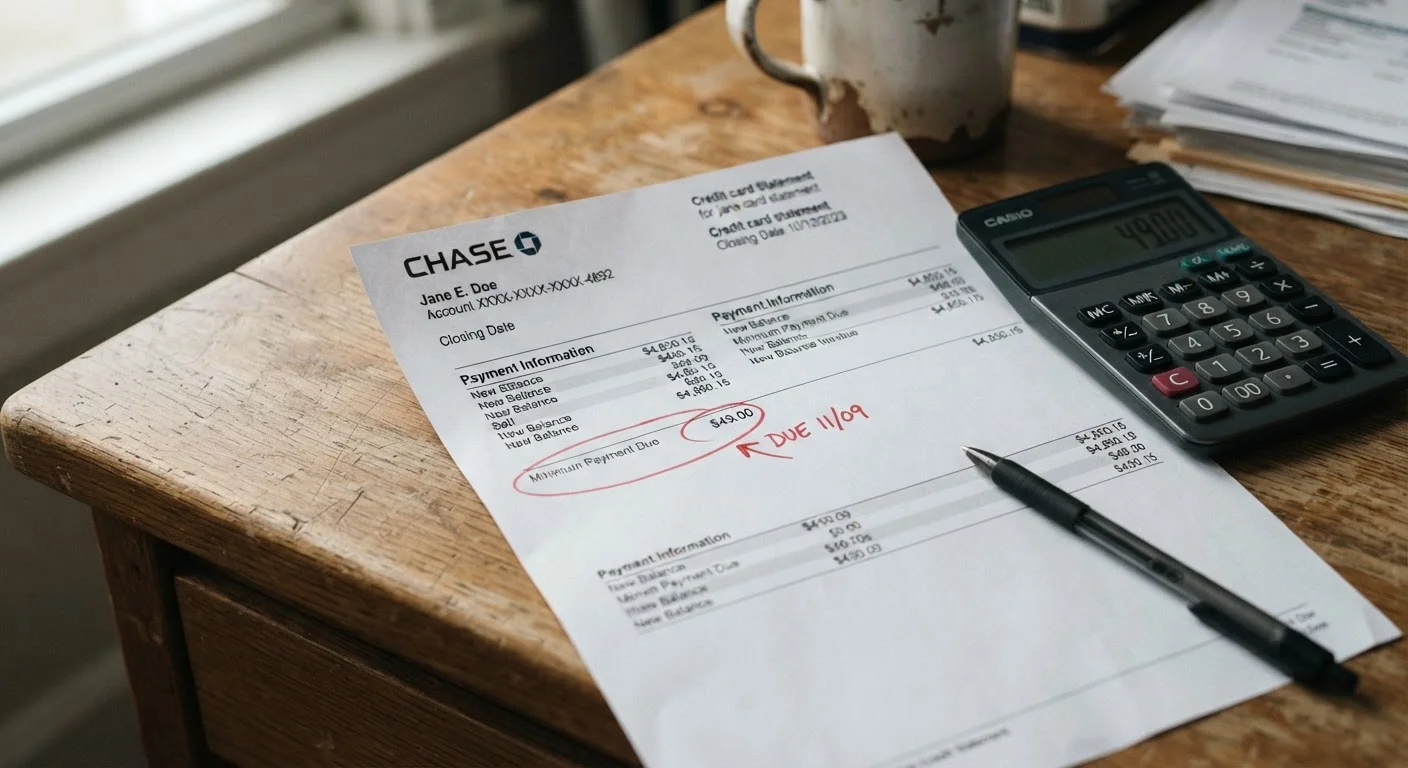
How Minimum Payments Are Actually Calculated
Most credit card issuers set the minimum payment as either a flat dollar amount (often $25–$35) or a small percentage of the outstanding balance — typically 1% to 2% — plus any interest and fees accrued that month. Whichever figure is higher becomes your minimum due.
Here's the trap: as your balance falls, so does the minimum payment. That sounds like good news, but it means you're perpetually paying just enough to satisfy the lender — not enough to meaningfully reduce what you owe. The principal shrinks slowly while interest keeps accumulating on the remaining balance.
Understanding this mechanic is the foundation of smarter repayment. The Saving & Credit hub covers related concepts, including how payment history shapes your credit score over time.
The Math That Makes Minimum Payments So Costly
Consider a concrete example: a $3,000 credit card balance at a 20% annual percentage rate (APR). If you make only the minimum payment each month — starting around $75 and declining as the balance drops — you could spend more than 14 years paying it off and fork over well over $3,000 in interest alone. That means you'd pay roughly double the original balance.
14+ years
Time to pay off $3,000 at 20% APR on minimums
Based on standard minimum payment calculations starting at roughly 2% of balance plus interest, as modeled by consumer finance educators.
~$3,300+
Estimated interest paid on that same $3,000 balance
Interest projections using a 20% APR with declining minimum payments illustrate how total repayment can exceed double the original balance.
The Credit CARD Act of 2009 requires issuers to print a "minimum payment warning" on every statement, showing the payoff timeline and total interest cost if you pay only the minimum. Most people glance past it. Reading that box carefully is one of the most clarifying moments in personal finance.
For a deeper look at how interest compounds over time on revolving balances, see the real cost of minimum payments on credit card debt.
Common Mistakes That Keep Balances From Falling
Minimum payments aren't the only behavior that extends debt repayment. Several related habits compound the problem — often without the cardholder realizing it.
Continuing to charge new purchases while paying down a balance.
Why it happens: People view the credit card as an available spending tool and don't mentally separate existing debt from new spending.
Treating the minimum payment as the default 'correct' amount to pay.
Why it happens: Statements highlight the minimum payment prominently, and it feels like paying it means you're handling the debt responsibly.
Ignoring the interest rate when deciding which balance to pay down first.
Why it happens: People often target the largest balance because it feels most urgent, without considering which debt is actually costing the most per month.
Skipping a larger payment when a minimum-only month feels financially tight.
Why it happens: Inconsistent income or unexpected expenses make it tempting to revert to the minimum to preserve cash, turning an exception into a habit.
Your Statement Already Shows the True Cost
Federal law requires credit card issuers to include a minimum payment warning on every billing statement. This box shows how many years it will take to pay off your balance and the total interest cost if you pay only the minimum each month. Reviewing this disclosure — rather than skipping past it — can be a powerful motivator for increasing your monthly payment.
Once you understand these patterns, it becomes easier to interrupt them. Structured payoff methods like the debt avalanche and debt snowball give your extra payments a deliberate direction. The debt avalanche and debt snowball, explained article walks through both approaches in plain language.
Practical Steps to Accelerate Payoff
You don't need a large windfall to escape the minimum-payment cycle. Small, consistent increases in your monthly payment have an outsized effect because they reduce the principal faster — which in turn reduces the interest charged the following month.
A general approach: identify a fixed payment amount you can commit to regardless of what the minimum is that month. Even paying $50 more than the minimum on a $3,000 balance at 20% APR can cut years off the repayment timeline and save hundreds in interest.
Avoid Pausing Payments Entirely During Hardship
If money is tight, it may be tempting to skip a payment altogether rather than pay less than planned. Missing a payment triggers late fees, a potential penalty APR (often 29% or higher), and a negative mark on your credit report. Always pay at least the minimum — and contact your issuer early if you're struggling, as many have hardship programs that can temporarily reduce your rate or waive fees.
If you're unsure where to start, building a realistic debt payoff plan from scratch offers a step-by-step framework for mapping out every balance and setting a repayment priority. It's also worth thinking through whether maintaining an emergency fund alongside debt payoff makes sense for your situation — Emergency Fund vs. Paying Off Debt explores that trade-off directly.
This article is for general informational and educational purposes only and does not constitute personalized financial advice. Consult a qualified financial professional for guidance specific to your situation.
The content on this site is for informational purposes only and is not a substitute for professional advice. Always consult a qualified professional for guidance specific to your situation.