

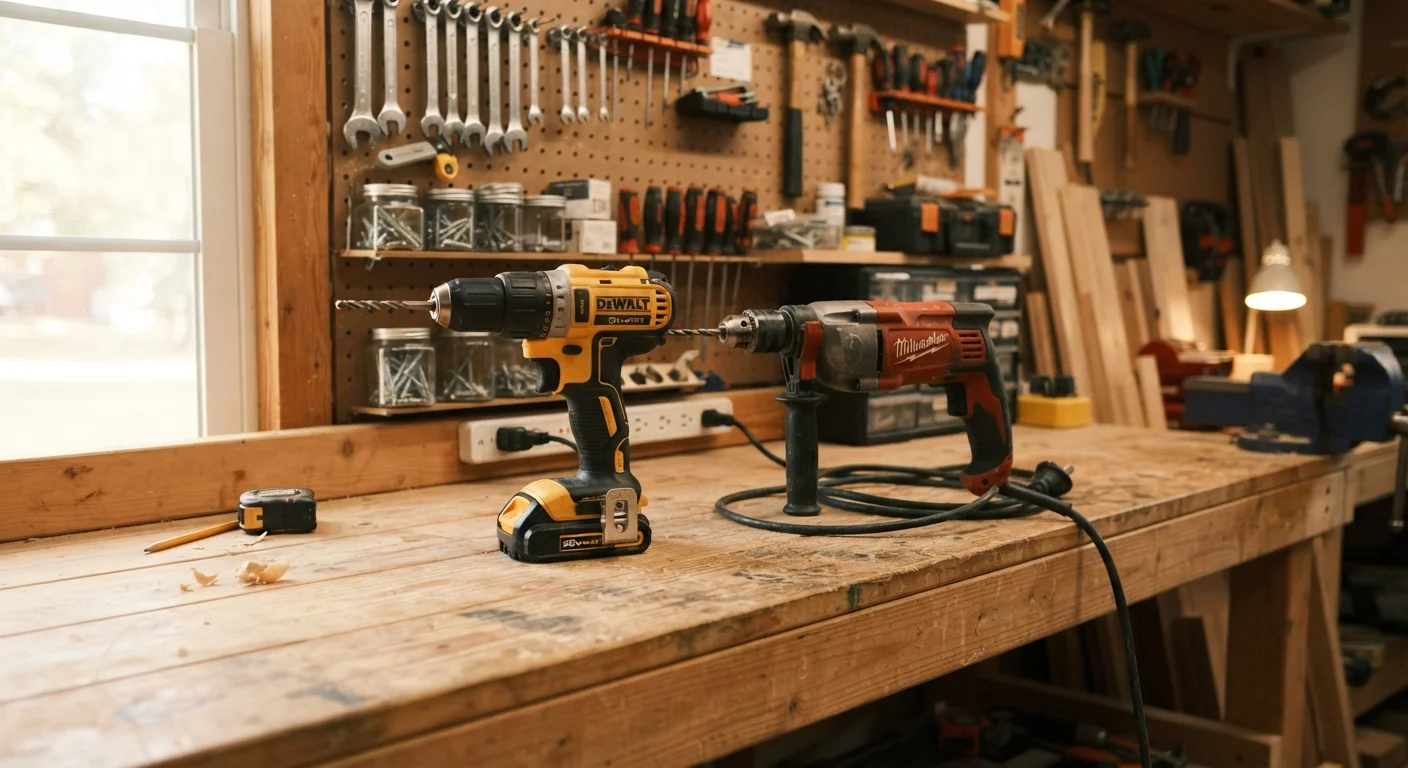
Option A
Cordless Drill
The flexible, go-anywhere everyday workhorse.
Best for: Homeowners who tackle a wide range of light-to-medium repairs and projects around the house, especially away from outlets.
Option B
Corded Drill
The consistent-power specialist for sustained, heavy-duty tasks.
Best for: Projects requiring continuous, uninterrupted power — like drilling through masonry, thick lumber, or metal over extended periods.
What Actually Separates These Two Tools
At their core, both drill types spin a bit to bore holes or drive fasteners. The real difference lies in how they receive power — and that shapes nearly every practical consideration: weight, runtime, torque delivery, and where you can use them.
A cordless drill runs on a rechargeable battery pack, typically rated at 12V, 18V, or 20V. Higher voltage generally means more torque capacity, though battery quality and motor design also matter. The freedom to move untethered is the defining advantage: you can climb a ladder, work inside a tight cabinet, or step into the backyard without dragging a cord.
A corded drill draws power directly from a wall outlet, meaning its performance doesn't degrade as a session wears on. There's no battery to charge, no runtime limit — just consistent amperage as long as it's plugged in. The trade-off is obvious: you're always within reach of an outlet and managing a cord in your workspace.
| Criterion | Cordless Drill | Corded Drill |
|---|---|---|
| Power source | Rechargeable battery (12V–20V+) | Direct outlet connection |
| Portability | Fully portable, no outlet needed | Limited by cord length and outlet location |
| Runtime | Limited by battery charge | Unlimited while plugged in |
| Sustained torque | Decreases as battery drains | Consistent throughout use |
| Weight | Heavier (battery adds 1–2 lbs) | Generally lighter body weight |
| Best task type | General repairs, mixed locations | Extended heavy-duty or masonry work |
| Long-term cost | Battery replacement over time | Fewer consumable components |
Performance and Power: Closing the Gap
For years, corded drills held a clear power advantage. That gap has narrowed considerably with the rise of brushless motors and high-capacity lithium-ion batteries. A quality brushless cordless drill at 18V–20V delivers enough torque for framing, cabinetry work, and most structural fasteners a homeowner encounters.
Where corded drills still hold an edge is in sustained heavy use. Drilling multiple holes through concrete, running long screws into dense lumber repeatedly, or using a hole-saw for extended periods will drain a battery noticeably faster than a corded tool would tire. If that describes your typical Saturday project, the corded format earns its place.
18V–20V
Common cordless voltage for home use
Most tool manufacturers now offer their primary homeowner-focused lines in this voltage range, which handles the majority of residential tasks.
~30–60 min
Typical runtime per battery charge
Runtime varies by task intensity and battery capacity (Ah rating); high-demand tasks like masonry drilling consume charge significantly faster.
For the typical homeowner — hanging a TV mount, building a raised garden bed, assembling flat-pack furniture — battery capacity is rarely the limiting factor in a modern cordless drill.
Practical Considerations for Home Repair Use
Beyond raw power, a few practical realities shape which format fits your life.
- Storage and portability: Cordless drills store easily in a drawer or bag and travel anywhere. Corded drills are bulkier to manage in tight spaces.
- Readiness: A corded drill is always ready; a cordless one needs a charged battery. Keeping a spare battery on the charger eliminates most of this concern.
- Weight: Battery packs add weight — typically 1–2 lbs — which matters during overhead work or prolonged sessions. Many users find this a fair trade for cord freedom.
- Cost over time: Batteries degrade and eventually need replacement, adding a long-term cost. Corded drills have fewer consumable components.
It's also worth thinking about the broader principle of matching your tools to your actual tasks. Just as knowing which jobs to tackle yourself keeps DIY work safe and productive, choosing the right drill format keeps your projects efficient and frustration-free.
A Note on Hammer Drills and Impact Drivers
A standard drill — cordless or corded — is not the same as a hammer drill or an impact driver. Hammer drills add a percussive action for masonry; impact drivers deliver rotational bursts ideal for driving long screws. If your project involves concrete anchors or heavy fastening, make sure you're using the right drill type for the job, not just the right power format.
When to Reach for Each — and When to Call a Pro
Most common home repair tasks — anchoring shelves, replacing door hardware, running screws into studs, drilling pilot holes before nailing — sit comfortably within cordless territory. For the occasional concrete anchor or heavier task, renting a hammer drill (corded or cordless) may be smarter than buying a specialty tool outright.
It's worth noting that some home projects go beyond what any drill alone can accomplish safely. Tasks involving electrical systems, for example, carry real risk. Our guide on what's realistic with DIY electrical work helps you understand where confident homeowner work ends and a licensed electrician begins.
The drill itself is simply a tool — used well within appropriate projects, either format can serve you reliably for years. Focus first on the task, then let the task tell you which format makes sense.
The content on this site is for informational purposes only and is not a substitute for professional advice. Always consult a qualified professional for guidance specific to your situation.