

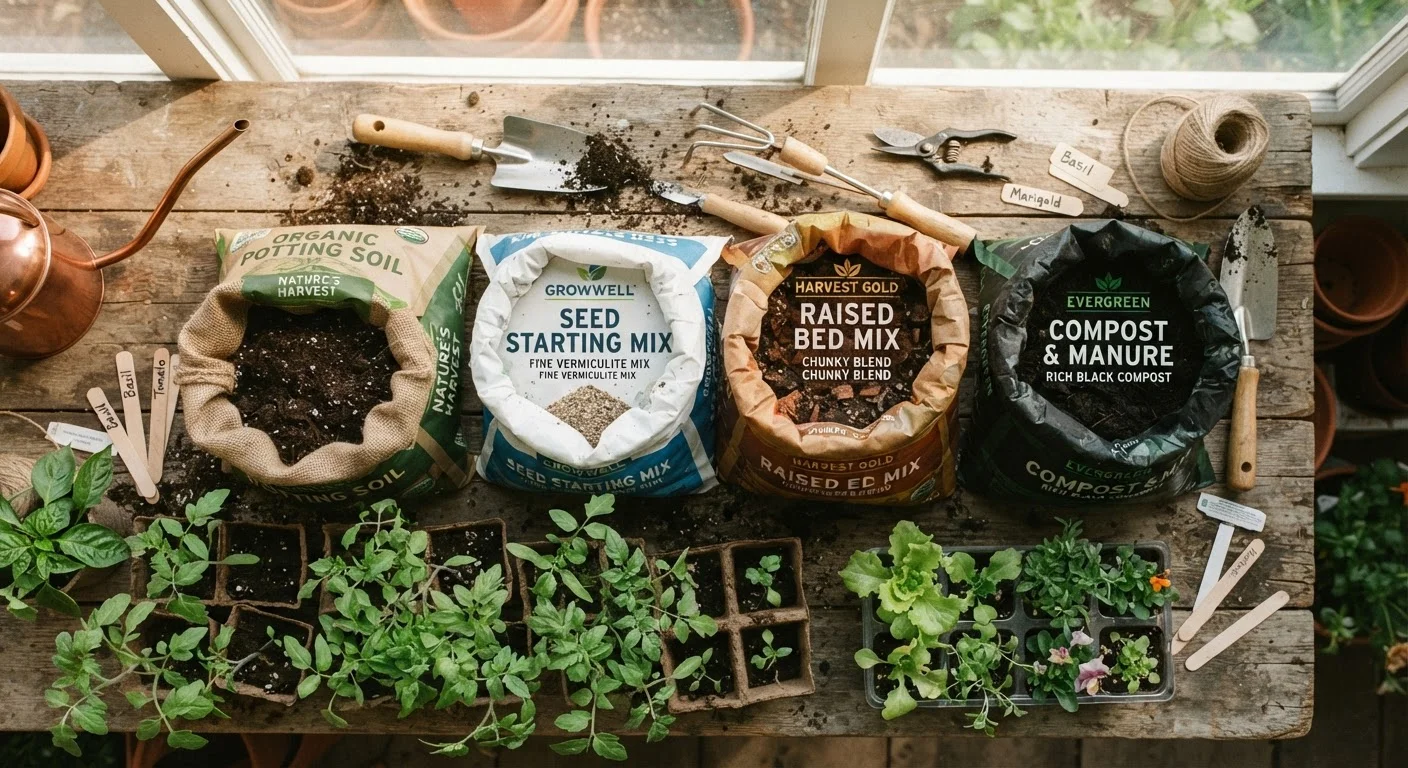
Why Soil Labels Confuse So Many Gardeners
Walk down the soil aisle at any garden center and you'll see a wall of similar-looking bags — brown, earthy, and often priced just dollars apart. The front labels read things like "Premium Garden Soil," "All-Purpose Topsoil," or "Professional Potting Mix." It's easy to assume they're mostly the same thing. They aren't.
Each of these products is engineered for a specific use case. Using the wrong one — potting mix buried in a raised bed, or dense topsoil packed into a container — can compact roots, drain too fast, or leave plants nutrient-starved. The good news: once you know what each term means, the right choice becomes obvious. Just like learning to read a nutrition label helps you understand what's actually in your food (see our guide to reading a nutrition facts label), understanding soil labels helps you make smarter purchases at the garden store.
~40%
Home gardens using the wrong soil type
Extension horticulture programs commonly cite incorrect soil selection as one of the leading causes of poor container and raised-bed plant performance among home gardeners.
3 main types
Distinct soil product categories
Topsoil, garden soil, and potting mix represent the three foundational categories, each designed for a different planting environment.
Up to 80%
Potting mix volume that can be air and pore space
Well-formulated potting mixes are engineered to keep up to 80% of their volume as air pockets and drainage channels, critical for healthy container roots.
The Big Three: Topsoil, Garden Soil, and Potting Mix
Topsoil is the most basic product. It's screened earth — typically taken from the top layer of a field or construction site, sifted to remove large debris, and bagged. It has no guaranteed nutrient content and no standardized texture. Quality varies widely. Topsoil is best used for filling low spots in a lawn, grading around a foundation, or bulking up large volumes of dirt. On its own, it's too dense and unpredictable for most planting.
Garden soil is topsoil that has been improved. Manufacturers blend in compost, aged bark, or other organic matter to loosen the texture and add nutrients. It's formulated to be worked into existing native soil in an in-ground garden bed, where it mixes with what's already there. Do not use garden soil alone in a container — it will compact over time, suffocate roots, and drain poorly.
Potting mix (sometimes called potting soil, though many varieties contain no actual soil) is designed specifically for containers and raised beds. It's built to stay loose, drain freely, and resist compaction — all critical when roots are confined to a pot. Ingredients typically include peat moss or coir, perlite or vermiculite, and sometimes a starter fertilizer. It costs more per bag than topsoil, but the structure it provides in a container is worth it.
Flip the Bag Before You Buy
The front of a soil bag is marketing; the back is information. Before purchasing, turn the bag over and read the ingredient list and any NPK numbers. A bag that lists compost, perlite, and aged bark is telling you something specific about its texture and drainage. One with vague terms like 'composted forest products' and no NPK ratio may be fine — or may need amending. Spending 60 seconds reading the back label can save you a failing garden season.
Decoding the Rest of the Label
Beyond the product name, soil bags carry additional terms that are worth understanding before you buy.
- Amended: Ingredients have been added to improve performance. Check the ingredient list to see what was added — compost, lime, and perlite are common.
- Organic: In the context of soil, this usually means the product contains carbon-based materials like compost or bark. It does not necessarily mean certified organic. Some products carry a third-party organic certification; look for that seal if it matters to you.
- Soilless: Made entirely from non-earth materials such as peat, coir, and perlite. These mixes are sterile and lightweight — ideal for seed starting and container growing.
- NPK ratio: Three numbers (such as 0.10-0.05-0.10) indicating the percentage of nitrogen, phosphorus, and potassium. If these numbers appear, fertilizer is present. No numbers means little to no added fertility.
For a deeper understanding of how fertilizer nutrients affect your garden long-term, our companion piece on organic vs. synthetic fertilizers is worth reading alongside this guide.
Putting It Together: Match Soil to the Job
The simplest way to choose correctly is to start with where the soil is going, not what the bag says on the front.
| Where you're planting | Best soil type |
|---|---|
| In-ground garden bed | Garden soil mixed into existing native soil |
| Container or pot | Potting mix (soilless is fine) |
| Raised bed (deep) | Blend of topsoil, compost, and potting mix |
| Lawn low spots / grading | Topsoil |
| Seed starting trays | Fine-textured soilless seed-starting mix |
Once your soil is selected, the next step is preparing your planting area properly. Our garden bed prep guide walks through how to clear, amend, and ready any planting area before the first seed goes in. And if you want to improve your soil over time without buying more bags, composting at home is one of the most effective and low-cost strategies available to any gardener.
Frequently Asked Questions
You can, but it's not cost-effective and may dry out faster than native soil once blended in. Potting mix is engineered to drain quickly in containers, which is less critical in a ground bed with natural moisture retention. For in-ground beds, a proper garden soil or amended topsoil is a better match.
Amended means extra ingredients have been mixed into a base soil to improve its performance. Common amendments include compost, perlite, lime, or slow-release fertilizer. The specific amendments are listed on the back of the bag, so check there to understand exactly what's been added.
No. Topsoil is essentially screened earth — it may contain clay, sand, and organic matter in whatever proportions existed at its source. Garden soil is a processed product with added compost or nutrients intended to support plant growth. Topsoil alone is often too dense for planting without further amendment.
Soilless potting mixes are made from peat moss, coir, perlite, and similar materials instead of actual earth. This keeps the mix lightweight and sterile, reducing pests and disease risk. The term 'soilless' does not mean it lacks nutrients — most mixes include a starter fertilizer charge.
Check the back label for an NPK ratio (three numbers like 0.05-0.05-0.05). If those numbers appear, fertilizer is included. The bag front may also say 'feeds plants for X months.' If no NPK ratio is listed, the product likely contains little to no fertilizer and you'll need to add your own.
It depends on the depth and drainage of your raised bed. In shallow raised beds, garden soil can compact and restrict drainage. A blended mix of garden soil plus compost and perlite usually performs better. Deeper raised beds with good drainage can tolerate garden soil more readily.
The content on this site is for informational purposes only and is not a substitute for professional advice. Always consult a qualified professional for guidance specific to your situation.