

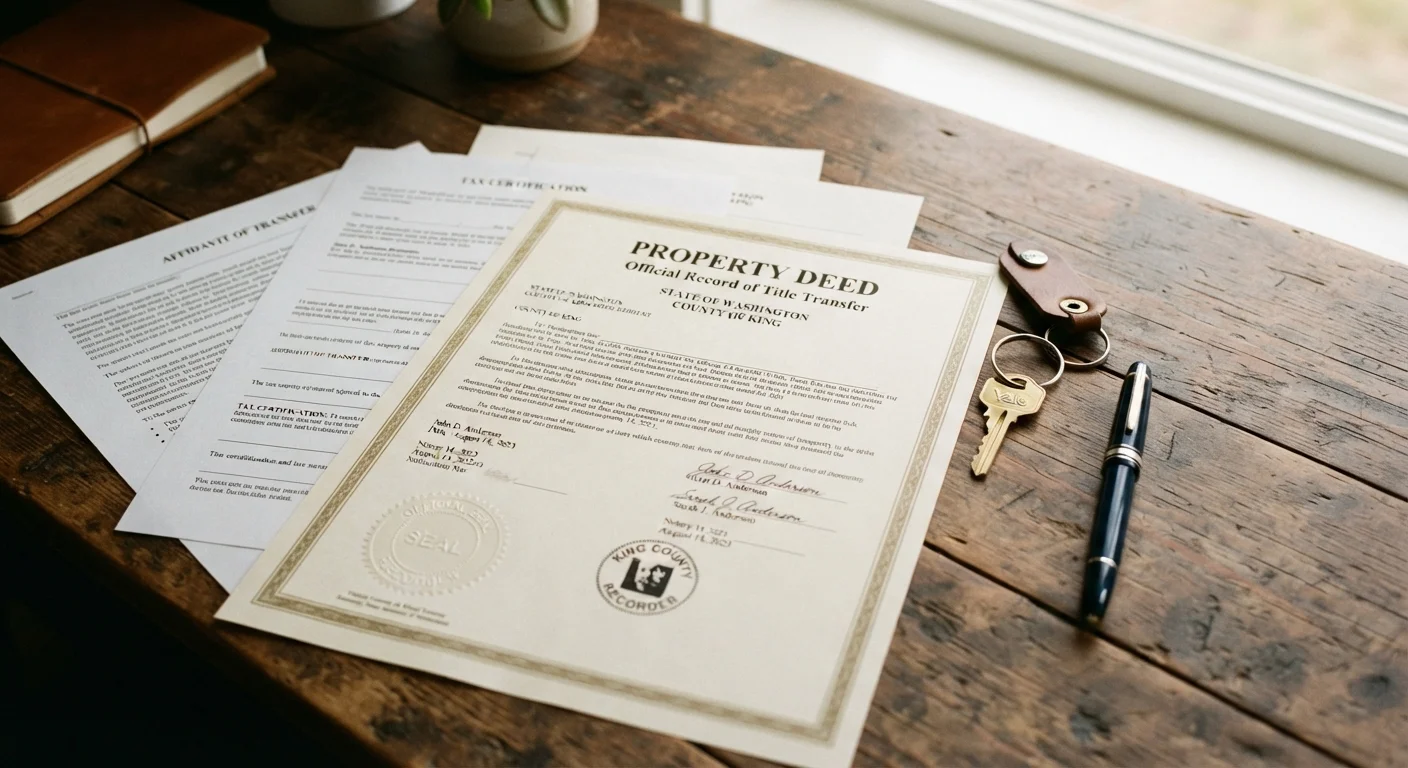
Deed vs. Title: Two Different Things
Many homeowners use the words deed and title interchangeably, but they represent two distinct concepts — and confusing them can lead to costly misunderstandings.
A deed is a physical, signed legal document. It is the instrument that formally transfers ownership of real property from a seller (the grantor) to a buyer (the grantee). Without a properly executed and recorded deed, the transfer of property is not legally complete.
Title, by contrast, is not a piece of paper at all. It is the legal concept of ownership — the bundle of rights you hold in a property once a transfer is complete. Holding title means you have the recognized right to occupy, use, sell, mortgage, or leave the property to heirs. To learn more about exactly what those rights include, see what property ownership actually means in the U.S..
| What a deed is | A physical legal document that transfers property ownership |
| What a title is | A legal concept — the bundle of rights that come with owning property |
| Where deeds are recorded | County recorder's office or register of deeds (varies by state) |
| Most protective deed type for buyers | General Warranty Deed |
| Least protective deed type | Quitclaim Deed |
| Title insurance types | Owner's policy (protects buyer) and lender's policy (protects lender) |
| When title insurance is paid | One-time premium, typically at closing |
Think of it this way: the deed is the document that moves title from one person to another. Once the deed is recorded, the buyer holds title.
Types of Deeds and What They Guarantee
Not all deeds offer the same level of protection. The type of deed used in a transaction determines what warranties — if any — the seller makes about the property's ownership history.
Deed
A deed is a signed legal document that transfers ownership of real property from one party (the grantor) to another (the grantee). It must be recorded with the appropriate county or municipal office to be legally effective against third parties.
Title
Title is not a physical document — it is the legal concept of ownership rights to a property. Holding title means you have the recognized right to use, sell, or transfer the property.
General Warranty Deed
A deed in which the seller guarantees clear ownership of the property going back through its entire history, not just the period the seller owned it. It offers buyers the broadest legal protection.
Quitclaim Deed
A deed that transfers whatever ownership interest the grantor currently holds, with no warranties or guarantees about the title's history. Commonly used between family members or to correct clerical errors.
Title Search
A review of public records to trace the chain of ownership for a property and identify any liens, encumbrances, or disputes that could affect a buyer's legal claim.
Title Insurance
A one-time premium insurance policy that protects the holder against financial losses arising from defects in the title that existed before the policy was issued but were not discovered during the title search.
Lien
A legal claim against a property as security for a debt or obligation. Common examples include mortgage liens and tax liens. Liens can prevent a clean transfer of title.
Chain of Title
The historical sequence of ownership transfers for a property, documented in public records. A clear, unbroken chain of title helps verify that ownership was transferred legally at each step.
General Warranty Deed
The most protective deed for buyers. The seller guarantees that the title is clear of all claims going back through the property's entire history, not just during the seller's ownership period. Most traditional home sales use this deed type.
Special Warranty Deed
The seller warrants the title only against claims arising during their own ownership — not for events that occurred before they acquired it. Common in commercial real estate and some estate sales.
Quitclaim Deed
Transfers only whatever ownership interest the grantor currently holds, with zero promises about history or title quality. Often used to add or remove a spouse's name, transfer property between family members, or correct a clerical error on a prior deed. Never use a quitclaim deed as a substitute for a warranty deed in an arm's-length sale.
Grant Deed
Used primarily in California and a few other states. The seller guarantees they have not previously transferred the property to someone else and that there are no undisclosed encumbrances from their period of ownership.
The Title Search and Why It Matters
Before a real estate transaction closes, a title search is conducted to examine the public record and verify that the seller actually holds clear, marketable title to the property. This process traces the chain of ownership — every recorded deed, mortgage, lien, easement, or judgment — going back decades, sometimes a century or more.
~1 in 3
Title searches that uncover a defect or issue
According to the American Land Title Association, roughly one in three title searches reveals a problem that must be resolved before closing can proceed.
4 main types
Common deed types used in U.S. residential transactions
General warranty, special warranty, quitclaim, and grant deeds are the four deed forms most commonly encountered in U.S. real estate closings.
Title searches commonly uncover issues such as unpaid property taxes, contractor liens, clerical errors in prior deeds, undisclosed heirs, or boundary disputes. Every one of these issues must be resolved before the transaction can proceed cleanly.
Once the search is complete and any defects are cleared, a title company issues a title commitment — a promise to issue title insurance if the sale closes under agreed conditions. For a detailed walkthrough of how this fits into the broader closing process, see The Home-Buying Process, From Offer to Closing.
Your Deed Should Always Be Recorded
Receiving a signed deed at closing is not enough on its own — the deed must be recorded in the public land records of the county or municipality where the property is located. An unrecorded deed may still be valid between the two parties, but it does not protect you against future claims by third parties such as creditors or subsequent buyers. Your title company or closing attorney typically handles recording as part of the closing process, but it is worth confirming.
Title Insurance: Owner's vs. Lender's Policy
Even a thorough title search cannot catch every possible problem — a forged document from 1987, an unknown heir, a clerical error buried in county records. Title insurance exists to protect against exactly these kinds of hidden defects.
There are two distinct policies issued at most closings:
- Lender's (or mortgagee's) policy: Required by virtually all mortgage lenders. It protects the lender's financial interest in the property — not yours. The coverage amount decreases as the mortgage is paid down.
- Owner's policy: Optional but strongly recommended. It protects the buyer's equity in the property for as long as they — or their heirs — hold an interest in it. Coverage is typically equal to the purchase price at the time of closing.
Both policies are purchased for a one-time premium paid at closing. Because how title is held also affects what happens to the property at death, it is worth reviewing how property rights transfer when an owner dies before finalizing vesting decisions.
Keeping Your Deed Accurate Over Time
Homeownership is not a one-time paperwork event. Life changes — marriage, divorce, a co-owner's death, a name correction — often require updating how title is held or who is named on the deed. Errors in recorded deeds, while uncommon, can complicate future sales or refinances.
Reviewing your deed periodically is a simple but important habit. Check that names are spelled correctly, that the legal property description matches your survey, and that any changes in ownership (such as adding a spouse or removing a deceased co-owner) are properly reflected in a newly recorded document. For a broader annual review of documents every homeowner should revisit, see the Annual Property Ownership Audit checklist.
If you discover an error, a real estate attorney or title professional can help determine the correct corrective deed to file. Keep copies of your recorded deed somewhere safe — alongside your title insurance policy and a copy of your closing disclosure. Understanding any limitations on what you can do with your land is equally important; easements, setbacks, and zoning rules often affect rights that deeds alone do not address.
This article is for general informational and educational purposes only and does not constitute legal advice. For questions about your specific deed, title, or ownership situation, consult a licensed real estate attorney in your state.
The content on this site is for informational purposes only and is not a substitute for professional advice. Always consult a qualified professional for guidance specific to your situation.