

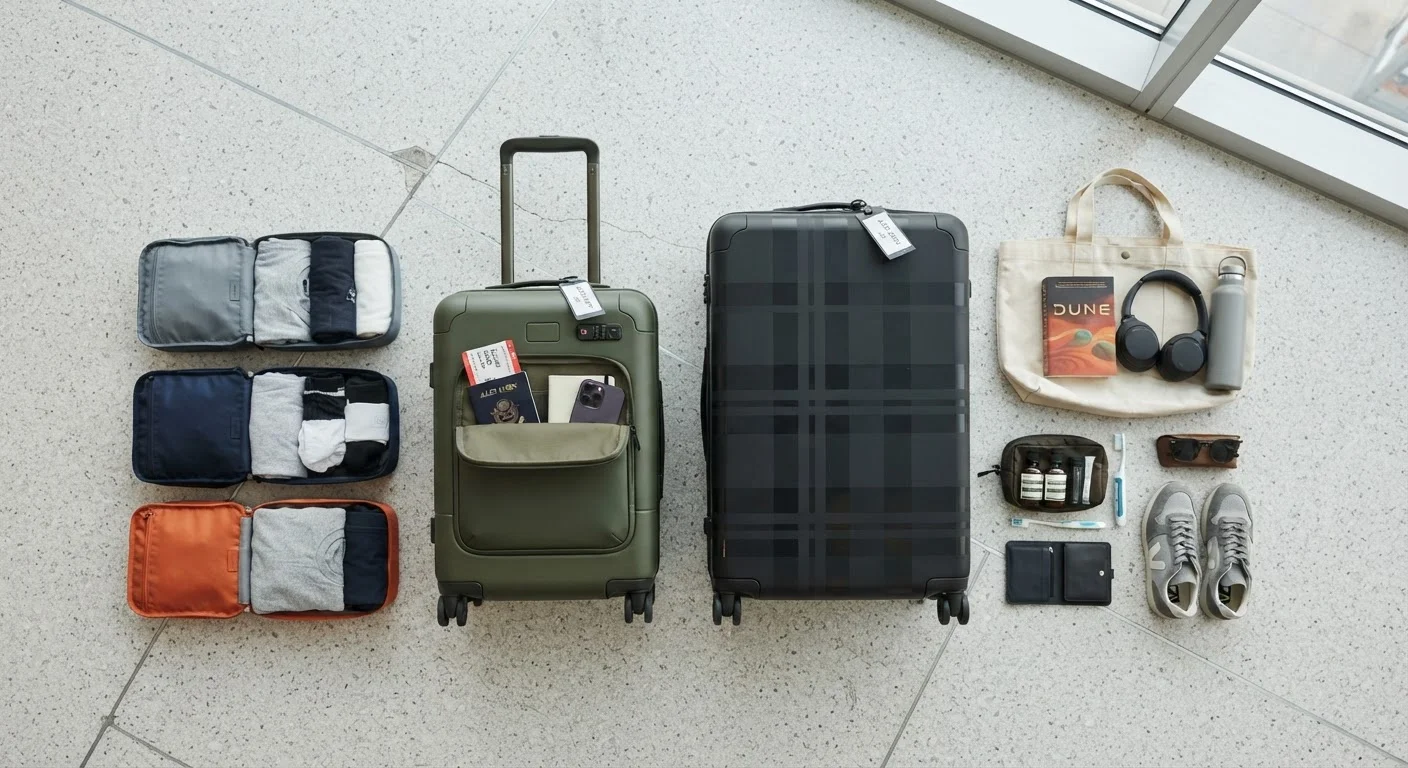
Option A
Carry-On Bag
The nimble, airport-friendly option for light packers.
Best for: Short trips, frequent flyers, and travelers who want speed and flexibility at the airport.
Option B
Checked Bag
The spacious, stress-free choice for longer or more complex trips.
Best for: Extended trips, family travel, or anyone bringing gear, formal wear, or liquids in full sizes.
The Core Trade-Off: Speed vs. Space
Every packing decision comes down to a single question: what do you value more on this particular trip — moving fast through the airport, or having everything you might need once you arrive?
A carry-on keeps you in control. You board knowing exactly where your bag is, you walk off the plane and straight to the exit, and you never file a lost luggage report. The catch is that you must pack with real discipline. Standard carry-on dimensions in the U.S. typically fall around 22 x 14 x 9 inches, though airlines vary — and overhead bin space is not guaranteed on crowded flights.
A checked bag removes the packing puzzle almost entirely. You can bring full-size toiletries, a wider clothing selection, and items like sporting equipment or formal attire without creative folding gymnastics. The trade-off is time: checked fees (which vary by airline and fare class), the check-in queue, and waiting at baggage claim after landing. On a long trip, that extra space often feels worth it. On a quick weekend away, it rarely does.
| Criterion | Carry-On Bag | Checked Bag |
|---|---|---|
| Typical size limit | ~22 x 14 x 9 in (varies by airline) | Up to 62 linear inches |
| Weight limit | Often 15–25 lbs (varies widely) | Typically 50 lbs (domestic U.S.) |
| Liquid restrictions | TSA 3-1-1 rule applies | No size restriction on liquids |
| Airport time | Faster — skip check-in & baggage claim | Adds check-in and claim wait time |
| Typical added cost | Usually free (varies by airline/fare) | Fees vary; often $30–$40+ per bag |
| Lost/delayed risk | Very low — bag stays with you | Small but real risk of misrouting |
| Best trip length | 1–4 nights | 5+ nights or gear-heavy trips |
What Actually Fits — And What Doesn't
Airline carry-on rules are stricter than many travelers expect. The TSA's 3-1-1 liquid rule limits carry-on containers to 3.4 ounces (100ml) each, all fitting in one quart-sized clear bag. That immediately rules out full-size shampoo, conditioner, and several skincare products. Checked bags face no such restriction.
Sharp objects, certain sporting gear, and oversized electronics may also need to go below. On the flip side, valuables, medications, and irreplaceable items should always travel in your carry-on — airlines accept limited liability for fragile or high-value items in checked luggage.
~2.9M
Mishandled bags reported in the U.S. annually
According to the Bureau of Transportation Statistics, U.S. airlines mishandle roughly 2–3 million bags per year — a key argument for keeping valuables in your carry-on.
3-1-1
TSA liquid rule for carry-on bags
The TSA requires all carry-on liquids to be in containers of 3.4 oz or less, placed in a single quart-sized clear bag — a limit that catches many travelers off guard.
Smart packing — whether carry-on or checked — comes down to choosing versatile pieces over single-use items. Our overpacking guide breaks down which items travelers most commonly regret bringing. Pair that with a trip-specific strategy from our packing strategies guide to match your approach to your actual itinerary.
When Your Trip Type Changes Everything
Trip length is the most reliable guide. For trips of three nights or fewer, most travelers can comfortably manage carry-on only with a few packing cubes and a personal item. For five nights or more — especially in destinations with varied weather or dress codes — a checked bag often earns its fee.
Destination type matters just as much. A beach week with minimal clothing and sandals packs small. A ski trip, a wedding, or a hiking tour with technical gear does not. Before you decide, think through the actual activities on your itinerary rather than packing for hypotheticals.
Always Verify Airline Rules Before You Pack
Carry-on size limits, checked bag fees, and weight allowances differ meaningfully between airlines — and even between fare classes on the same carrier. What fits on one airline's overhead bin may be gate-checked on another. Check your specific airline's current baggage policy directly on their website before you finalize your packing approach. Rules can also change seasonally or during high-demand periods.
If you're choosing between flying and driving altogether, the bag question looks different — road trip vs. flying covers how transportation mode affects what you can realistically bring. And once you've settled your bag strategy, our pre-departure checklist can help you leave home without a nagging sense that you've forgotten something important.
The content on this site is for informational purposes only and is not a substitute for professional advice. Always consult a qualified professional for guidance specific to your situation.