

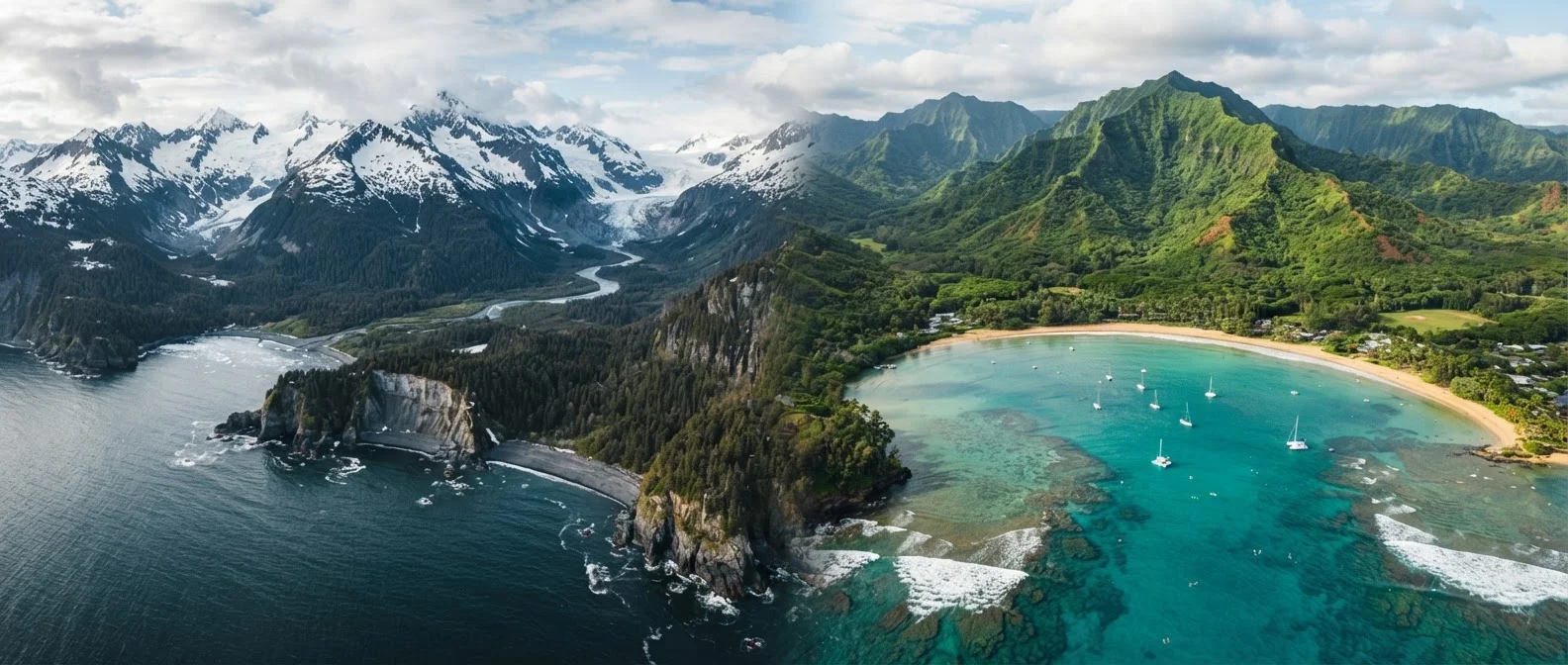
Our Verdict
Alaska and Hawaii reward visitors who embrace their logistical realities rather than resist them. Both destinations offer experiences unavailable anywhere else in the US, but they require more planning, more budget flexibility, and more realistic expectations than a typical domestic road trip. The payoff — extraordinary landscapes, distinct cultures, and genuine remoteness — is hard to match.
Best suited for travelers who plan ahead, have flexible budgets, and prioritize transformative experiences over convenience or predictability.
Why These Two States Play by Different Rules
Most American road trips involve loading up the car and heading out. Alaska and Hawaii simply don't work that way. Both states are geographically detached from the continental US — Hawaii sits more than 2,000 miles into the Pacific Ocean, while Alaska is separated from the Lower 48 by Canada. That physical reality reshapes every aspect of trip planning, from how you get there to how you move around once you arrive.
This isn't a reason to avoid them — quite the opposite. But it does mean that treating either destination like a spontaneous weekend escape is likely to lead to frustration. See our trip planning hub for a broader look at organizing any American trip from the ground up.
Entry Requirements Are Still US Domestic Rules
Because Alaska and Hawaii are US states, American citizens don't need a passport to visit, and no currency exchange is required. However, some protected land areas — particularly tribal lands and certain wildlife refuges in Alaska — may have specific access requirements or permit systems. Always verify entry rules for specific sites with the relevant land management authority before your trip.
Both states are also dramatically diverse within themselves. Hawaii's five main visitor islands each have distinct weather patterns, landscapes, and characters. Alaska spans nearly 665,000 square miles — larger than the next three largest US states combined. Visiting either state "fully" in one trip is essentially impossible, and that's worth acknowledging early when setting expectations.
The Real Advantages of Going
Landscapes unavailable anywhere else in the US
Active volcanoes, ancient rainforests, tidewater glaciers, and aurora-lit skies aren't found on the mainland. Both states offer genuinely singular natural environments that justify the extra effort to reach them.
Rich and distinct cultural experiences
Native Hawaiian culture and Alaska Native traditions are living, vibrant presences — not museum pieces. Engaging respectfully with both adds meaning that purely scenic destinations can't replicate.
National Parks with exceptional variety
Alaska alone contains eight national parks, including Denali and Kenai Fjords. Hawaii Volcanoes National Park offers rare geological access. Both states outperform many mainland options for park diversity. Understanding national park timing is especially useful here.
Strong domestic travel infrastructure despite remoteness
Both states are served by major US carriers, have well-developed tourism infrastructure in key areas, and require no passport or currency exchange — a practical advantage over international alternatives.
Opportunities for every travel style
From luxury resorts in Maui to remote wilderness camping in the Brooks Range, both states accommodate vastly different budgets and comfort levels, making them accessible in different ways to a wide range of travelers.
The case for visiting Alaska or Hawaii isn't hard to make — these are genuinely bucket-list destinations for millions of Americans. What matters is understanding why they deliver, so your expectations match reality. If you're weighing a solo adventure to either state, solo travel first-timer advice applies with extra relevance given the logistics involved.
The Honest Challenges Visitors Face
Flights are mandatory and often expensive
There is no driving or ferrying directly from the continental US to Hawaii, and Alaska is practically flight-dependent for most itineraries. Round-trip airfare represents a significant baseline cost before any other expenses.
Cost of living inflates visitor expenses significantly
Groceries, dining, and gear rentals cost notably more in both states due to shipping distances and limited local supply. Budget travelers should plan for per-day costs that typically exceed mainland equivalents.
Weather is unpredictable and highly localized
Hawaii's microclimates mean one side of an island can be sunny while the other is rainy. Alaska's weather can change rapidly and close access to remote areas with little warning.
Limited mobility once you arrive
In Hawaii, seeing multiple islands requires booking additional inter-island flights. In Alaska, remote regions may require expensive bush plane charters or ferry travel on the Alaska Marine Highway.
Popular sites face serious overcrowding in peak season
Road to Hana, Waimea Canyon, and Denali's entrance corridors can see traffic and permit bottlenecks that significantly reduce the experience for visitors who don't plan around peak periods.
Neither Alaska nor Hawaii is a "set it and forget it" destination. Weather, access, and cost combine in ways that can derail under-prepared travelers. Hawaii's common visitor misconceptions — including assumptions about consistent sunshine or easy island-hopping — catch a surprising number of first-timers off guard.
2,400 mi
Distance from California to Honolulu
According to general geographic data, Hawaii sits roughly 2,400 miles southwest of the US West Coast, making it one of the most remote state capitals in the world.
8
National Parks in Alaska alone
Alaska is home to eight national parks — more than any other US state — spanning tundra, coastline, glaciers, and subarctic wilderness.
Timing is one of the most controllable variables. Traveling outside peak summer and holiday windows can ease crowding at both destinations, though it introduces trade-offs of its own — especially in Alaska, where shoulder-season access to certain areas narrows considerably. Off-season travel trade-offs are worth understanding before you commit to a shoulder-season itinerary.
Planning Principles That Apply to Both States
A few consistent principles apply regardless of which state you're visiting:
- Book flights early. Both states see limited seat inventory on popular routes, and fares can rise sharply as departure dates near.
- Secure permits in advance. Trails like Kauaʻi's Nā Pali Coast and Denali's backcountry routes require advance reservation. These fill quickly, especially in summer.
- Build buffer days. Weather delays — particularly small-plane delays in Alaska — are common. A tight connection or a single-day margin is a liability.
- Research inter-island or intra-state logistics separately. Moving between Hawaiian islands requires additional flights. Moving between regions in Alaska may involve bush planes, ferries, or long drives on unpaved roads.
If you're curious how Alaska and Hawaii compare to other distinctly American landscape experiences, mountain towns versus coastal getaways offers a useful framework for identifying what kind of environment energizes you most.
The content on this site is for informational purposes only and is not a substitute for professional advice. Always consult a qualified professional for guidance specific to your situation.