

Option A
New Orleans, Louisiana
The deep-rooted, culturally layered original.
Best for: Travelers who want immersive history, Creole cuisine, jazz traditions, and a city that feels unlike anywhere else in America.
Option B
Nashville, Tennessee
The energetic, accessible, country-music capital.
Best for: Visitors drawn to live country and Americana music, a booming food scene, and a walkable downtown with round-the-clock entertainment.
The Music: Same Passion, Completely Different Roots
Both cities wear their musical identities proudly — but the genres, venues, and histories couldn't be more distinct.
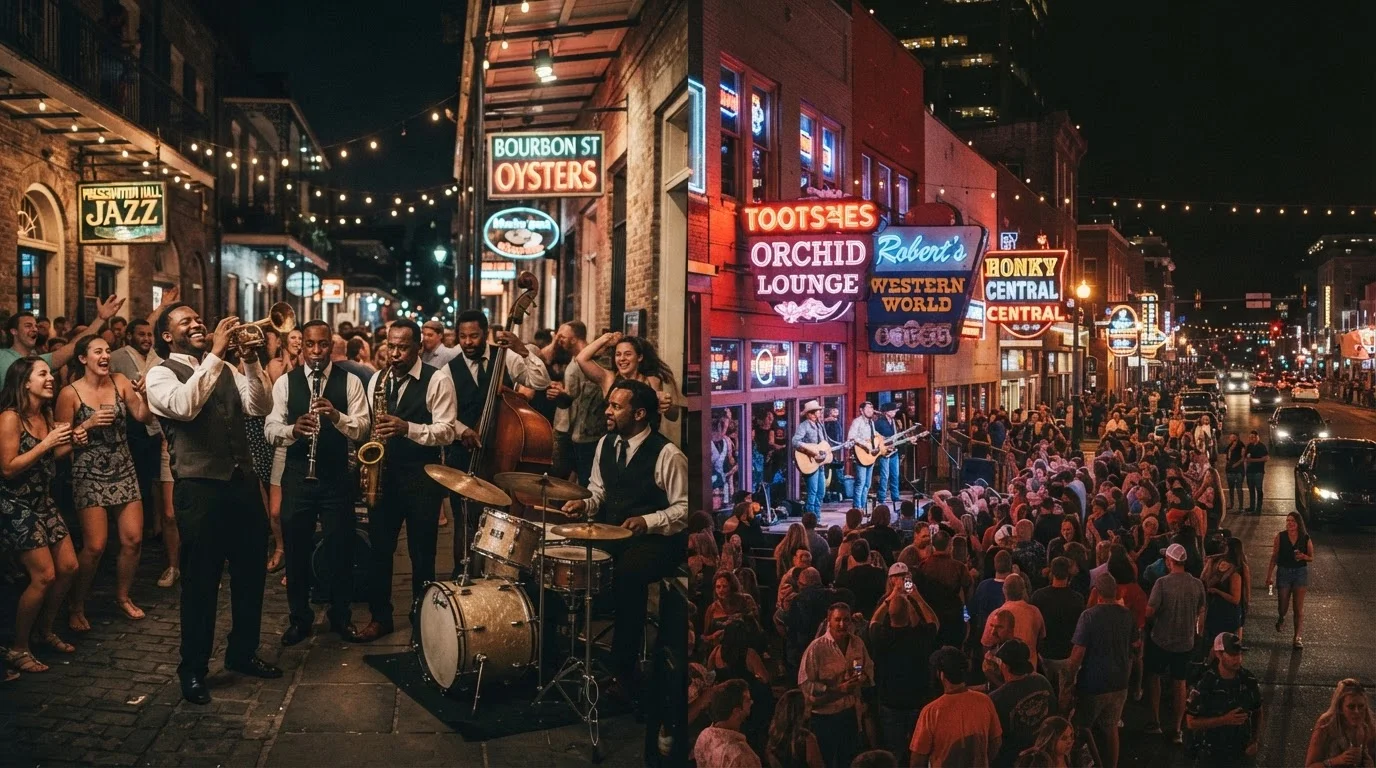
New Orleans is widely considered the birthplace of jazz. Music here emerged from Congo Square, where enslaved Africans gathered and preserved rhythmic traditions that would eventually shape American popular music. Today, that lineage is living and audible in Frenchmen Street venues, second-line parades, and brass bands that spill onto sidewalks with zero fanfare. Music in New Orleans is woven into daily life rather than confined to ticketed stages.
Nashville built its identity around country music and the Grand Ole Opry, which has broadcast live performances since 1925. Lower Broadway — the city's famous honky-tonk corridor — is an uninterrupted stretch of live music venues where bands play from mid-morning to the early hours. Nashville has also broadened well beyond country, with a growing indie, Americana, and R&B scene centered in neighborhoods like East Nashville and The Gulch.
| Criterion | New Orleans | Nashville |
|---|---|---|
| Music tradition | Jazz, blues, brass band, second lines | Country, Americana, honky-tonk |
| Music setting | Streets, clubs, parades | Venues, honky-tonks, arenas |
| Signature cuisine | Creole and Cajun cooking | Hot chicken, evolving chef scene |
| City pace | Slow, atmospheric, spontaneous | High-energy, accessible, planned |
| Iconic neighborhoods | French Quarter, Marigny, Garden District | Broadway, East Nashville, The Gulch |
| Cultural depth | Centuries of layered multicultural history | Country-music heritage, rapid modern growth |
| Best for | History lovers, foodies, music traditionalists | Nightlife seekers, first-time Southern visitors |
For music lovers planning their itinerary, it helps to think about what kind of experience you're after: participatory and street-level, or polished and venue-driven. For broader trip planning context, consider the type of energy you want your trip to carry from day one.
Food, Neighborhoods, and Everyday Atmosphere
The food alone could settle this debate for some travelers. New Orleans has a culinary tradition unlike any other American city — gumbo, jambalaya, beignets, muffulettas, and crawfish étouffée reflect a cuisine shaped by French, Spanish, West African, and Native American influences. Neighborhood spots often outshine famous restaurants, and finding great food requires little effort beyond wandering.
The French Quarter is the obvious starting point — historic, atmospheric, and tourist-ready — but locals tend to point visitors toward the Garden District, Marigny, and Bywater for a more authentic feel. The city moves at its own unhurried pace, which is either charming or frustrating depending on your expectations.
Nashville's food scene has exploded over the past decade. Hot chicken is the city's iconic export, but visitors now find everything from acclaimed chef-driven restaurants to thriving food halls and international neighborhoods in areas like Nolensville Pike. The city's rapid growth shows in its gleaming new developments alongside historic buildings — a contrast that not everyone finds charming, but which signals a city with serious culinary ambition.
Timing Your Visit Matters in Both Cities
New Orleans summers are intensely hot and humid, while Nashville's peak festival season (CMA Fest, for example) drives accommodation prices up sharply. Spring and fall are generally the most comfortable windows for both cities. That said, both destinations have legitimate year-round appeal — Mardi Gras in New Orleans and the holiday season in Nashville each offer experiences you won't find at any other time of year.
Both cities reward off-peak visits. For context on how shoulder-season timing can shape these experiences, see our look at off-season travel trade-offs. If you're thinking bigger, both cities anchor nicely into a broader Southern route — see planning a multi-state road trip across the American South for routing ideas.
Which City Fits Your Travel Style?
Choosing between New Orleans and Nashville often comes down to pace and priority. New Orleans rewards slow wandering — get lost, follow live music, linger over a meal. Nashville rewards intentional itinerary-building — plan your honky-tonk nights, book your Opry tickets, and carve out time for the neighborhoods beyond Broadway.
Budget-wise, both cities offer a wide range — from free street music to pricier ticketed experiences. Accommodation costs vary seasonally, and both cities see significant price spikes around festivals and major events. Checking the local events calendar before booking is always worth doing.
1925
Year the Grand Ole Opry began broadcasting
The Grand Ole Opry has been a continuous fixture of Nashville's musical identity for a century, making it one of the longest-running radio programs in US history.
~400
Live music venues in New Orleans
New Orleans is estimated to have hundreds of live music venues and performance spaces, reflecting the city's deep-rooted tradition of music as a public and communal practice.
Families, solo travelers, and groups all find their footing in both cities, though Nashville's more navigable downtown layout can be slightly easier to orient around for first-time visitors. New Orleans is compact too, but its charms often require a bit more exploration to uncover.
If you enjoy discovering cities with real, unhurried character beyond the tourist circuit, our guide to under-the-radar US cities is worth a read. Either way, you're choosing between two genuinely great American destinations — the harder question is simply which version of great fits your trip right now.
The content on this site is for informational purposes only and is not a substitute for professional advice. Always consult a qualified professional for guidance specific to your situation.