

Why Your Owner's Manual Beats Generic Advice
Most drivers have heard the old rule: change your oil every 3,000 miles. But for many modern vehicles, that interval is outdated by a wide margin. The actual recommendation - written specifically for your engine, your transmission, and your driving conditions - lives in the owner's manual sitting in your glove compartment.
Generic maintenance timelines circulating online or posted at quick-lube shops are built around worst-case assumptions. Your manufacturer's schedule is engineered around your actual vehicle. Following it keeps your powertrain warranty intact and ensures you're not over-maintaining (wasting money) or under-maintaining (inviting expensive repairs).
For a broader look at what keeping a vehicle in shape actually involves, see our practical owner's overview.
| Where to find your schedule | Owner's manual - usually the final third of the book |
| Two schedule types | Normal duty and severe/special operating conditions |
| Oil change interval (many modern vehicles) | 7,500-10,000+ miles with synthetic oil (Verify against your specific manual) |
| Spark plug lifespan (iridium/platinum) | Up to 60,000-100,000 miles (Varies by manufacturer and plug type) |
| Coolant flush interval | Typically 60,000-100,000 miles (Check your manual for your vehicle's specification) |
| Digital backup tip | Photograph schedule pages and store on your phone |
How to Find and Read Your Maintenance Schedule
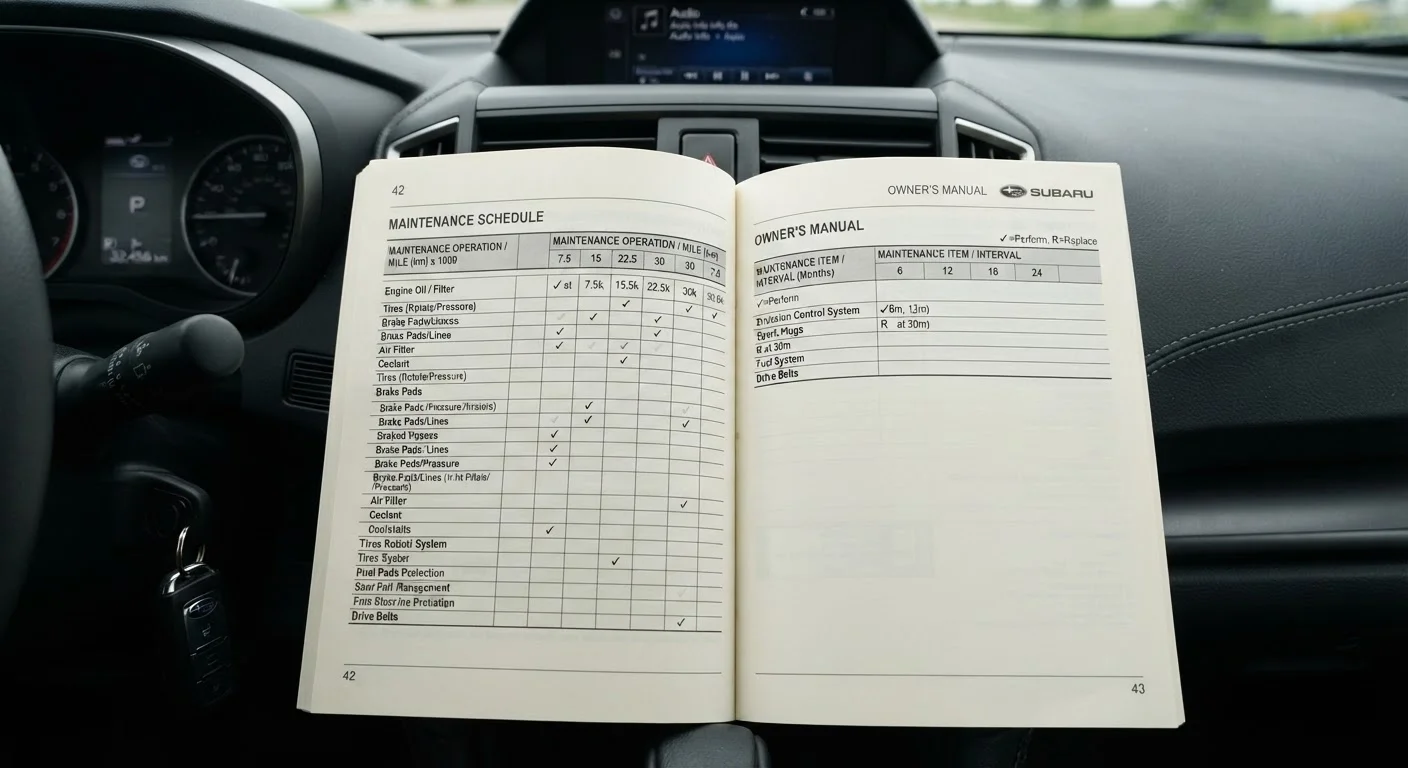
Open your owner's manual and look for a section titled "Maintenance Schedule," "Scheduled Maintenance," or "Service Intervals" - usually toward the back third of the manual. Most manufacturers organize it one of two ways:
- Mileage-based tables: Lists services at intervals like 5,000, 15,000, 30,000, and 60,000 miles. Each row shows which component to inspect, replace, or flush.
- Time-or-mileage tables: Recommends service at whichever comes first - a mileage milestone or a set number of months. This matters for low-mileage drivers who still put time on rubber and fluids.
Pay close attention to any section labeled Severe Duty or Special Operating Conditions. If you regularly tow a trailer, drive in stop-and-go traffic, live in extreme heat or cold, or make lots of short trips under five miles, your vehicle qualifies - and several service intervals shorten significantly under those conditions.
Severe Duty Conditions
A manufacturer designation for driving patterns that place extra stress on components - such as frequent towing, extreme temperatures, stop-and-go traffic, or many short trips. Vehicles operating under these conditions typically need shorter service intervals.
Oil Life Monitor
An onboard system that calculates remaining oil life based on engine temperature, speed, and load rather than a fixed mileage counter. It alerts the driver when an oil change is actually needed for their specific driving pattern.
Service Interval
The mileage or time period between required maintenance actions, as specified by the vehicle manufacturer. Intervals vary by service type and operating conditions.
Powertrain Warranty
A manufacturer guarantee covering the engine, transmission, and drivetrain components. Following the manufacturer's maintenance schedule - and keeping documentation - is typically required to preserve warranty coverage.
Coolant Flush
A service that removes old engine coolant (antifreeze) from the cooling system and replaces it with fresh fluid. Over time, coolant degrades and loses its ability to prevent corrosion and regulate temperature effectively.
The Services Most Schedules Actually Include
While every vehicle differs, owner's manuals typically cover these service categories:
- Engine oil and filter: Modern synthetic-oil engines often specify 7,500-10,000-mile intervals or longer. Check your manual - not the sticker on your windshield.
- Tire rotation: Usually every 5,000-7,500 miles, often timed to oil changes for convenience.
- Air filter (engine): Typically every 15,000-30,000 miles, shorter in dusty environments.
- Cabin air filter: Often every 15,000-25,000 miles; many drivers don't realize this exists.
- Brake fluid: Some manufacturers specify replacement every two years regardless of mileage; others inspect it conditionally.
- Transmission fluid: Intervals vary widely - anywhere from 30,000 to 100,000 miles depending on the design and whether it's manual or automatic.
- Coolant flush: Often scheduled at 60,000-100,000 miles for most modern vehicles.
- Spark plugs: Conventional plugs may need replacement around 30,000 miles; iridium or platinum plugs in many modern engines last 60,000-100,000 miles.
Skipping these services rarely feels urgent in the moment - but the costs compound quickly. Our article on what happens when you skip regular maintenance walks through exactly what goes wrong and why.
If your car is showing subtle signs of wear even before a warning light appears, these signals to watch for can help you catch problems early.
60,000-100,000 mi
Typical iridium spark plug lifespan
Many modern vehicles with iridium or platinum plugs far outlast the older 30,000-mile conventional plug standard.
2 years
Brake fluid replacement interval (some manufacturers)
Several automakers specify brake fluid replacement on a time basis rather than mileage, regardless of how much the vehicle has been driven.
7,500-10,000+ mi
Modern synthetic oil change interval
Many current vehicles using full synthetic oil carry manufacturer-specified intervals well beyond the traditional 3,000-mile guideline.
Putting the Schedule Into Practice
Once you've located your schedule, the simplest system is to photograph the relevant pages and keep them on your phone. Note the mileage intervals that apply to your driving pattern - severe duty or normal - and track your odometer against them.
Many vehicles now include an oil life monitoring system that calculates change intervals based on actual driving data rather than a fixed mileage rule. If your car has one, the manual will explain how it works and whether it replaces or supplements the printed schedule.
Not every service on the list is a DIY task. Some - like brake fluid replacement or transmission service - are straightforward for experienced home mechanics, while others carry real safety implications if done incorrectly. Our guide on DIY maintenance vs. taking it to a shop helps you decide which jobs belong in each column.
For habits that protect your vehicle over the long haul - beyond just scheduled service - see keeping a car in good shape. And if you've absorbed some long-held car care assumptions over the years, it's worth checking them against common myths that keep costing drivers money.
No Manual? You Have Options
If your owner's manual is missing, many automakers publish digital versions on their official websites - searchable by model year and trim level. Your vehicle's VIN (Vehicle Identification Number) can help you locate the exact edition. Dealership service departments can also provide printed copies or point you to the right resource.
The content on this site is for informational purposes only and is not a substitute for professional advice. Always consult a qualified professional for guidance specific to your situation.