

Why Roundabouts Confuse American Drivers
The United States built its road network around signalized intersections and stop signs for most of the 20th century. Roundabouts were rare, so generations of drivers simply never had to learn them. When roundabouts started appearing more widely — the U.S. now has tens of thousands — many drivers hit them without a clear mental model of how they work.
The confusion usually shows up in two ways: freezing at the entry point because it's unclear when to go, or cutting across lanes inside the circle. Both behaviors come from the same source — treating a roundabout like a four-way stop or an on-ramp, which it isn't. For more on high-stress situations that can freeze drivers, see how to build confidence for challenging road scenarios.
~75%
Reduction in injury crashes at roundabouts
According to the Insurance Institute for Highway Safety, roundabouts reduce injury crashes by roughly 75% compared with conventional intersections.
~90%
Reduction in fatal crashes at roundabouts
IIHS research indicates fatal crash rates drop by up to 90% when a traditional signalized intersection is converted to a roundabout.
~10,000+
Roundabouts currently in the U.S.
The U.S. has expanded roundabout adoption substantially since the early 2000s, with thousands now operating across urban, suburban, and rural roads.
The Core Rule: Yield to What's Already Moving
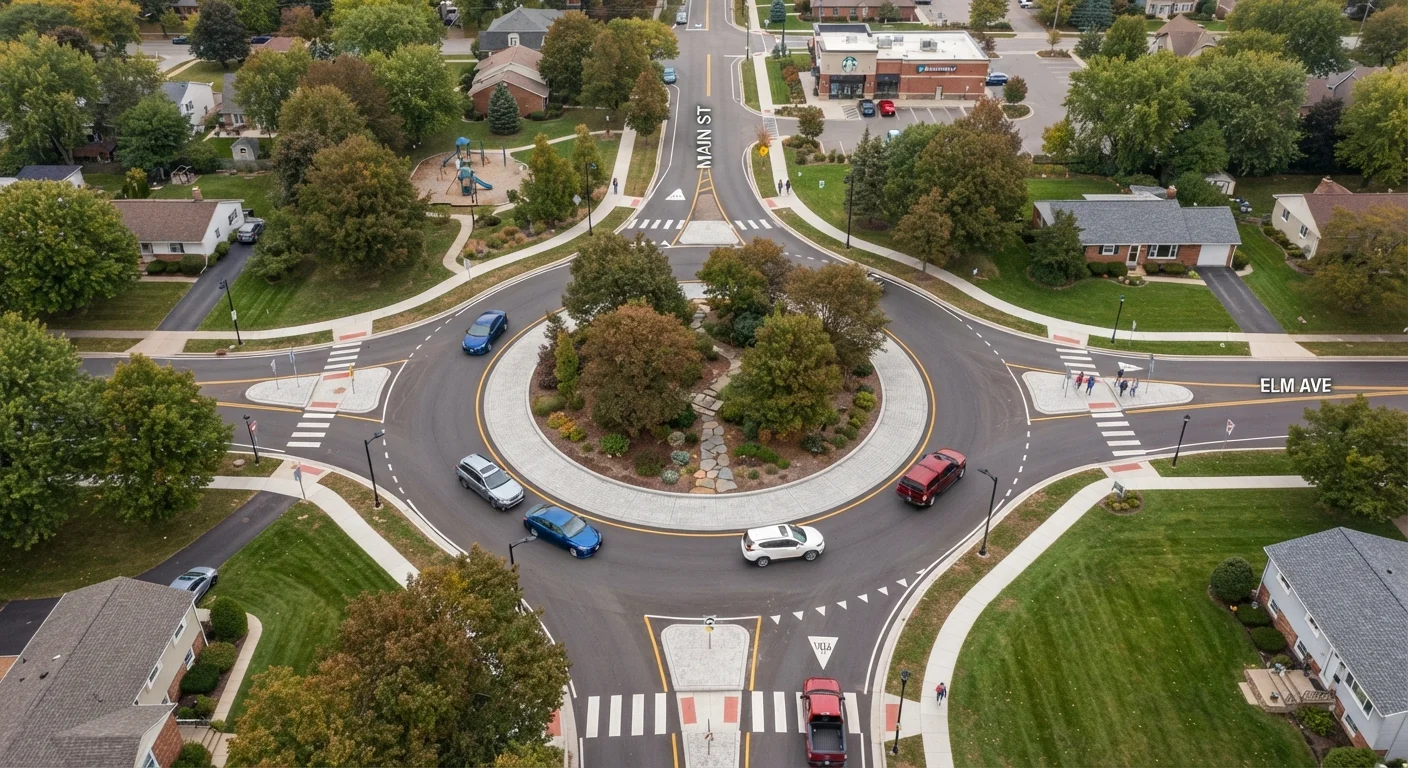
Everything about roundabout navigation flows from one principle: yield to circulating traffic. If cars are already moving inside the circle, you wait. When there's a safe gap — similar to merging onto a highway — you enter and join the flow. You do not have a green light telling you it's your turn. You read the gap yourself.
This is where drivers who are used to traffic signals struggle most. At a signal, the light makes the decision for you. At a roundabout, you make it. That shift from passive to active decision-making is the root of most hesitation.
Scan the circle before you commit
As you slow down on the approach, look left and scan the circulating lanes — not just the first car, but the full arc of visible traffic. Give yourself a moment to gauge speed and gaps before you commit to entering. Rushing the entry is the most common mistake drivers make at roundabouts.
Once you're in the circle, keep moving at a steady, low speed. Roundabouts are designed to operate at 15–25 mph. Braking sharply inside disrupts the flow for everyone behind you.
Lane Choice, Exits, and Common Mistakes
In a single-lane roundabout, navigation is straightforward: enter when there's a gap, travel to your exit, and leave. Two-lane roundabouts require a bit more planning. The key is to choose your lane before you reach the entry, not after you're already inside.
- Right lane: Generally used for the first or second exit (right turn or straight through).
- Left lane: Generally used for exits further around the circle (think of it as a U-turn direction).
Changing lanes inside a roundabout is one of the most common causes of collisions. If you're in the wrong lane, don't panic — just complete the loop and try again. Approach signs and pavement markings guide lane choice; the same sign-reading logic covered in understanding U.S. road sign conventions applies here too.
Also watch your mirrors and blind spots as you approach and exit — pedestrian crosswalks sit just outside the circle. Proper mirror adjustment matters more than many drivers realize in these situations.
The Safety Case for Roundabouts
Roundabouts remove the conditions that make traditional intersections deadly: right-angle T-bone crashes, high-speed head-on conflicts, and red-light running. Because all traffic moves in the same direction at low speed, any collision that does occur is typically a sideswipe or a low-speed rear-end — far less likely to cause serious injury than a broadside impact.
“Roundabouts are one of the most effective tools we have for reducing serious injuries and deaths at intersections. The physics work in everyone's favor — lower speeds mean crashes that people walk away from.”
— Anne McCartt, Senior Vice President for Research, Insurance Institute for Highway Safety
Research from the Insurance Institute for Highway Safety consistently shows roundabouts outperform conventional intersections on injury and fatality rates. They also reduce idling time, which has modest fuel-efficiency and emissions benefits.
Understanding roundabout logic is part of the broader skill set that keeps drivers safe in any non-standard road condition — including construction zones, which present their own set of hazards and rules.
Frequently Asked Questions
Traffic already circulating inside the roundabout always has the right of way. Drivers entering from any approach must yield — even if the roundabout appears clear — until it's safe to merge in.
As a general rule, use the right lane for right turns and straight-through exits, and the left lane for exits that require going more than halfway around. Check posted signage on your approach, since lane assignments can vary by location.
Stay calm and keep circling. Complete another loop and exit at the correct street on your next pass. Never reverse or stop in a roundabout.
Research from the Insurance Institute for Highway Safety indicates roundabouts reduce injury crashes by about 75% and fatal crashes by up to 90% compared with conventional intersections. The lower speeds and elimination of right-angle conflicts are the main reasons.
Yes. Most modern roundabouts include a slightly raised, mountable apron around the central island that large vehicles can drive over when needed. Emergency vehicles follow standard yield rules, and other drivers should pull to the right and stop when possible.
The content on this site is for informational purposes only and is not a substitute for professional advice. Always consult a qualified professional for guidance specific to your situation.