

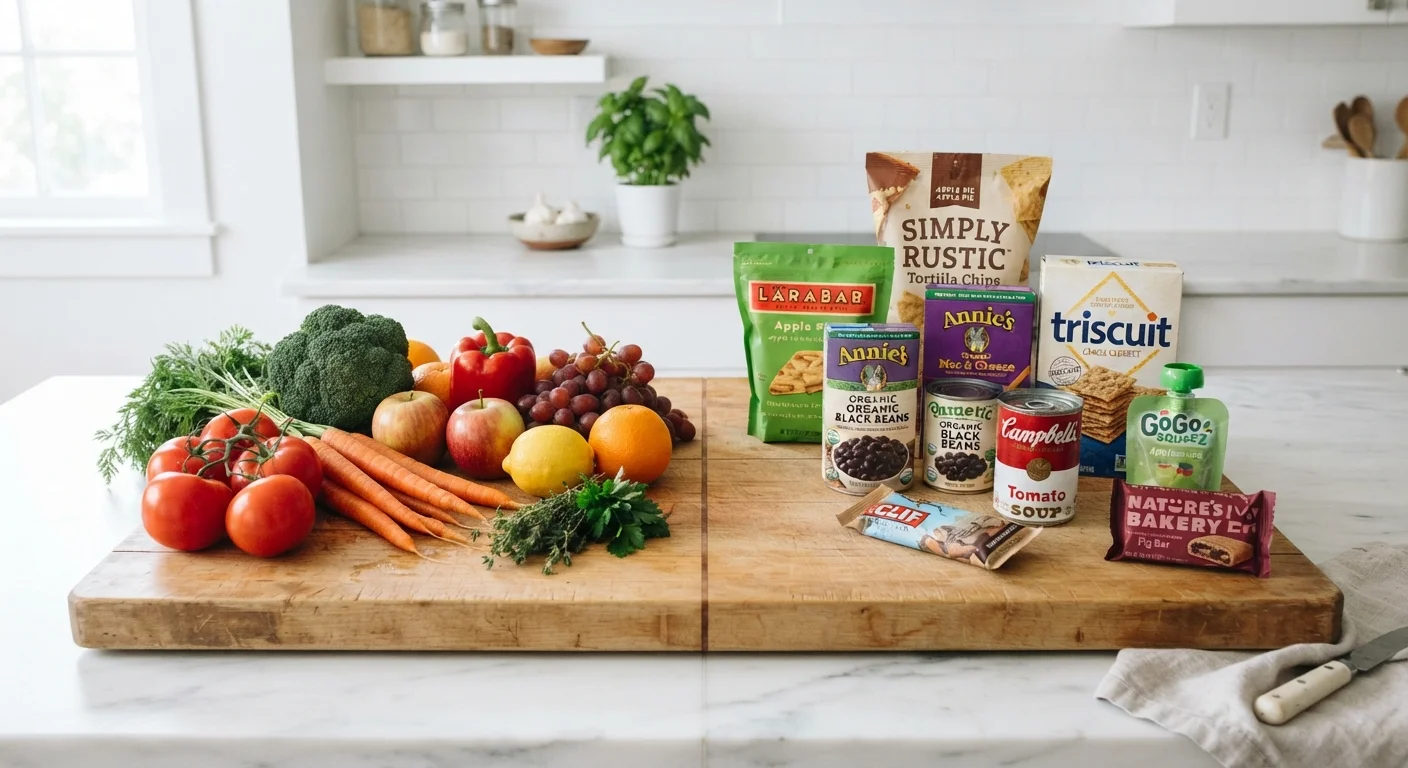
Option A
Whole Foods
The nutritionally intact, minimally altered option.
Best for: People prioritizing nutrient density, fiber, and foods as close to their natural state as possible.
Option B
Processed Foods
A broad spectrum — from mildly altered to heavily engineered.
Best for: Busy households seeking convenience, affordability, and longer shelf life, though choices vary widely in nutritional quality.
What Does "Processed" Actually Mean?
The word processed triggers concern for many shoppers, but it describes almost everything we eat. Technically, any food that has been altered from its raw state — washed, cut, cooked, frozen, or fermented — has been processed. The meaningful question is how much and to what end.
Nutrition researchers commonly use the NOVA classification, developed at the University of São Paulo, which groups foods into four categories based on the extent and purpose of processing:
- Group 1 – Unprocessed or minimally processed: Fresh fruit, vegetables, plain meat, eggs, plain nuts, and dried legumes.
- Group 2 – Processed culinary ingredients: Oils, flours, salt, and sugars used in home cooking.
- Group 3 – Processed foods: Canned fish, cured meats, cheese, and freshly baked bread — typically made from Group 1 foods with Group 2 additions.
- Group 4 – Ultra-processed foods (UPF): Products formulated primarily from industrial ingredients — emulsifiers, artificial flavors, modified starches — with little or no whole food content.
This framework matters because the health research distinguishing outcomes largely clusters around ultra-processed consumption, not processing as a whole.
| Criterion | Whole Foods | Processed Foods |
|---|---|---|
| Definition | Unaltered or minimally changed from natural state | Altered by industrial or culinary processes |
| Nutrient retention | High — fiber, vitamins, minerals largely intact | Varies widely by processing level |
| Added sugars / sodium | Naturally low or absent | Often elevated in ultra-processed products |
| Shelf life | Short — requires fresh sourcing | Extended — often weeks to years |
| Convenience | Requires preparation time | Often ready-to-eat or quick to prepare |
| Cost | Variable; fresh produce can be seasonal | Often lower cost, especially staples |
| Health research association | Linked to lower chronic disease risk | Ultra-processed linked to higher risk; minimally processed broadly neutral |
What the Research Shows About Ultra-Processed Foods
Multiple large observational studies have linked higher ultra-processed food intake to elevated risks of cardiovascular disease, type 2 diabetes, and all-cause mortality. A notable 2019 study published in JAMA Internal Medicine, following more than 44,000 French adults, found that a 10-percentage-point increase in ultra-processed food consumption was associated with a statistically significant increase in mortality risk.
Researchers hypothesize several mechanisms: UPFs tend to be energy-dense, lower in fiber, and high in sodium and added sugars. They may also disrupt satiety signals, leading to higher caloric intake. However, it is important to note that most evidence comes from observational studies — these show associations, not direct causation. Dietary patterns are difficult to isolate from other lifestyle factors.
58%
Share of U.S. calories from ultra-processed foods
A 2016 analysis published in BMJ Open estimated that ultra-processed foods account for roughly 58% of total energy intake among American adults.
10%
Mortality risk increase per 10-point UPF intake rise
A 2019 JAMA Internal Medicine cohort study of 44,551 adults found this association, though causality remains under investigation.
By contrast, minimally processed foods — plain Greek yogurt, frozen edamame, canned tomatoes — preserve most of their original nutritional profile and behave much like their whole-food counterparts in dietary studies. Understanding ingredient lists and nutrition labels is a practical first step; our guide to reading a Nutrition Facts label explains what each section actually signals.
Building a Practical, Evidence-Informed Approach
The goal is not to eliminate processing from your diet — that is neither realistic nor necessary. The goal is to shift the balance. Nutrition researchers broadly recommend anchoring meals in whole and minimally processed foods while treating ultra-processed items as occasional choices rather than dietary staples.
Here are several evidence-informed strategies:
- Prioritize whole foods at meals: Build plates around vegetables, legumes, whole grains, and lean proteins in their least-altered forms.
- Use minimally processed foods strategically: Canned beans, frozen vegetables, and plain rolled oats are cost-effective, convenient, and nutritionally sound. For budget-conscious shoppers, see our practical strategies for eating well on a tight budget.
- Check ingredient lists, not just front-of-pack claims: A long list of unfamiliar industrial additives is a stronger indicator of ultra-processing than a "low-fat" label.
- Diversify protein sources: Whole and minimally processed plant proteins — beans, lentils, tofu — are well-researched options. Plant-based protein sources each come with their own nutritional trade-offs worth understanding.
"Natural" Doesn't Always Mean Unprocessed
Front-of-package terms like "natural," "clean," or "simple" are not regulated definitions in the U.S. and do not reliably indicate how much processing a food has undergone. A product marketed as "all natural" can still contain significant added sugars, sodium, or industrial additives. The ingredient list and Nutrition Facts panel are more reliable tools than label claims when assessing a food's processing level.
No single food choice defines your diet. A weekly grocery nutrition audit can help you evaluate your overall shopping patterns without the pressure of perfection.
This article is for general informational and educational purposes only and is not a substitute for personalized medical or dietary advice. Consult a qualified healthcare professional or registered dietitian before making significant changes to your diet, especially if you have an existing health condition.
The content on this site is for informational purposes only and is not a substitute for professional advice. Always consult a qualified professional for guidance specific to your situation.