

Why Plants Make Good (or Bad) Neighbors
Plants aren't passive. They release chemical compounds through their roots and leaves, attract or repel insects, and compete — or cooperate — for light, water, and nutrients. Companion planting takes advantage of these natural interactions to help your garden work more efficiently.
The benefits fall into a few categories: pest deterrence (one plant's scent confuses or repels insects targeting its neighbor), nutrient sharing (legumes pull nitrogen from the air and deposit it in the soil for heavy-feeding crops), physical support (tall plants provide trellising or shade), and pollinator attraction (flowering companions draw bees that improve fruit set in nearby vegetables).
Not every pairing is helpful, though. Some plants release compounds that inhibit a neighbor's growth — a phenomenon called allelopathy. Understanding both the good and bad pairings is what makes companion planting genuinely useful rather than guesswork.
Research Varies by Pairing
The evidence behind companion planting ranges from well-documented (nitrogen fixation by legumes) to largely observational (basil repelling tomato pests). Many studies are conducted under controlled conditions that differ from a typical home garden. Treat pairings without strong research backing as worth experimenting with rather than guaranteed to work.
The Classic Three Sisters: A Proven System
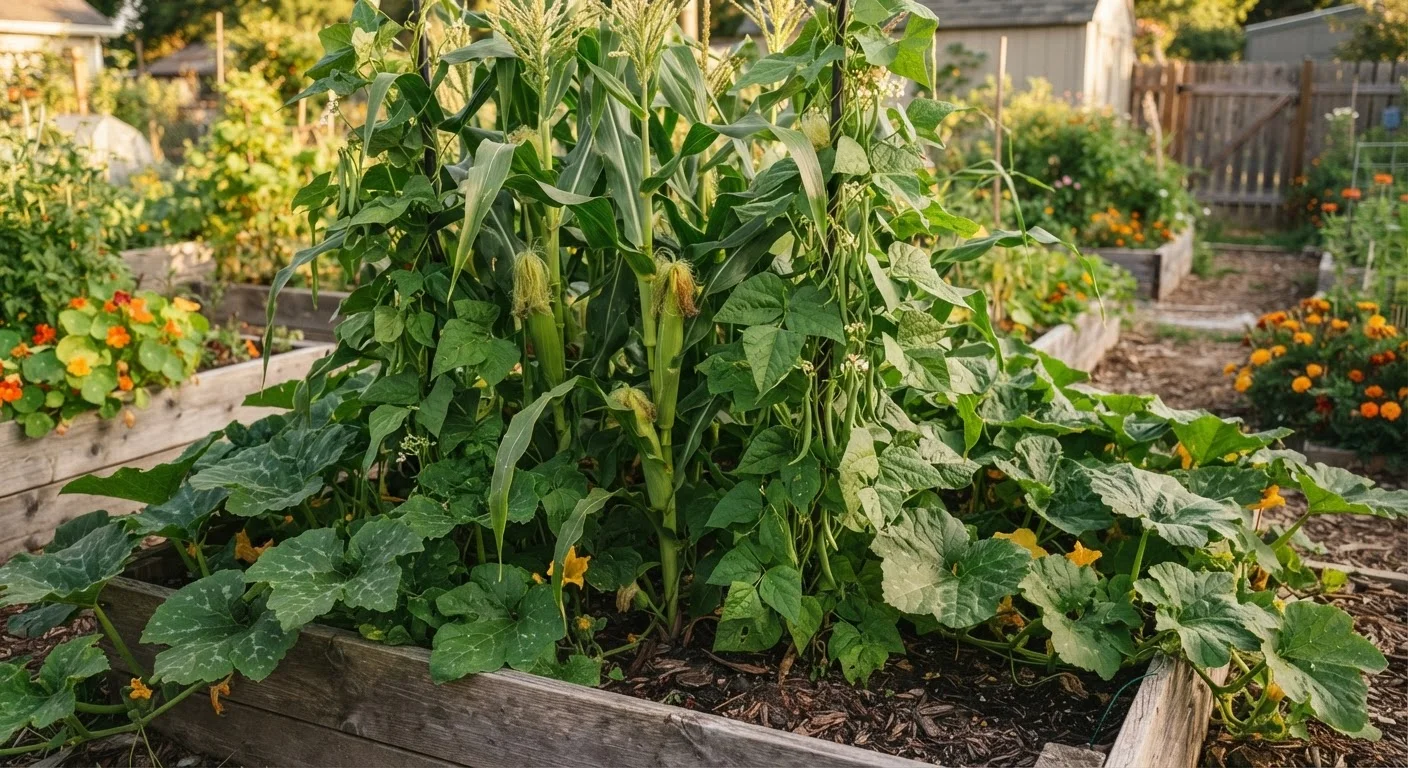
The most famous companion planting system comes from Indigenous agricultural traditions in North America. The Three Sisters — corn, beans, and squash — are planted together to support each other in distinct ways.
- Corn grows tall and provides a natural pole for bean vines to climb.
- Beans (a legume) fix atmospheric nitrogen into the soil, feeding the corn and squash around them.
- Squash spreads wide along the ground, shading the soil to retain moisture and suppress weeds while its prickly leaves deter some animal pests.
This system is so effective that it's been studied by agricultural researchers as a model of sustainable polyculture. If you're mapping out a new garden bed, starting with the Three Sisters gives you a solid, time-tested foundation. For timing your planting correctly, check our seasonal gardening calendar to know when to get each in the ground.
Other Reliable Companion Pairings to Try
Beyond the Three Sisters, many combinations show consistent real-world benefits in home gardens:
16%
Yield increase with polyculture vs. monoculture
A meta-analysis published in the journal Science of the Total Environment found that polyculture systems (growing multiple crops together) can yield roughly 16% more per unit of land than monocultures on average.
~200 lbs
Nitrogen fixed per acre annually by legumes
Nitrogen-fixing legumes such as beans and clover can contribute roughly 100–200 lbs of nitrogen per acre each year, according to Cooperative Extension resources from land-grant universities.
- Tomatoes + Basil
- Basil is widely grown alongside tomatoes. Some gardeners and limited research suggest it may deter aphids and thrips, and it makes good use of the same sunny bed. At minimum, you'll harvest two crops from one space.
- Carrots + Radishes
- Radishes germinate and grow quickly, loosening soil and marking rows while carrots slowly develop underground. Harvest radishes before they compete for space.
- Cabbage + Dill or Nasturtiums
- Nasturtiums act as a trap crop, attracting aphids away from brassicas. Dill draws parasitic wasps that prey on cabbage worms — a natural, chemical-free form of pest control. For more on this approach, see our article on dealing with garden pests without chemical sprays.
- Peppers + Marigolds
- French marigolds are one of the better-studied companion flowers. Their roots release a compound that deters root-knot nematodes, and their scent may confuse some flying pests.
If you're new to growing vegetables, pairing companions with forgiving crops makes the learning curve gentler. Our guide to easy vegetables for first-time growers lists reliable starter crops that pair well with many companions.
Keep a Simple Garden Journal
Note which companion pairings you tried, where they were placed, and how each crop performed. After one or two seasons, you'll have personalized data that's more relevant to your soil and climate than any general guide. Even a small notebook or phone note works well for this.
Pairings to Avoid
Companion planting can backfire if incompatible plants end up side by side. A few combinations to keep separated:
- Fennel and almost everything — Fennel releases compounds that inhibit many vegetables. Grow it in its own pot or a corner well away from food crops.
- Onions and beans — Alliums (onions, garlic, leeks) appear to suppress bean and pea growth when planted close together.
- Brassicas and strawberries — Both are heavy feeders and tend to compete rather than cooperate.
- Corn and tomatoes — Both attract the tomato/corn earworm, so planting them together may concentrate pest pressure rather than spread it.
When planning your layout, space potential incompatibles on opposite ends of the garden and observe how each combination performs in your specific conditions over a season or two. Local soil, microclimate, and pest populations all influence outcomes.
Frequently Asked Questions
There is solid evidence for some pairings, such as legumes fixing nitrogen for neighboring crops, and some research supports pest-repelling effects. However, results vary by garden conditions, climate, and pest pressure. Treat companion planting as a helpful tool rather than a guaranteed solution.
Yes. Compact pairings like basil with tomatoes or carrots with radishes work well in raised beds and larger containers. Just make sure each plant still has enough root space and light. See our guide on <a href="/home/gardening-basics/container-gardening-on-patios-and-balconies">container gardening on patios and balconies</a> for practical space-saving tips.
Fennel is notoriously incompatible with most vegetables, including tomatoes and peppers, and is best grown in isolation. Onions and garlic can stunt bean growth. Brassicas (cabbage, broccoli) and strawberries often compete poorly when planted together.
Most companion vegetables are annuals and are replanted each season anyway. Rotating companion groupings annually also helps with pest control and soil health, so it's a good habit to build into your gardening calendar.
Close enough to interact — typically within 12 to 18 inches — but still respecting each plant's spacing requirements. Overcrowding reduces airflow and can invite disease, so read seed packets for individual spacing needs before planning your layout.
The content on this site is for informational purposes only and is not a substitute for professional advice. Always consult a qualified professional for guidance specific to your situation.