

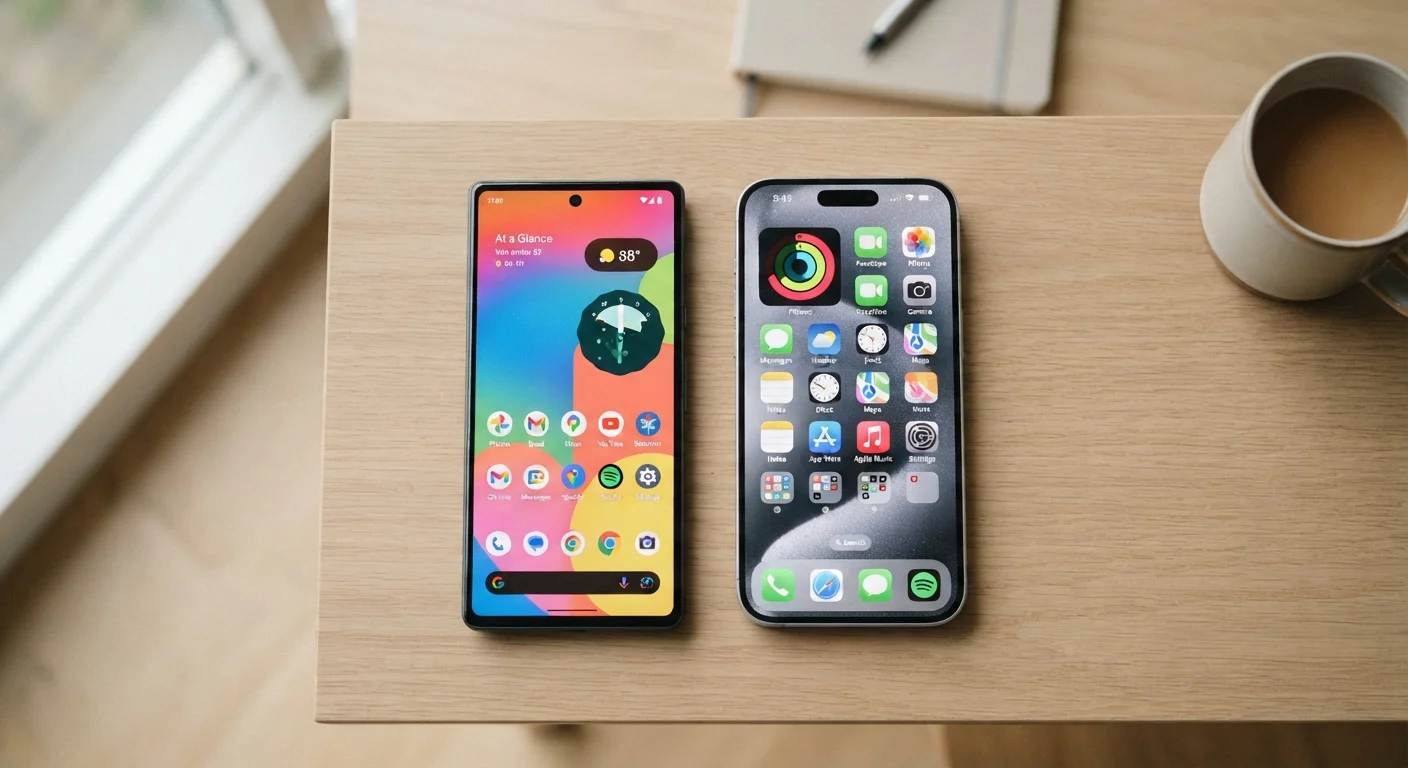
Option A
Android
The flexible, open-ended platform for hands-on users.
Best for: People who want more control over how their phone looks, behaves, and connects with other devices.
Option B
iOS
The streamlined, tightly integrated experience for simplicity seekers.
Best for: People who want a consistent, low-maintenance experience — especially if they already use other Apple products.
What the Operating System Actually Controls
An operating system (OS) is the software layer that runs everything on your phone — from how apps open to how notifications appear to whether you can plug in a USB drive. Android and iOS are the two dominant mobile operating systems in the United States, and the differences between them shape your experience every single day.
If you're new to smartphones or thinking about switching, our guide for first-time owners is a helpful place to start before diving into platform comparisons.
The core distinction: Android is developed by Google and licensed to many device manufacturers, so it runs on a huge range of hardware. iOS is developed by Apple and runs exclusively on iPhones. That single fact explains most of the downstream differences — in pricing, customisation, and update delivery.
| Criterion | Android | iOS |
|---|---|---|
| Hardware variety | Many manufacturers, wide price range | Apple only; fewer models |
| Customisation | High — defaults, layout, file access | Moderate — improving, but structured |
| Software update delivery | Varies by manufacturer and carrier | Simultaneous for all supported devices |
| Typical OS support lifespan | 2–4 years (varies by device) | 5–6 years for most models |
| Ecosystem integration | Strong with Google services | Strong with Apple devices and services |
| App availability | Broad; occasional late arrivals | Broad; occasional early exclusives |
| File system access | Direct access supported | Limited; managed through apps |
Customisation vs. Consistency
Android gives you meaningful control over how your phone behaves. You can set a third-party app as your default browser or maps app, rearrange your home screen with widgets anywhere you like, and — on many devices — access files directly as you would on a computer. If you enjoy tinkering, Android rewards that instinct.
iOS trades that flexibility for predictability. The home screen follows a fixed grid; most default apps are Apple's own, though this has loosened somewhat in recent years. In exchange, the experience is highly consistent — what works on one iPhone tends to work identically on another, and the interface rarely surprises you.
Neither approach is objectively better. What matters is whether you find deep menus energising or exhausting. It's worth separating this question from common assumptions — our piece on smartphone myths addresses a few misconceptions about what customisation actually changes under the hood.
~55%
US smartphone market share held by iOS
According to Statcounter data, iOS holds a majority share in the United States, while Android leads globally.
5–6 years
Typical iOS major update support window
Apple has historically provided major OS updates to iPhones for five to six years after release, a benchmark some Android manufacturers are now working toward.
3.5M+
Apps available across both major app stores
Both the Google Play Store and Apple App Store each carry millions of apps, making platform-exclusive gaps relatively rare for everyday users.
Updates, Privacy, and App Access
iOS updates roll out simultaneously to all supported iPhones on the same day. Android updates depend on your device's manufacturer and carrier, so two Android phones bought the same week may run different software versions months later. Apple generally supports iPhones with major OS updates for five to six years; Android support timelines range widely, typically landing between two and four years for most devices, though some manufacturers now extend this.
Both platforms have made significant privacy investments in recent years — giving users tools to limit app tracking and review permissions. Understanding what you're granting when an app asks for access to your microphone or location is important on either platform. Our explainer on app permissions covers what each request actually means.
On apps: both stores carry the vast majority of popular apps. Occasional exceptions exist — some apps launch on one platform first, or offer features only on one OS — but for everyday use, the app gap is minimal.
Switching Platforms: What You May Lose
Moving from Android to iOS — or vice versa — is straightforward for contacts, photos, and basic data. However, some things don't transfer cleanly: iMessage history, Google Play purchases, and certain app data may not carry over. If you've spent years in one ecosystem, it's worth auditing what you'd need to migrate before committing to a switch.
Which One Actually Fits Your Life?
The most practical question isn't which OS is superior — it's which one fits the devices and services you already use. If your household runs on Google services (Gmail, Google Drive, Google Photos), Android typically integrates these more smoothly. If you use a MacBook, iPad, or Apple Watch, iOS connects to those devices with less friction.
Storage and performance trade-offs are also worth understanding before deciding. Our overview of smartphone storage explains what RAM and internal storage mean in plain terms — useful when comparing specs across both platforms.
Finally, think about how much of your life runs through your phone. If you're considering using it as a near-primary device, the real trade-offs of doing everything on a smartphone are worth reading before committing to either platform.
The content on this site is for informational purposes only and is not a substitute for professional advice. Always consult a qualified professional for guidance specific to your situation.