

Start here
What Tire Pressure Actually Means
Understand the stakes
The Real Consequences of Wrong Pressure
Get the number right
How to Find the Right PSI for Your Vehicle
Take action
How to Check and Adjust Tire Pressure
Stay ahead of changes
Temperature and Seasonal Pressure Changes
What Tire Pressure Actually Means
Tire pressure is simply the amount of air inside your tire, measured in PSI (pounds per square inch). Air is what actually supports the weight of your car - the rubber and steel structure of the tire are just the container. When that air is at the right level, the tire maintains the correct shape, distributes your vehicle's weight evenly, and grips the road the way it was designed to.
PSI
Pounds per square inch - the unit used to measure how much air is inside a tire. Most passenger car tires are recommended at 30-35 PSI.
Valve stem
The small rubber or metal tube sticking out of your wheel where you add or release air. It has a cap and a tiny pin inside that controls airflow.
Cold tire pressure
Tire pressure measured before the tire has been driven on (or after sitting for several hours). This is the accurate baseline used by manufacturers for their recommendations.
Rolling resistance
The force a tire has to overcome to keep rolling forward. An under-inflated tire has more rolling resistance, which means your engine uses more fuel to maintain speed.
Tire sidewall
The side surface of the tire, between the tread and the wheel. It often shows the maximum pressure limit - which is not the same as your vehicle's recommended pressure.
Too little air and the tire flattens slightly, stressing the sidewalls and creating excess heat. Too much and the tire becomes rigid, reducing the contact patch between rubber and road. Either way, performance and safety suffer - often without any obvious warning signs until real damage is done.
The Real Consequences of Wrong Pressure
Most drivers assume that if a tire looks inflated, it's fine. That's a misleading rule of thumb. A tire can be 10 PSI below its target and still look full to the naked eye. Here's what's actually happening when pressure is off:
- Under-inflation: The tire's edges bear more load than the center, causing faster outer-edge wear. Rolling resistance increases, so your engine burns more fuel. Heat builds up inside the tire - and heat is the primary cause of tire failure. You may also notice the car feels sluggish or pulls to one side.
- Over-inflation: The center of the tread takes on too much of the load, wearing prematurely. Ride quality gets harsh, and the tire is more vulnerable to road hazards like potholes. Braking distances can also increase because less rubber is in contact with the pavement.
For a deeper look at what happens when a small air loss goes ignored, see our article on why slow tire leaks are riskier than they seem. Wet roads amplify all of these handling issues - driving in rain already reduces grip even on properly inflated tires.
Don't Rely on Visual Inspection Alone
A tire can look fully inflated while sitting 8-10 PSI below its recommended pressure. At that level, handling and braking are already compromised. The only reliable way to know your tire pressure is to measure it with a gauge - looking at the tire tells you very little.
How to Find the Right PSI for Your Vehicle
The correct tire pressure for your car is not the number printed on the tire sidewall. That figure is the tire's maximum rated pressure - it's a limit, not a target. Your vehicle's recommended PSI is set by the manufacturer based on the car's weight, suspension design, and intended use.
Where to find it:
- Driver's door jamb sticker: This is the most reliable source. Open the driver's door and look along the door frame or the door itself for a small sticker. It lists the recommended PSI for front and rear tires (they sometimes differ).
- Owner's manual: The tire pressure section covers your specific vehicle and may include notes on load conditions or spare tire pressure.
Front and rear pressures sometimes differ by a few PSI, so check both. If your vehicle has a full-size spare you rely on, check its pressure too.
Set a Monthly Reminder
Tire pressure is easy to overlook because it changes gradually. Setting a recurring monthly phone reminder - or tying the check to something routine like paying a bill - keeps it from slipping through the cracks. It takes about two minutes per vehicle and pays for itself in fuel savings and tire longevity.
How to Check and Adjust Tire Pressure
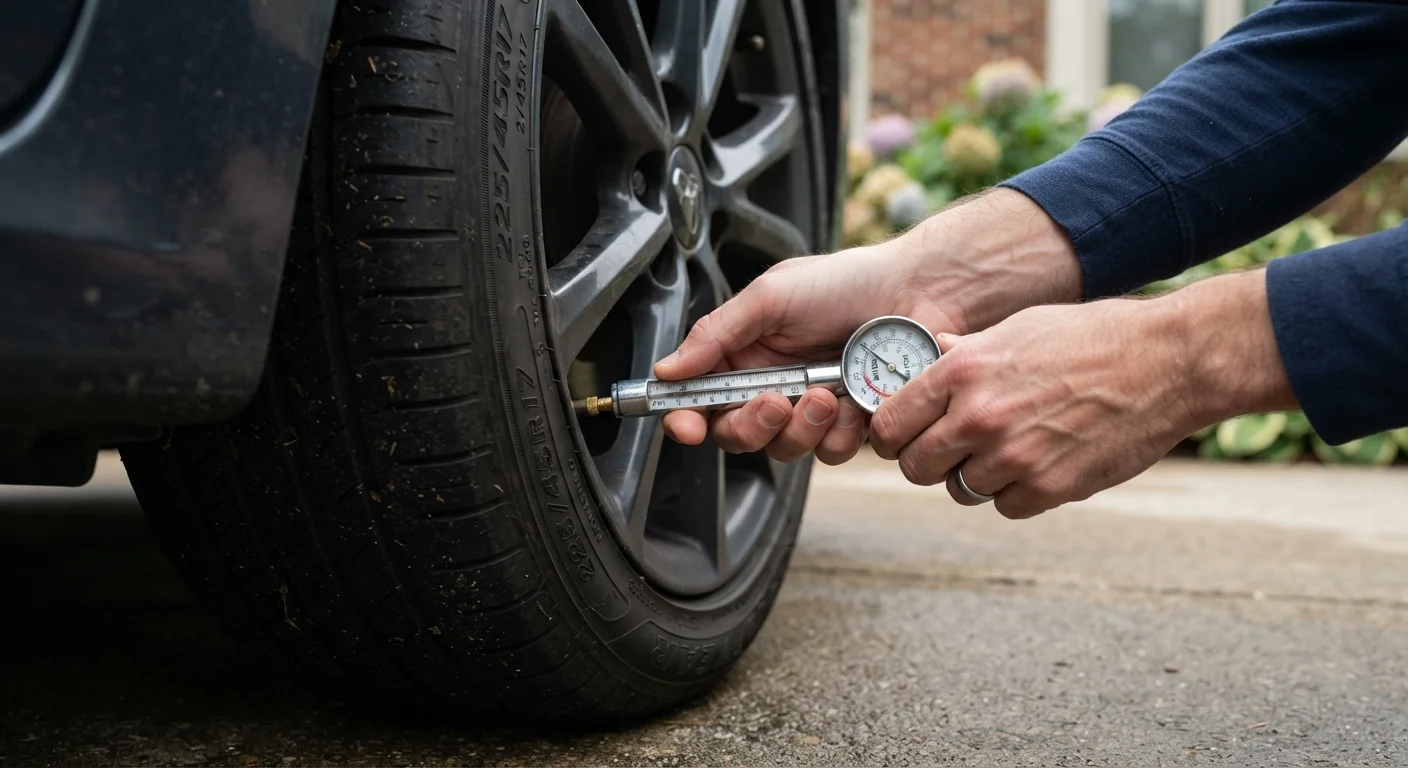
You'll need a tire pressure gauge - a basic dial or digital model from an auto parts store works well. Avoid relying solely on gas station gauges, which can drift out of accuracy with heavy use.
Check pressure when the tires are cold. Driving heats the air inside your tires and raises the reading by several PSI. For an accurate baseline, check before you've driven more than a mile or two, or after the car has sat for at least three hours.
Steps:
- Remove the valve cap from the tire stem (the small rubber or metal nub on the wheel).
- Press the gauge firmly and squarely onto the valve stem. You may hear a brief hiss - that's normal.
- Read the pressure and compare it to your door sticker's recommendation.
- If it's low, add air in short bursts using a pump, rechecking frequently. If it's high, press the small pin inside the valve stem to release air gradually.
- Replace the valve cap when done.
This task fits naturally into a broader maintenance routine. Our practical car maintenance overview covers where tire checks fit alongside other regular inspections like fluid level checks.
Temperature and Seasonal Pressure Changes
Air expands when it warms and contracts when it cools. As a general rule, tires gain or lose roughly 1 PSI for every 10°F change in ambient temperature. That means a tire at the correct pressure on a 70°F fall day could be 4-5 PSI low by a cold January morning - without any leak at all.
This makes seasonal pressure checks especially important. After the first sustained cold snap of the year, check all four tires before your next longer drive. The same logic applies in summer: if you inflated your tires on a cold morning and the afternoon gets hot, pressure will rise. This is rarely a problem if you started at the recommended PSI rather than near the maximum, but it's worth knowing.
For a full seasonal vehicle checklist that includes tire care alongside battery, fluids, and other cold- or heat-sensitive components, see our guide to seasonal car care for summer and winter. And if you're tracking where tire maintenance fits into the broader cost of owning a vehicle, our article on the real cost of car ownership puts routine upkeep in financial context.
Frequently Asked Questions
A monthly check is a reasonable minimum for most drivers. You should also check before any long road trip and whenever outside temperatures shift significantly. It takes about two minutes and can prevent bigger problems down the road.
Look for a sticker on the inside edge of the driver's door or in your owner's manual - not the number printed on the tire sidewall. That sidewall number is the tire's maximum rated pressure, not the target for your specific vehicle.
Yes, gas station air pumps work fine. Bring your own gauge, though, since station gauges can be inaccurate from heavy use. Add air in short bursts and check frequently to avoid over-inflating.
It's not ideal. Even tires that are 5-8 PSI low can increase stopping distance, reduce fuel economy, and cause uneven tread wear. A slow leak that goes unchecked can become a blowout risk over time.
Yes. The U.S. Department of Energy has noted that under-inflated tires increase rolling resistance, which means your engine works harder. Keeping tires properly inflated is one of the simplest ways to avoid wasting fuel.
The number on the sidewall (often 44-51 PSI) is the maximum pressure the tire can safely hold, not a target. Your vehicle's recommended PSI - typically 30-35 for passenger cars - is on the door jamb sticker or in the owner's manual.
The content on this site is for informational purposes only and is not a substitute for professional advice. Always consult a qualified professional for guidance specific to your situation.