

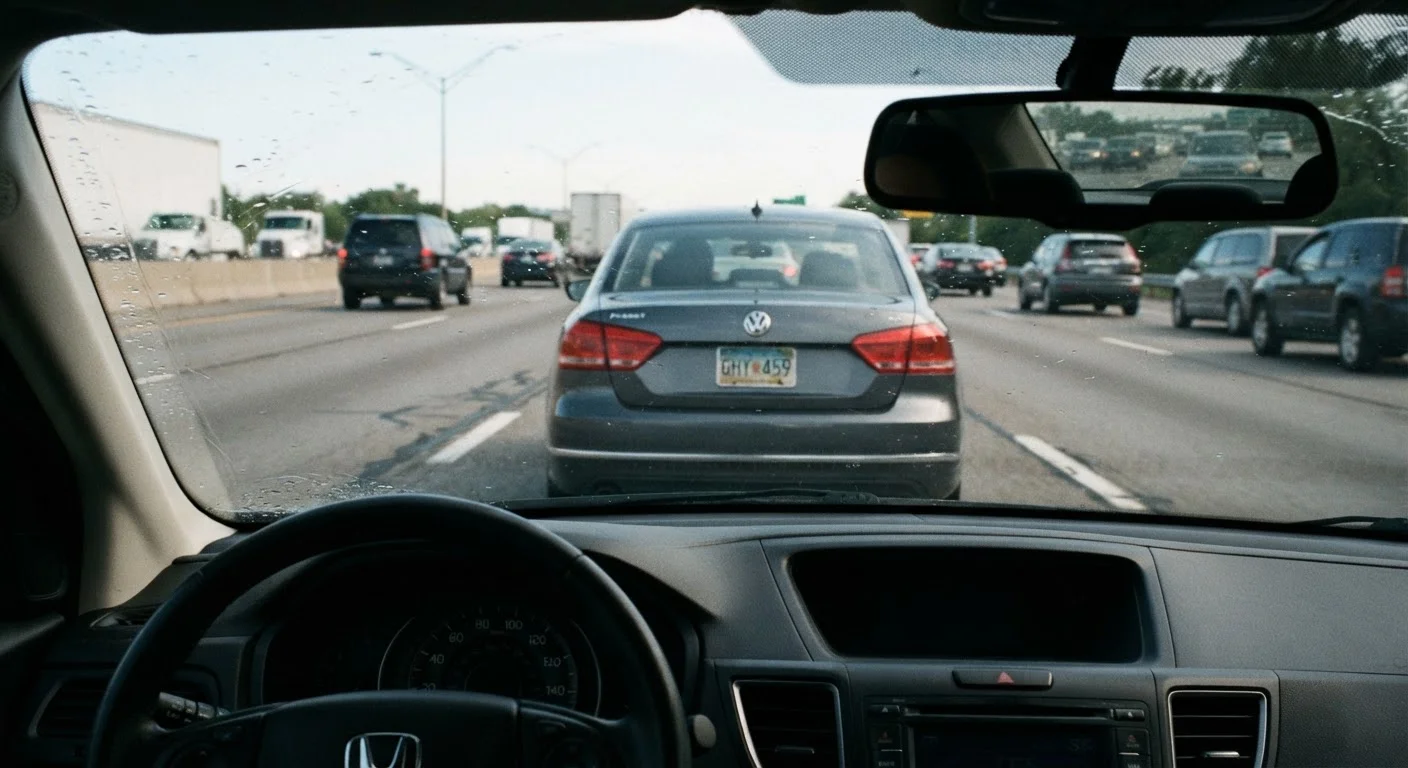
Why Following Distance Matters More Than Drivers Think
Most drivers have heard they should keep a safe following distance, but fewer understand exactly why — or how bad they are at judging it. Tailgating feels low-stakes when traffic is moving smoothly. The danger only becomes obvious when something goes wrong, and by then it's too late.
When a vehicle in front of you brakes hard, you face two consecutive delays before your car actually slows down: your personal reaction time (typically 1.5 seconds or more) and your vehicle's braking time. At 60 mph, you're covering about 88 feet every second. That means before your foot even depresses the brake pedal, you've already traveled over 130 feet. Add braking distance on top of that, and you need substantially more room than most drivers allow.
Rear-end collisions are among the most frequently reported crash types on American roads. According to the National Highway Traffic Safety Administration (NHTSA), they account for roughly 29% of all serious injury crashes. Tailgating is consistently cited as a primary contributing factor.
~29%
Share of serious injury crashes that are rear-end collisions
According to NHTSA crash data, rear-end collisions consistently account for roughly 29% of serious injury crashes on U.S. roads.
130+ ft
Distance traveled at 60 mph before braking starts
At 60 mph, a driver with an average 1.5-second reaction time covers more than 130 feet before the brake pedal is even depressed.
3 sec
Minimum recommended following distance in ideal conditions
Most U.S. driver safety programs and state DMV guidance recommend a 3-second following distance as the baseline for dry, clear conditions.
Common Myths About Safe Following Distance — Corrected
A lot of what drivers believe about tailgating simply isn't accurate. These misconceptions lead to habits that feel safe but dramatically raise crash risk.
Myth
If I'm paying attention, I can stop in time even if I'm close behind another car.
Fact
Attention doesn't compress physics. Reaction time plus braking distance requires far more space than most drivers maintain.
Even an alert driver takes roughly 1.5 seconds to perceive a hazard and begin braking. At 65 mph, that's about 143 feet of travel before braking starts. Your vehicle then needs additional distance to stop — often another 200+ feet on dry pavement. Tailgating leaves no margin for this two-step process.
Myth
The 2-second rule is plenty of following distance at highway speeds.
Fact
Most driving safety authorities recommend at least 3 seconds under ideal conditions, with more needed in adverse weather or at higher speeds.
The 2-second rule originated as a rough guideline for lower-speed city driving. On the highway, where speeds and stopping distances are greater, 3 seconds is the widely recommended baseline. The Federal Motor Carrier Safety Administration recommends even longer gaps for commercial truck drivers. Conditions — wet roads, heavy loads, worn tires — can push the needed distance well beyond 3 seconds.
Myth
Following closely actually makes traffic flow better because it keeps gaps small.
Fact
Close following destabilizes traffic flow and is a documented cause of highway "phantom jams" — slowdowns with no visible cause.
Traffic engineers describe a phenomenon where one driver's small brake tap triggers a chain reaction of harder braking behind them, eventually causing a full stop far back in traffic. Larger following distances actually smooth out these ripple effects. Studies in traffic flow dynamics consistently show that moderate gaps improve overall throughput on congested highways.
Myth
Tailgating is only dangerous at high speeds — at 30 mph it's basically harmless.
Fact
Rear-end crashes at city speeds cause thousands of injuries annually. Even low-speed impacts can cause whiplash and serious injury.
Whiplash — a soft-tissue neck injury — is one of the most common outcomes of rear-end collisions and can occur at impacts as low as 5–10 mph. At 30 mph, a driver following 1 second behind has less than 45 feet to react and stop, which is not achievable for most people and most vehicles. Urban rear-end crashes are extremely common precisely because drivers drop their guard at lower speeds.
Myth
Modern cars with automatic emergency braking (AEB) make tailgating much safer.
Fact
AEB systems reduce crash severity but are not designed to compensate for inadequate following distance.
Automatic emergency braking is a genuine safety advance, but manufacturers and safety researchers are consistent: it's a last-resort assist, not a substitute for proper spacing. AEB systems have detection limits, can be affected by weather and road conditions, and may not activate in time at very short following distances. Relying on AEB as a reason to follow closely is a misunderstanding of what the technology is built to do.
When You Need Even More Space
The 3-second rule is a starting point for ideal conditions — dry pavement, good visibility, a well-maintained vehicle. Real-world driving rarely checks all those boxes at once.
Rain is one of the biggest multipliers of stopping distance. Wet pavement reduces tire grip significantly, meaning your car takes longer to stop even with modern anti-lock brakes. Our guide on wet-road driving risks explains how hydroplaning and reduced visibility compound the danger. In rain, increase your following distance to at least 5–6 seconds.
Ice and snow can increase stopping distances by 10 times compared to dry pavement. Nighttime driving adds another layer of complexity — your headlights illuminate only so far ahead, shrinking the window in which you can detect a hazard. The habits that reduce risk on dark roads apply directly here: slowing down and increasing your gap are two of the most effective adjustments you can make.
Large trucks and vehicles towing trailers also need extra consideration. Their stopping distances are significantly longer than a passenger car's, so if you're following one closely, you're in the blind spot and you have almost no time to react if they brake hard.
Double Your Distance in Poor Conditions
Rain, fog, ice, and nighttime driving all extend stopping distances substantially. If conditions are anything less than dry and clear, treat 3 seconds as an absolute minimum and aim for 5–6 seconds or more. This is especially important on unfamiliar roads or in construction zones where unexpected hazards can appear with little warning.
Construction zones deserve special attention too. Lane widths shrink, workers are present, and traffic patterns shift without much warning. Work zone rules and risks are worth reviewing if you frequently drive through highway construction areas.
The Legal and Behavioral Side of Tailgating
Tailgating isn't just dangerous — it's illegal in every U.S. state. Most states define it under statutes requiring drivers to maintain a "reasonable and prudent" following distance. What counts as reasonable is judged by conditions, not a fixed number. That means even if you're following at 2 seconds on a clear day, a court could still find you at fault if conditions warranted more space.
Tailgating also frequently overlaps with aggressive driving, which carries its own legal consequences in many jurisdictions. If you find yourself frustrated with slow traffic and riding bumpers as a result, that pattern is worth examining — it's discussed further in our breakdown of aggressive driving versus road rage.
The most practical mindset shift: think of your following distance as the buffer that protects you, not as a courtesy to the driver ahead. Other vehicles will sometimes cut into that space — that's a cue to ease back and rebuild it, not a reason to abandon it.
Tailgating Is a Legal Offense Everywhere in the U.S.
Every state has a law requiring drivers to maintain a safe following distance. Being rear-ended doesn't automatically mean the driver behind you is at fault — but if you were tailgating, you are almost certainly liable. Beyond fines, a rear-end collision caused by following too closely can result in license points, increased insurance costs, and civil liability for injuries.
The content on this site is for informational purposes only and is not a substitute for professional advice. Always consult a qualified professional for guidance specific to your situation.