

Why the Great Lakes Region Deserves a Serious Look
Most travelers picture the Great Lakes as a backdrop — massive, blue, impressive from a distance — but not necessarily a destination. That's a missed opportunity. The Great Lakes states (Minnesota, Wisconsin, Michigan, Illinois, Indiana, Ohio, Pennsylvania, and New York) collectively form one of the most geographically and culturally varied regions in the country.
The lakes themselves hold roughly 21% of the world's surface fresh water, but what surrounds them is the real story: ancient sand dunes, peninsulas draped in fruit orchards, dense national forests, revitalized industrial cities, and island communities that feel worlds away from the mainland. Whether you're after outdoor adventure, culinary exploration, or quiet lakeside solitude, there's a version of this region that fits.
Compared to mountain or coastal escapes, the Great Lakes offer something harder to categorize — and harder to forget.
21%
Share of world's surface fresh water
The Great Lakes collectively hold approximately 21% of the world's surface fresh water, according to the U.S. Environmental Protection Agency.
8
US states bordering the Great Lakes
Eight states — Minnesota, Wisconsin, Michigan, Illinois, Indiana, Ohio, Pennsylvania, and New York — share Great Lakes shoreline.
3,200+
Miles of US Great Lakes shoreline
The US side alone accounts for over 3,200 miles of Great Lakes shoreline, offering enormous variety in landscape and access points.
Dunes, Bluffs, and Natural Landscapes
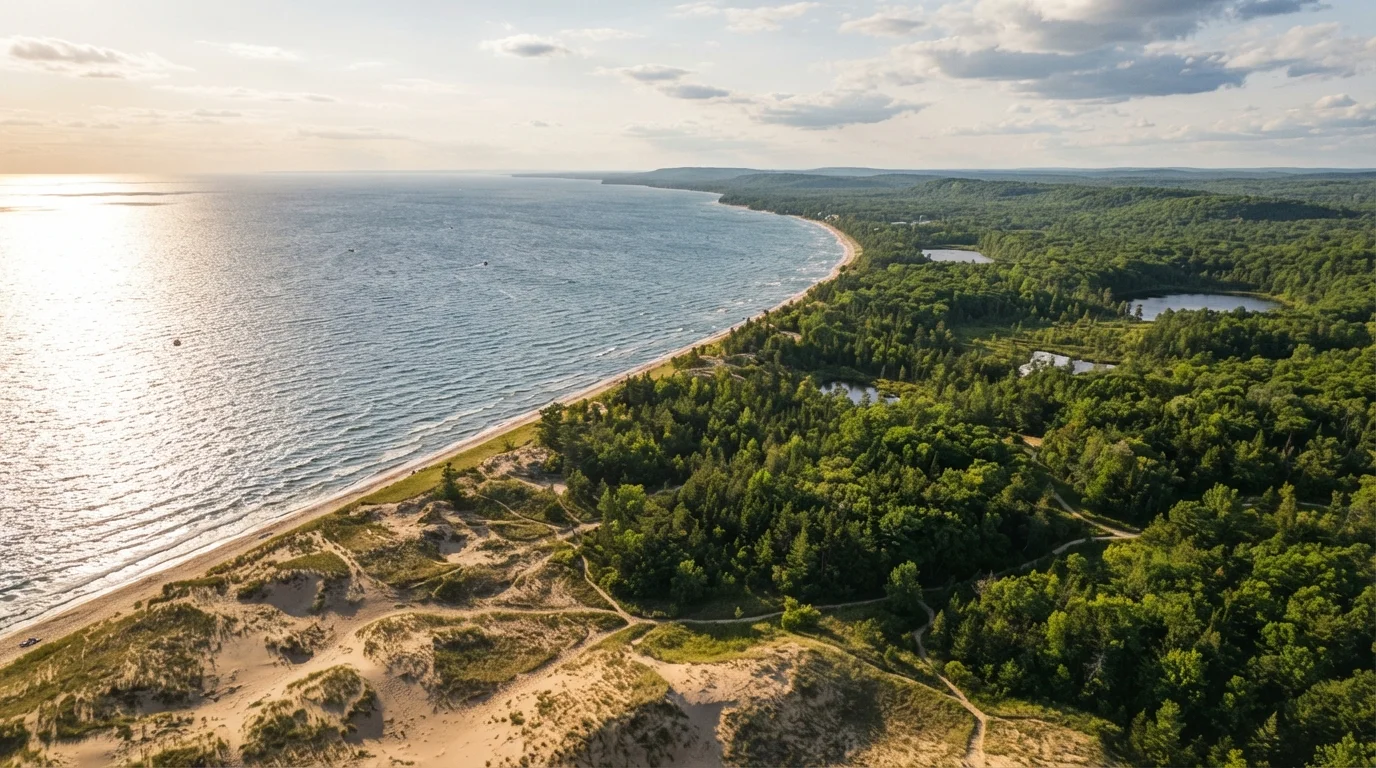
Sleeping Bear Dunes National Lakeshore in northwestern Michigan is one of the most visually striking landscapes in the entire country. The dunes rise up to 450 feet above Lake Michigan, and climbing them rewards hikers with panoramic views that feel almost oceanic. The National Park Service manages the site, making it an accessible and well-supported destination for families and solo travelers alike.
Indiana Dunes National Park — the country's most recently designated national park at time of its elevation — packs remarkable biodiversity into a relatively compact footprint along the southern shore of Lake Michigan. Birders, wildflower enthusiasts, and geology fans all find something here that surprises them.
For those who like their scenery with fewer crowds, the Pictured Rocks National Lakeshore along Michigan's Upper Peninsula offers multicolored sandstone cliffs, sea caves, and waterfalls that rival any coastline in the lower 48. Different national park regions have their own character, but the Great Lakes parks hold their own in drama and scale.
Visit Pictured Rocks by Kayak if Conditions Allow
Seeing Pictured Rocks from the water gives you an entirely different perspective than the hiking trails alone. Guided kayak tours operate out of Munising, Michigan during summer months and are run by outfitters familiar with the lake's variable conditions. Always check weather forecasts and guide credentials before booking — Lake Superior can turn quickly.
Historic Cities With Real Character
The urban anchors of the Great Lakes are often overlooked in favor of Chicago, but several mid-sized cities offer rich, walkable experiences without the big-city price tag or crowds. Milwaukee's historic Third Ward neighborhood blends warehouse architecture with independent restaurants and galleries. Cleveland's West Side Market has been a community institution since 1912 and remains one of the best food markets in the Midwest. Duluth, Minnesota, perched on a steep hillside above Lake Superior, feels like a port city transplanted from the Pacific Northwest — all shipping heritage, craft breweries, and stunning water views.
Detroit's resurgence is well documented, but worth experiencing firsthand: the city's Eastern Market district, world-class art museum (the DIA), and Midtown walkability have made it one of the more compelling urban turnarounds in recent American history.
If you enjoy exploring cities that don't appear on most travelers' shortlists, our coverage of under-the-radar US cities highlights some excellent Great Lakes-adjacent picks.
When visiting Great Lakes cities, prioritize neighborhoods over downtown cores — the most authentic food, music, and local character tends to cluster in districts a few blocks off the main tourist strip.
Cities like Milwaukee, Cleveland, and Detroit have seen significant neighborhood-level investment, and their most interesting culinary and cultural scenes are often in areas that don't show up prominently on standard travel itineraries.
Book ferry reservations for Mackinac Island and the Apostle Islands well in advance for summer weekends — these routes fill up faster than most visitors expect.
Island ferry services in the Great Lakes region operate on limited schedules with finite vehicle and passenger capacity, particularly during peak summer months.
Island Communities and Off-the-Beaten-Path Getaways
Mackinac Island, Michigan, bans motor vehicles entirely — transportation runs on foot, bicycle, and horse-drawn carriage. The island sits in the strait between Lakes Huron and Michigan and is accessible by ferry from Mackinaw City or St. Ignace. Its Victorian architecture, fudge shops, and forested interior trails create a throwback atmosphere that families reliably love.
Madeline Island in Wisconsin's Apostle Islands cluster offers a quieter, more rugged alternative. The Apostle Islands National Lakeshore encompasses 21 islands with sea caves, historic lighthouses, and exceptional kayaking. Getting there requires a ferry from Bayfield, a small town worth a full day on its own.
These destinations differ meaningfully from more logistically complex island travel — for perspective on what truly remote island travel demands, see our look at Alaska and Hawaii travel logistics.
Ferry and Access Schedules Change Seasonally
Ferry services to Mackinac Island, Madeline Island, and the Apostle Islands operate on seasonal schedules that can shift with weather and demand. Always verify current operating hours and advance reservation requirements directly with ferry operators before planning your itinerary around island visits. Road and trail conditions in the Upper Peninsula can also vary significantly by season.
Forests, Trails, and Outdoor Adventure
The Upper Peninsula of Michigan and northern Wisconsin contain some of the most intact temperate forest in the eastern United States. The Ottawa National Forest and Hiawatha National Forest together offer hundreds of miles of hiking and mountain biking trails, along with fishing lakes and river paddling that draw serious outdoor enthusiasts year after year.
Fall color in this region is genuinely spectacular — the combination of maple, birch, and aspen creates brilliant displays typically peaking from mid-September through mid-October, depending on latitude. The Keweenaw Peninsula, the northernmost tip of Michigan's Upper Peninsula, is considered one of the most dramatic fall foliage drives in the Midwest.
For practical trip-planning tips that apply to any outdoor adventure in the region — from packing for variable weather to navigating ferry schedules — it's worth doing some research before you head north, particularly if you're traveling outside summer.
Weather Variability Is Real Up North
The Upper Peninsula and northern Wisconsin can experience frost as early as September and as late as May. Even in summer, temperatures along Lake Superior can be significantly cooler than inland areas — packing layers is strongly advised regardless of season. This is general regional guidance; always check current forecasts from NOAA or your preferred weather service before departing.
Planning Your Great Lakes Trip
The region's main advantage for American travelers is accessibility: most of it is drivable from Chicago, Detroit, Columbus, or Minneapolis without requiring a flight. That makes it ideal for road-trip itineraries where you move between small towns and state parks at your own pace.
Shoulder seasons — particularly late May through mid-June, and September into early October — tend to offer reduced crowds at popular natural sites while still delivering good weather. Summers are warm but can be humid; winters in the Upper Peninsula are serious and snowy, which attracts a different type of traveler entirely (snowshoers, skiers, and ice cave enthusiasts).
Accommodations range from lakeside state park campgrounds to boutique hotels in renovated downtown buildings. Budgets can be stretched considerably by camping in state parks, where sites are often well-maintained and scenery rivaling any private resort.
National Park Service — Great Lakes Parks
The NPS maintains detailed visitor guides for Sleeping Bear Dunes, Indiana Dunes, Pictured Rocks, and Apostle Islands — including trail maps, ferry info, and seasonal advisories.
Great Lakes Information Network (GLIN)
A multi-agency resource covering environmental conditions, water levels, and regional geography useful for travelers planning water-adjacent activities.
State Park Campground Reservation Systems
Each Great Lakes state operates its own reservation portal for state park campsites. Booking several weeks ahead is advisable for summer weekends at popular lakeside parks.
The content on this site is for informational purposes only and is not a substitute for professional advice. Always consult a qualified professional for guidance specific to your situation.